ARCHIVES
of
COLUMNISTS
Listed alphabetically








ARCHIVES
of
FEATURES
Listed alphabetically























COMPLETED
SERIES



|
|

|
 With the Protestant Revolution threatening to eliminate Rome, God rose up a humble priest to lead a Company to proselytize the true Faith. Guided by Saint Ignatius' Spiritual Exercises the Jesuits would grow into a formidable force in converting countless souls, while over the last century caving to the heretics. Sadly, the holy man of Loyola would not recognize the Society of Jesus today.
  Today is the Double Feast of Saint Ignatius Loyola, the chief architect of the Society of Jesus which he co-founded in order to stabilize the Church in the aftermath of the Protestant Revolution of the sixteenth century. Realizing in the face of opposition he must marshal forces to defend the Holy Father against all attacks and thus Ignatius and his companions, by means of the Spiritual Exercises endeavored to raise the clergy to a higher realization of their own dignity and mission. Their zeal for the Liturgy led them to restore the churches to their former cleanliness, dignity, and magnificence. Drawn by these exterior attractions, the faithful were the more easily induced to frequent the Sacraments and the Offices of the Church. From the very beginning they undertook works of education and missionary labors that would earmark the intelligence of the Order that would go through plenty of battles of its own following Ignatius' death with the Order's banishment and then reinstitution to the practical total sellout today in embracing, yea, promoting the very heresies so warned against. For more, see Saint Ignatius Loyola
 A Pair of Persians paved the way for Providence, through the persecution of uncompromising souls, to provide proof of Christ's divinity and nourish the seeds of Christianity by the blood of the martyrs including the saints we honor today.
  In today's Feria proper there is a commemoration of the holy martyrs Saints Abdon and Sennen. They were Persians who, coming to Rome in the Third Century, courageously confessed the faith of Christ and were put to death during the terrible persecution of Decius in 250. The emperor Decius was a bitter enemy of Christians and was furious that Abdon and Sennen had given due honor to St. Polychrome, a bishop, by burying him with the proper ritual. Decius tried to coerce them to renounce their faith. When they steadfastly refused, the evil emperor had them thrown to the lions. But, through the hand of God, the ferocious beasts became tame and reclined harmlessly next to the saints. Furious at this miraculous event, Decius dispatched gladiators to finish the dastardly deed which Heaven then allowed for witnesses had been moved and converted. Besides, Abdon and Sennen welcomed dying for our Lord to prove He is the Resurrection and the Life and that only through submission to the will of God could man hope to acquire eternal salvation. For more, see Saints Abdon and Sennen
The ways by which God leads men's souls are very varied; one way may be more perfect than another, but each soul must sanctify itself in its own fashion. For St. Martha it was through an active ministry of waiting on others.  Today is the feast of Saint Martha, who was the active host compared to her sister Mary's contemplative manner. Grace does not do violence to nature, but perfects it; thus, although St. John tells us that Jesus loved Martha, Mary, and Lazarus, each of the sisters always retains her own individual character in the Gospel narrative. Mary feels more deeply, and, therefore, though she is habitually more recollected, yet she is also a woman of an eager and pleasing disposition, more courageous in her actions. The virtues of Martha, the elder sister of Lazarus, on the other hand, are more commonplace and less exceptional. She is a good housekeeper, diligent, affectionate, and forbearing in undertaking the additional labor which Mary's different nature puts upon her. In discharging her daily duties she looks at life chiefly from the practical side. The Savior loves her much, because, though Mary is eager to receive spiritual food from him, Martha, on the contrary, shows a mother's tender care both for Him and for His disciples, who were always received as members of the family in her home at Bethany. Some time after the Ascension, Martha accompanied Mary Magdalen and Lazarus to Gaul (France). There's also a commemoration of Saint Felix II and companion martyrs. For more, see Saint Martha

 Taking quotes out of context is a favorite tactic of those who master in misdirection and misrepresent themselves to others as to their knowledge of theology and Catholic doctrine. If it's a case of "invincible ignorance" than they're dumber than we've given them credit for. Of course, considering the plethora of doctrinal documentation available, we know such is impossible today. Therefore, it has to be deliberate deception for they do know better and that makes it all the more tragic for theirs and their followers' salvation.
 Griff Ruby continues his comprehensive series "The Art of Scholastic Dishonesty" with his fifth installment that is most necessary for Catholics to understand one's responsibility to educate, inform and rebuke as St. Paul entreats in 2 Timothy 4: 2-5 and to be faithful to the Word and what holy Mother Church teaches and to be on guard for what the Apostle warns in Galatians 1: 8-11. The tomes of quotes by Peter Dimond in his supposedly "air-tight" arguments in his Treatise The erosion of truth from the tomes of quotes by Peter Dimond in his weighty wordage (as in poundage, not clarity and truth) leads one to assume the agenda Dimond and Feeneyites are trying to ramrod down people's throats could be correct
  except for one very important canard that Griff exposes: that those being quoted, for the most part, never had the same intention Dimond's using is his miasma of misdirection. But, as Griff points out, Dimond's rationale whenever his "smoking gun" backfires is to blame God! Griff provides the empty casing shells left by the Treatise to prove not only how far off target the Feeneyites are, but that Dimond's been shooting blanks. Griff provides the proof in Part Five What About the What-Abouts? except for one very important canard that Griff exposes: that those being quoted, for the most part, never had the same intention Dimond's using is his miasma of misdirection. But, as Griff points out, Dimond's rationale whenever his "smoking gun" backfires is to blame God! Griff provides the empty casing shells left by the Treatise to prove not only how far off target the Feeneyites are, but that Dimond's been shooting blanks. Griff provides the proof in Part Five What About the What-Abouts?
Compassionate for the temporal and spiritual welfare of God's children, St. Pantaleon was promised that Christ would always be with him. Indeed He was for He appeared to St. Pantaleon during his tortures and foiled the saint's persecutors numerous times, to give the holy physician time to forgive and convert those who sought to punish him.  There is a commemoration at Sunday Low Masses for the holy martyr Saint Pantaleon. It is most appropriate this year that his feast falls on the Eleventh Sunday after Pentecost when the gospel treats of Christ healing a man deaf and dumb. Pantaleon was a Venetian physician of Nicomedia who sacrificed riches and power because of his love for Jesus. Pantaleon's name in the Greek can be translated to "many shall obtain mercy". It was through the saints compassion that many were moved to conversion including his persecutors. Because he himself was converted by the priest Hermalaus, it was given him by Christ with the promise that Jesus would be with him at all times including during his martyrdom when our Lord appeared to him in the body of Hermalaus as St. Pantaleon was tortured on the rack and burned with flaming torches, then thrown into the sea and numerous other tortures that were miraculously prevented until Pantaleon fully accepted martyrdom by decapitation. He is the principal patron (along with St. Luke and Sts. Cosmas and Damian) of the medical profession. His blood liquifies on his feast day in the vial in which it is preserved at Ravello near Amalfi much in the same manner of St. Januario in Naples. For more, see Saint Pantaleon
 To heal the deaf and dumb man, our Lord used no hocus pocus, no 'abracadabra' but merely separated the man from the crowd using only His Own finger and spittle and one simple word while groaning in empathy for the sinners still so deaf and dumb. It is a fitting parallel of one being healed in the confessional through the simple formula of absolution to those who are sincere of heart.
 To enhance each Sunday's Epistle and Gospel we present, at least through this month, this special feature provided by John Gregory with the Haydock Commentary found at the bottom of each page of the Douay-Rheims Bible. We publish it here in conjunction with the Epistle and Gospel for the Sunday Mass, with the cogent comprehensive Catholic Commentary penned by Father George Leo Haydock because the type size is normally so hard to read and not everyone has access to the Commentary, let alone the authentic Catholic edition of Holy Writ. For the Eleventh Sunday after Pentecost we see how St. Paul gives witness that only through the grace of God has he been able to accomplish what God has aided, elevated and cured of sin. That is the message of the Gospel indicating that the deaf and blind man represents the spiritual blindness and deafness mankind has contracted by turning from God and embracing the chaotic din of the world, the flesh and the devil which, ironically, causes spiriritual deafness and dumbness. Really dumb! Yet, with just one word from our Lord "Ephpheta" the man in the gospel is healed. So also by absolution in the Sacrament of Penance by a valid, truly ordained priest, can one's soul be similarly healed. You can better understand this in the Eleventh Sunday after Pentecost Haydock Commentary To enhance each Sunday's Epistle and Gospel we present, at least through this month, this special feature provided by John Gregory with the Haydock Commentary found at the bottom of each page of the Douay-Rheims Bible. We publish it here in conjunction with the Epistle and Gospel for the Sunday Mass, with the cogent comprehensive Catholic Commentary penned by Father George Leo Haydock because the type size is normally so hard to read and not everyone has access to the Commentary, let alone the authentic Catholic edition of Holy Writ. For the Eleventh Sunday after Pentecost we see how St. Paul gives witness that only through the grace of God has he been able to accomplish what God has aided, elevated and cured of sin. That is the message of the Gospel indicating that the deaf and blind man represents the spiritual blindness and deafness mankind has contracted by turning from God and embracing the chaotic din of the world, the flesh and the devil which, ironically, causes spiriritual deafness and dumbness. Really dumb! Yet, with just one word from our Lord "Ephpheta" the man in the gospel is healed. So also by absolution in the Sacrament of Penance by a valid, truly ordained priest, can one's soul be similarly healed. You can better understand this in the Eleventh Sunday after Pentecost Haydock Commentary
 Long have Feeneyites strained themselves by trying to lean on papal decrees as pitiful "proof" that they have not been in heresy all this time. But when push comes to shove all should realize their "doctrine of deception" has been so taken out of context that it has left the faithful with a mephetic stench for the past 60 years that needs to be cleaned up and sanitized for the sake of souls.
 Thanks to Dr. Thomas A. Droleskey, who was given permission from Father Martin Stepanich, OFM S.T.D. to republish his excellent series of articles from the The Remnant back in the seventies, we've been able to bring you Father's no-nonsense authentic Catholic teaching on the doctrine of Extra Ecclesiam Nulla Salus, which totally debunked Feeneyism then and does so again. This is only too evident as we link his final installment of this series in which Fr. Martin nails the heretic to the door, even though said heretic or heretics are so ashamed of their untenable position that they tried to remain anonymous. However Fr. Martin could easily see through the facade that the one trying to rebut Father's airtight arguments was the very one who had tried to elude Pope Pius XII in the fifties: none other than Fr. Leonard Feeney himself. As an added bonus to this final installment Tom adds an epilogue reinforcing the importance of the dangers of playing God in sitting in judgment of souls. Despite the fact that Fr. Martin and Tom are both both person non grata with The Remnant crowd, we pray that, through publication of all we have published on these pages of The Daily Catholic, both those stubbornly and pridefully clinging to the heresy of Feeneyism and those who still blindly acknowledge that a blatant manifest and material heretic could possibly be a true pope, will come to their sensus Catholicus and make no concessions whatsoever to the Robber Barons, the VulgArians of the counterfeit church of conciliarism beginning with Roncalli through Ratzinger and all their appointments per Pope Paul IV's truly ex cathedra (ergo: infallible when dealing with Faith and Morals) Papal Bull Cum Ex Apostolatus Officio. Thus we proudly present the final part of Fr. Martin Stepanich's Outside The Church There Is No Salvation, Part seven Thanks to Dr. Thomas A. Droleskey, who was given permission from Father Martin Stepanich, OFM S.T.D. to republish his excellent series of articles from the The Remnant back in the seventies, we've been able to bring you Father's no-nonsense authentic Catholic teaching on the doctrine of Extra Ecclesiam Nulla Salus, which totally debunked Feeneyism then and does so again. This is only too evident as we link his final installment of this series in which Fr. Martin nails the heretic to the door, even though said heretic or heretics are so ashamed of their untenable position that they tried to remain anonymous. However Fr. Martin could easily see through the facade that the one trying to rebut Father's airtight arguments was the very one who had tried to elude Pope Pius XII in the fifties: none other than Fr. Leonard Feeney himself. As an added bonus to this final installment Tom adds an epilogue reinforcing the importance of the dangers of playing God in sitting in judgment of souls. Despite the fact that Fr. Martin and Tom are both both person non grata with The Remnant crowd, we pray that, through publication of all we have published on these pages of The Daily Catholic, both those stubbornly and pridefully clinging to the heresy of Feeneyism and those who still blindly acknowledge that a blatant manifest and material heretic could possibly be a true pope, will come to their sensus Catholicus and make no concessions whatsoever to the Robber Barons, the VulgArians of the counterfeit church of conciliarism beginning with Roncalli through Ratzinger and all their appointments per Pope Paul IV's truly ex cathedra (ergo: infallible when dealing with Faith and Morals) Papal Bull Cum Ex Apostolatus Officio. Thus we proudly present the final part of Fr. Martin Stepanich's Outside The Church There Is No Salvation, Part seven
 Today we celebrate the Double of the Second Class Feast of Saint Anne. The privileges and graces with which God had surrounded the Immaculate Conception of His Blessed Mother Mary were reflected upon her happy parents, Joachim and Anne. We find, therefore, that in the Sixth Century Justinian built a church at Constantinople in honor of St. Anne. Devotion to the grandparents of the divine Redeemer spread almost everywhere in the East. The Syrians venerated St. Anne under the name of Dina on July 25; other eastern Churches placed her feast on another date. Pope Leo III placed pictures of Joachim and Anne in the Church of St. Mary Major. Pope Gregory XIII in 1584 inserted the feast of St. Ann in the Roman Missal. At Rome in the patriarchal basilica of St. Paul the precious relic of the arm of St. Anne was venerated even in the days of St. Bridget of Sweden, who obtained a very small portion of it as a gift. St. Anne then appeared to her and showed her how to venerate and take care of the sacred relics. Popes Leo XIII and Benedict XV gave several fragments of this arm of St. Anne to celebrated sanctuaries dedicated to her in Canada and in Normandy, where God has been pleased to honor them by performing various miracles. Her feast was extended to the Universal Church by Pope Leo XIII in 1879. Pope Benedict XV visited her chapel outside the Vatican; this was the first time after 1870 that a Pope left the Vatican.
For more, see Saint Anne Today we celebrate the Double of the Second Class Feast of Saint Anne. The privileges and graces with which God had surrounded the Immaculate Conception of His Blessed Mother Mary were reflected upon her happy parents, Joachim and Anne. We find, therefore, that in the Sixth Century Justinian built a church at Constantinople in honor of St. Anne. Devotion to the grandparents of the divine Redeemer spread almost everywhere in the East. The Syrians venerated St. Anne under the name of Dina on July 25; other eastern Churches placed her feast on another date. Pope Leo III placed pictures of Joachim and Anne in the Church of St. Mary Major. Pope Gregory XIII in 1584 inserted the feast of St. Ann in the Roman Missal. At Rome in the patriarchal basilica of St. Paul the precious relic of the arm of St. Anne was venerated even in the days of St. Bridget of Sweden, who obtained a very small portion of it as a gift. St. Anne then appeared to her and showed her how to venerate and take care of the sacred relics. Popes Leo XIII and Benedict XV gave several fragments of this arm of St. Anne to celebrated sanctuaries dedicated to her in Canada and in Normandy, where God has been pleased to honor them by performing various miracles. Her feast was extended to the Universal Church by Pope Leo XIII in 1879. Pope Benedict XV visited her chapel outside the Vatican; this was the first time after 1870 that a Pope left the Vatican.
For more, see Saint Anne
 The Mother of the Mother of God. What greater attribute can be assigned to the one who set the standard for preparing her child for God's specific purpose?
 To commemorate Saint Anne, we present a devotional tribute provided by Denise Michelle in which she lists the holy attributes of St. Joachim's holy wife. While today is not Mother's Day, it could very well be. At the least it should be "Grandmother's Day" because it is the feast of the greatest grandmother who ever lived, the grandmother of none other than the Son of God Himself. Yes, we are referring to good Saint Anne. What other term can one give to this awesome, obedient and patient loving mother of the Mother of God? She is the patron of many and, in the great clarion of saints is often overlooked, lost in the shuffle since she was one of the very first saints. Her cooperation with God through her spouse Joachim produced in her autumn years the miracle of birth. In her womb was formed the most Immaculate, perfect finite being the world has ever, or will ever, know. How could we ever forget Mary's mother and Jesus' Grandma? She sets the example of perseverance and the priority of bearing children. This is a lesson lost on today's selfish, instant-gratification generation who have so sadly forgotten that the rewards of motherhood are 'rolled over' in Heaven forever. Why? Because mothers work in cooperation with God to populate Heaven, and this would never have been possible without the fiat of good Saint Anne.
Denise also takes the reader inside St. Anne's Shrine in Massachusetts to illustrate some of the magnificent statues in this magnificent edifice, most notably of St. Anne herself nurturing her beloved, Immaculate daughter in body, mind and soul. Denise shares her experience in Good Saint Anne, Patroness of Mothers To commemorate Saint Anne, we present a devotional tribute provided by Denise Michelle in which she lists the holy attributes of St. Joachim's holy wife. While today is not Mother's Day, it could very well be. At the least it should be "Grandmother's Day" because it is the feast of the greatest grandmother who ever lived, the grandmother of none other than the Son of God Himself. Yes, we are referring to good Saint Anne. What other term can one give to this awesome, obedient and patient loving mother of the Mother of God? She is the patron of many and, in the great clarion of saints is often overlooked, lost in the shuffle since she was one of the very first saints. Her cooperation with God through her spouse Joachim produced in her autumn years the miracle of birth. In her womb was formed the most Immaculate, perfect finite being the world has ever, or will ever, know. How could we ever forget Mary's mother and Jesus' Grandma? She sets the example of perseverance and the priority of bearing children. This is a lesson lost on today's selfish, instant-gratification generation who have so sadly forgotten that the rewards of motherhood are 'rolled over' in Heaven forever. Why? Because mothers work in cooperation with God to populate Heaven, and this would never have been possible without the fiat of good Saint Anne.
Denise also takes the reader inside St. Anne's Shrine in Massachusetts to illustrate some of the magnificent statues in this magnificent edifice, most notably of St. Anne herself nurturing her beloved, Immaculate daughter in body, mind and soul. Denise shares her experience in Good Saint Anne, Patroness of Mothers
You can't keep a good saint down! Long live the memory and veneration of Saint Christopher, instrinsically linked to St. James and our Lord Jesus Christ.
 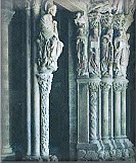  While today we celebrate the Double of the Second Class Feast of Saint James the Greater, lost in the shuffle is poor Saint Christopher whom the Vatican II Modernists didn't particularly take a hankering to and, with the feeble excuse that "there wasn't enough historical proof of his existence", eliminated him from the liturgical calendar just as he did dear Saint Philomena. In a way they weren't offended. After all, what else would you expect from an impostor intent on destroying the holy faith? In an effort to keep St. Christopher visible for Catholics, we present here a brief summation of his virtues by the renowned Abbot Dom Prosper Gueranger from The Liturgical Year: While today we celebrate the Double of the Second Class Feast of Saint James the Greater, lost in the shuffle is poor Saint Christopher whom the Vatican II Modernists didn't particularly take a hankering to and, with the feeble excuse that "there wasn't enough historical proof of his existence", eliminated him from the liturgical calendar just as he did dear Saint Philomena. In a way they weren't offended. After all, what else would you expect from an impostor intent on destroying the holy faith? In an effort to keep St. Christopher visible for Catholics, we present here a brief summation of his virtues by the renowned Abbot Dom Prosper Gueranger from The Liturgical Year: The name of Christopher, whose memory enhances the solemnity of the son of thunder, signifies one who bears Christ. Christina yesterday reminded us that Christians ought to be in every place the good odor of Christ (2 Corinthians 2: 15), Christopher today puts us in mind that Christ truly dwells by faith in our hearts (Ephesians 3: 17). The graceful legend attached to his name is well known. [though Montini and his gang of Modernists didn't think so!] As other men were at a later date, to sanctify themselves in Spain by constructing roads and bridges to facilitate the approach of pilgrims to the tomb of St. James, so Christopher in Lycia had vowed for the love of Christ to carry travelers on his strong shoulders across a dangerous torrent. Our Lord will say on the last day: 'What you did to one of these My least brethren, you did it unto Me.' One night, being awakened by the voice of a child asking to be carried across, Christopher hastened to perform his wonted task of charity, when suddenly, in the midst of the surging and apparently trembling waves, the giant, who had never stooped beneath the greatest weight, was bent down under his burden, now grown heavier than the world itself. 'Be not astonished,' said the mysterious child, 'thou bearest Him Who bears the world.' And He disappeared, blessing His carrier and leaving him full of heavenly strength. Christopher went on to be crowned with martyrdom under Decius. The aid our fathers knew how to obtain from him against storms, demons, plague, accidents of all kinds, has caused him to be ranked among the saints called helpers. In many places the fruits of the orchards were blessed on this day, under the common auspices of St. Christopher and St. James.
In many traditional parishes, vehicles are blessed on this day as well for St. Christopher medals and statues still populate traditional homes and cars. St. Christopher ferried so many of His "lesser ones" across the turbulent river to pray at the tomb (above left) of St. James the Greater at Santiago Compostela in Spain. A final thought. Why would Archbishop Giovanni Montini have wanted to rid the calendar of St. Christopher? Why would Bishop Karol Wojtyla and Father Joseph Ratzinger have followed suit in condoning such insolence? Could it be because St. Christopher, is, as Abbe Gueranger points out above, the patron saint against demons and we all know who let the demon dogs in the front door after Cardinal Angelo Roncalli opened wide the back door. Sancte Christophorus, ora pro nobis. For more, see Saint Christopher
Saint James the Greater was graced by Christ to join Peter and John both at the Transfiguration and in the Garden of Gethsemane. His temporal reward: to drink from the Chalice of Martyrdom at the hands of the antagonist Herod Agrippa. James' ultimate reward as promised by Christ to his mother: Eternal glory.
  We celebrate today the feast of Saint James the Greater along with Saint Christopher (see Abbe Gueranger's reflection above). James was the brother of St. John the Apostle, and the first of the Apostolic College to suffer martyrdom. He was beheaded by Herod Agrippa about the year 44. He was one of the intimate friends of our Lord and Savior. James witnessed the Transfiguration and the agony in the Garden of Olives. Christ foretold his martyrdom on the occasion when the mother of James and John asked for her two sons that they be seated one at his right hand and one at his left in His Kingdom. James preached the Gospel in Judea and Samaria and even in distant Spain. In the Sixth Century the tomb of the two apostIes of the name of James was still being venerated at Jerusalem. But in the Ninth Century we find that the relics of St. James the Greater were already the object of great devotion at Santiago de Compostella, where they must have been carried after the infidels had taken possession of the Holy City. Throughout the Middle Ages, the pilgrimage to Galicia to the tomb of St. James was one of the most popular of all, and wholly worthy of the special place which St. James occupied beside our Blessed Lord. He is the patron saint of Spain.
For more, see Saint James the Greater We celebrate today the feast of Saint James the Greater along with Saint Christopher (see Abbe Gueranger's reflection above). James was the brother of St. John the Apostle, and the first of the Apostolic College to suffer martyrdom. He was beheaded by Herod Agrippa about the year 44. He was one of the intimate friends of our Lord and Savior. James witnessed the Transfiguration and the agony in the Garden of Olives. Christ foretold his martyrdom on the occasion when the mother of James and John asked for her two sons that they be seated one at his right hand and one at his left in His Kingdom. James preached the Gospel in Judea and Samaria and even in distant Spain. In the Sixth Century the tomb of the two apostIes of the name of James was still being venerated at Jerusalem. But in the Ninth Century we find that the relics of St. James the Greater were already the object of great devotion at Santiago de Compostella, where they must have been carried after the infidels had taken possession of the Holy City. Throughout the Middle Ages, the pilgrimage to Galicia to the tomb of St. James was one of the most popular of all, and wholly worthy of the special place which St. James occupied beside our Blessed Lord. He is the patron saint of Spain.
For more, see Saint James the Greater
The trap is so easy to fall into by allowing nuances of error until pretty soon it has become all-out heresy. Such is the case with Feeneyites in their stubbornness to acknowledge what Catholic doctrine teaches. Unfortunately too many have been duped into believing the spin the "doctors" of deception have foisted on the faithful.
 We continue to bring you this series Dr. Thomas A. Droleskey has been given permission from Father Martin Stepanich, OFM S.T.D. to republish. It is part of an excellent series of articles that The Remnant so enthusiastically ran back in the seventies on the authentic Catholic teaching on the doctrine of Extra Ecclesiam Nulla Salus. Those possessed of the false interpretation of the doctrine that outside the Church there is no Salvation made the same arguments then, with the same demonic fury and pride, that are being made today by their successors. So, as you can see, little has changed with the persistent stubborn pride of Feeneyites who continue to deceive. What is sad however is that Fr. Martin, a pioneer and giant of the Traditional Catholic movement, is today persona non grata to those who are presently floundering on the fence, flailing away in trying to justify a false pope and his Motu hoax. It is time they quit schmoozing heretics and join us in denouncing heresies for they are not just nuances of error, but, as this outstanding Franciscan priest states in all charity, outright heresy. He explains in exposing their misdirection with Outside The Church There Is No Salvation, Part five and six We continue to bring you this series Dr. Thomas A. Droleskey has been given permission from Father Martin Stepanich, OFM S.T.D. to republish. It is part of an excellent series of articles that The Remnant so enthusiastically ran back in the seventies on the authentic Catholic teaching on the doctrine of Extra Ecclesiam Nulla Salus. Those possessed of the false interpretation of the doctrine that outside the Church there is no Salvation made the same arguments then, with the same demonic fury and pride, that are being made today by their successors. So, as you can see, little has changed with the persistent stubborn pride of Feeneyites who continue to deceive. What is sad however is that Fr. Martin, a pioneer and giant of the Traditional Catholic movement, is today persona non grata to those who are presently floundering on the fence, flailing away in trying to justify a false pope and his Motu hoax. It is time they quit schmoozing heretics and join us in denouncing heresies for they are not just nuances of error, but, as this outstanding Franciscan priest states in all charity, outright heresy. He explains in exposing their misdirection with Outside The Church There Is No Salvation, Part five and six
Saint Christina is another saint that the Modern Church eliminated from the liturgical year in their effort to eradicate tradition and sacrifice.
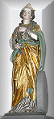 On this Vigil of the Feast of St. James the Greater, there is a commemoration on this Feria day of the holy virgin and martyr Saint Christina. She was a Tuscan virgin, who when ten years old had taken and destroyed the silver idols in her father's house. As a consequence she was tied to a post and pierced with arrows. Her tomb was discovered in 1880; an examination of her relics showed that she was scarcely more than fourteen years of age at the time of her death. On this day the Greeks celebrate another St. Christina, martyr of Tyre. The Greeks salute her as a "stainless bride wounded by arrows."
For more, see Saint Christina On this Vigil of the Feast of St. James the Greater, there is a commemoration on this Feria day of the holy virgin and martyr Saint Christina. She was a Tuscan virgin, who when ten years old had taken and destroyed the silver idols in her father's house. As a consequence she was tied to a post and pierced with arrows. Her tomb was discovered in 1880; an examination of her relics showed that she was scarcely more than fourteen years of age at the time of her death. On this day the Greeks celebrate another St. Christina, martyr of Tyre. The Greeks salute her as a "stainless bride wounded by arrows."
For more, see Saint Christina
 While they clean up Sydney in the aftermath of the mess left by the Worldy Youth last week, isn't it time to call supposed non-profits to task for being profiteers of the debacle down under?
 We haven't published much from the recent Wordly Youth Days that took place late last week because, frankly, it has nothing to do with true Catholicism or any kind of Catholicism for that matter. But Remnant wag Christopher Ferrara was sent down under to cover the anticipated abberations while still trying to justify the new Remnant policy that Benedict was still trying to be a "traditional 'pope'" whereas his actions clearly illustrated what most of our readers already knew: He couldn't possibly be Catholic, let alone a Vicar of Christ. The base photo above left is from the Remnant article. We publish Gary Morella's preface to it and the link provided to Ferrara's piece We haven't published much from the recent Wordly Youth Days that took place late last week because, frankly, it has nothing to do with true Catholicism or any kind of Catholicism for that matter. But Remnant wag Christopher Ferrara was sent down under to cover the anticipated abberations while still trying to justify the new Remnant policy that Benedict was still trying to be a "traditional 'pope'" whereas his actions clearly illustrated what most of our readers already knew: He couldn't possibly be Catholic, let alone a Vicar of Christ. The base photo above left is from the Remnant article. We publish Gary Morella's preface to it and the link provided to Ferrara's piece  "Sydney or Sodom?" in which he also takes Karl Keating of 'Catholic' Answers to task about missing the real target. But then Keating is not about getting to the real truth, but about padding his own pocket taking a salary of over $200,000 a year while desperately sending out slick mailers pleading disaster to souls if his "non-profit" entity doesn't get these tracts in the hands of the youth. It's all about the money, folks, not souls. I doubt you'd find any Traditional Catholic ministry where the Executive Director takes a salary above the national poverty level. We here at the Daily Catholic take no salary for our non-profit organization, nor do any of those Traditional non-profits we promote. Not so with the Motuarians and Vulgarians who accept Vatican II. Know this, those Novus Ordo mercenary "missionaries" are not prophets, but profiteers. Do you think Keating paid his way to Australia with the money he gets in salary, or dipped into "travel funds" to cover costs? We provide Gary's pertinent preface here and why there is so much Mass Confusion Benedict XVI is an enigma "Sydney or Sodom?" in which he also takes Karl Keating of 'Catholic' Answers to task about missing the real target. But then Keating is not about getting to the real truth, but about padding his own pocket taking a salary of over $200,000 a year while desperately sending out slick mailers pleading disaster to souls if his "non-profit" entity doesn't get these tracts in the hands of the youth. It's all about the money, folks, not souls. I doubt you'd find any Traditional Catholic ministry where the Executive Director takes a salary above the national poverty level. We here at the Daily Catholic take no salary for our non-profit organization, nor do any of those Traditional non-profits we promote. Not so with the Motuarians and Vulgarians who accept Vatican II. Know this, those Novus Ordo mercenary "missionaries" are not prophets, but profiteers. Do you think Keating paid his way to Australia with the money he gets in salary, or dipped into "travel funds" to cover costs? We provide Gary's pertinent preface here and why there is so much Mass Confusion Benedict XVI is an enigma
Consecrated by St. Peter, Saint Apollinaris was the First Bishop of Ravenna and one of the earlier martyrs of the Church
 Today is the semi-double feast of St. Apollinaris, a the disciple of St. Peter, who preached the Gospel at Ravenna. The importance of the See of Ravenna in the Sixth Century brought about an attempt to exalt that See unduly. On this account we have in the Mass today the voice of St. Peter recommending the pastors of the Church to avoid the spirit of domination and pride, and the words of the Gospel teaching the lesson of humility. St. Apollinaris Today is the semi-double feast of St. Apollinaris, a the disciple of St. Peter, who preached the Gospel at Ravenna. The importance of the See of Ravenna in the Sixth Century brought about an attempt to exalt that See unduly. On this account we have in the Mass today the voice of St. Peter recommending the pastors of the Church to avoid the spirit of domination and pride, and the words of the Gospel teaching the lesson of humility. St. Apollinaris  after a cruel scourging and exile was martyred at Ravenna in 79 A.D. The great cathedral of that city is dedicated to him.
There is also a Commemoration of St. Liborius, bishop and Confessor. He was the fourth bishop of Le Mans, France. He was renowned for the miracles which he wrought on behalf of those suffering from stone; his name was added to the Calendar by Pope Clement XI, who suffered with this dangerous malady and was cured by the intercession of the saint. He died about the year 397.
For more, see Saint Apollinarius and St. Liborius after a cruel scourging and exile was martyred at Ravenna in 79 A.D. The great cathedral of that city is dedicated to him.
There is also a Commemoration of St. Liborius, bishop and Confessor. He was the fourth bishop of Le Mans, France. He was renowned for the miracles which he wrought on behalf of those suffering from stone; his name was added to the Calendar by Pope Clement XI, who suffered with this dangerous malady and was cured by the intercession of the saint. He died about the year 397.
For more, see Saint Apollinarius and St. Liborius
In discrediting Feeneyism who better to have as a prime witness against this heresy than the Prince of Theologians, the Angelic Doctor himself?
 We continue to bring you this series Dr. Thomas A. Droleskey has been given permission from Father Martin Stepanich, OFM S.T.D. to republish. It is part of an excellent series of articles that The Remnant so enthusiastically ran back in the seventies. As noted, nothing has changed since then except for the fact that Fr. Martin is persona non grata to those who are presently floundering on the fence, flailing away in trying to justify a false pope and his Motu hoax. Nothing has also changed with those Feeneyites who tried to shout Fr. Martin down thirty years ago. They're still trying to villify this now 90 plus-year old giant of Tradition who was not "senile" or "out of touch" then nor is he now in continuing to exhibit the wisdom of saints, something so lacking in this era when Modernism stifles the quest for holiness. If Father Martin was wrong, then so also were numerous true Popes, saints and Doctors of the Church, most notably St. Thomas Aquinas. Of course, that is preposterous as Father proves in his brief, but comprehensive essays, continuting with part three and four of seven parts from this outstanding Franciscan priest with Outside The Church There Is No Salvation, Part three and four We continue to bring you this series Dr. Thomas A. Droleskey has been given permission from Father Martin Stepanich, OFM S.T.D. to republish. It is part of an excellent series of articles that The Remnant so enthusiastically ran back in the seventies. As noted, nothing has changed since then except for the fact that Fr. Martin is persona non grata to those who are presently floundering on the fence, flailing away in trying to justify a false pope and his Motu hoax. Nothing has also changed with those Feeneyites who tried to shout Fr. Martin down thirty years ago. They're still trying to villify this now 90 plus-year old giant of Tradition who was not "senile" or "out of touch" then nor is he now in continuing to exhibit the wisdom of saints, something so lacking in this era when Modernism stifles the quest for holiness. If Father Martin was wrong, then so also were numerous true Popes, saints and Doctors of the Church, most notably St. Thomas Aquinas. Of course, that is preposterous as Father proves in his brief, but comprehensive essays, continuting with part three and four of seven parts from this outstanding Franciscan priest with Outside The Church There Is No Salvation, Part three and four
It is regarded as Catholic belief that St. Mary Magdalen, who was closest to Jesus, His Blessed Mother and the Apostles, was the repentant sinner, Mary of Bethany and the one who annointed Christ's feet. One thing is for sure: She is an excellent example of our Lord's mission: to heal the sinner.
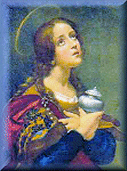 Today the Church honors Saint Mary Magdalen. The Latin writers, beginning with Tertullian, have generally and with great probability identified Mary of Magdala as the sister of Lazarus, and as the sinner who anointed the feet of Jesus. The Greeks, on the other hand, distinguished three Marys. Her brother Lazarus, died in the island of Cyprus. His body was brought to Constantinople by the Emperor Leo VI and laid in the Lazarion in 899. The body of Mary, his sister, who, according to a tradition dating from the Sixth Century, had been buried at Ephesus, was soon brought and laid beside him in the new sepulchral basilica of Byzantium. The Greeks gave her the title of "like unto an apostle" because she first announced to the world and to the apostles themselves the resurrection of the Lord. For this reason the Credo is said in the Mass today, as in Masses of the apostles. The scene of the conversion of Mary of Magdala is perhaps one of the incidents in the Gospel which best reveal the gentleness of the heart of the Redeemer. To Mary much is forgiven, because she loved much; this is the remedy for sinners; this is the spirit which sustains the Church Militant, wherein we may indeed see many sins caused by human frailty, but in which there may be found also a great love ready to pardon all.
For more, see Saint Mary Magdalen Today the Church honors Saint Mary Magdalen. The Latin writers, beginning with Tertullian, have generally and with great probability identified Mary of Magdala as the sister of Lazarus, and as the sinner who anointed the feet of Jesus. The Greeks, on the other hand, distinguished three Marys. Her brother Lazarus, died in the island of Cyprus. His body was brought to Constantinople by the Emperor Leo VI and laid in the Lazarion in 899. The body of Mary, his sister, who, according to a tradition dating from the Sixth Century, had been buried at Ephesus, was soon brought and laid beside him in the new sepulchral basilica of Byzantium. The Greeks gave her the title of "like unto an apostle" because she first announced to the world and to the apostles themselves the resurrection of the Lord. For this reason the Credo is said in the Mass today, as in Masses of the apostles. The scene of the conversion of Mary of Magdala is perhaps one of the incidents in the Gospel which best reveal the gentleness of the heart of the Redeemer. To Mary much is forgiven, because she loved much; this is the remedy for sinners; this is the spirit which sustains the Church Militant, wherein we may indeed see many sins caused by human frailty, but in which there may be found also a great love ready to pardon all.
For more, see Saint Mary Magdalen
The depositions of quotes in Dimond's Treatise reek of being taken out of context, thus twisting the meaning for the Prosecution against Baptism of Blood and Baptism of Desire, but Griff stands in for the Defense, keeping everything in context in proving that the Means will justify his arguments.
 Griff Ruby continues his comprehensive series "The Art of Scholastic Dishonesty" with his fourth installment that is most necessary for Catholics to understand one's responsibility to educate, inform and rebuke as St. Paul entreats in 2 Timothy 4: 2-5 and to be faithful to the Word and what holy Mother Church teaches and to be on guard for what the Apostle warns in Galatians 1: 8-11. The tomes of quotes by Peter Dimond in his supposedly "air-tight" arguments in his Treatise
 have more holes than Swiss cheese. Once readers discover his dishonesty of omitting key components that actually quite often refute his forced and faulty conclusions, they should smell what's really intended. And once readers clearly understand his deliberate deception of placing misdirected emphasis on the words of Fathers, Doctors, Saints and Popes of the Church in his Treatise to forge a different conclusion, then readers should begin to understand only too well where that putrid stench originated. Griff fumigates more of the mephetic MHFM's misrepresentations in Part Four The Treatise is in Contempt of Context have more holes than Swiss cheese. Once readers discover his dishonesty of omitting key components that actually quite often refute his forced and faulty conclusions, they should smell what's really intended. And once readers clearly understand his deliberate deception of placing misdirected emphasis on the words of Fathers, Doctors, Saints and Popes of the Church in his Treatise to forge a different conclusion, then readers should begin to understand only too well where that putrid stench originated. Griff fumigates more of the mephetic MHFM's misrepresentations in Part Four The Treatise is in Contempt of Context
To Saint Praxedes her virginity was a greater treasure than the temporal treasures she gave up to help the poor and dedicate herself to God, By her example many were converted.
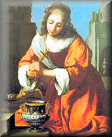 There is a commemoration today of Saint Praxedes, sister of Saint Pudentiana, whose feast is celebrated, on May 19th. Though there is little known for sure about St. Praxedes, it is known that she was the daughter of the Roman Senator Pudens, and after consecrating her virginity to God, she, along with Pudentiana, gave up all their wealth to the poor, disregarding Roman prestige, power and temporal prizes for greater mansions in Heaven. There is no known record of how St. Praxedes died for the Church designates white, but many think she could have been a martyr considering the times and persecutions in the mid second century. Some six centuries later Pope Paschal I transferred the bodies of many saints from thec catacombs and placed their relics in the Church of St. Praxedes; an inscription states that 2,300 bodies of saints and martyrs repose in the crypt under the apse of the Church.
For more, see Saint Praxedes There is a commemoration today of Saint Praxedes, sister of Saint Pudentiana, whose feast is celebrated, on May 19th. Though there is little known for sure about St. Praxedes, it is known that she was the daughter of the Roman Senator Pudens, and after consecrating her virginity to God, she, along with Pudentiana, gave up all their wealth to the poor, disregarding Roman prestige, power and temporal prizes for greater mansions in Heaven. There is no known record of how St. Praxedes died for the Church designates white, but many think she could have been a martyr considering the times and persecutions in the mid second century. Some six centuries later Pope Paschal I transferred the bodies of many saints from thec catacombs and placed their relics in the Church of St. Praxedes; an inscription states that 2,300 bodies of saints and martyrs repose in the crypt under the apse of the Church.
For more, see Saint Praxedes

 Everyone seems to think "comfort" is about "feelings." The point is it has nothing to do with how good we feel, but how good we make God feel by worshipping Him as He ordained and treating others as He has taught us.
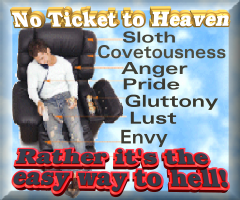 Gabriel Garnica returns with a sobering question: Are you comfortable in your comfort zone? For the sake of your soul, let us hope you aren't. Too many have discarded the necessary hairshirts that made saints out of sinners; men and women who deliberately avoided temporal comfort to make them more comfortable in knowing their quest to attain everlasting comfort was the only way to Heaven. Lost are those self-immolating practices that reminded us we are nothing without God and that from dust we came, to dust we will return. How dare we waste the bodies God gave us by lounging around and looking for the easy way out. That has never been the Catholic way and if you do not agree with that, if you think you can embrace the world, the flesh and the devil and emerge unscathed, then you're not Catholic. That's another uncomfortable fact that countless souls will have to come to grips with sooner or later. The sooner the better, if you get the drift. Too often the ultimate epicurean comfort today, and in all too many homes, is the easy chair. That is not a malaprop. They don't call these plush stuffed single sofas "lazy boys" for nothing! It all starts so innocently: this comfort, that convenience, this delight, that pleasure and, pretty soon, if we do not discipline our senses, our senses will rule and that leads to each and every one of the Seven Deadly Sins. We all know where that leads. Enough said. If that makes you uncomfortable, it should as Gabriel tweaks consciences in his article If You Are Comfortable, You Are Not With God Gabriel Garnica returns with a sobering question: Are you comfortable in your comfort zone? For the sake of your soul, let us hope you aren't. Too many have discarded the necessary hairshirts that made saints out of sinners; men and women who deliberately avoided temporal comfort to make them more comfortable in knowing their quest to attain everlasting comfort was the only way to Heaven. Lost are those self-immolating practices that reminded us we are nothing without God and that from dust we came, to dust we will return. How dare we waste the bodies God gave us by lounging around and looking for the easy way out. That has never been the Catholic way and if you do not agree with that, if you think you can embrace the world, the flesh and the devil and emerge unscathed, then you're not Catholic. That's another uncomfortable fact that countless souls will have to come to grips with sooner or later. The sooner the better, if you get the drift. Too often the ultimate epicurean comfort today, and in all too many homes, is the easy chair. That is not a malaprop. They don't call these plush stuffed single sofas "lazy boys" for nothing! It all starts so innocently: this comfort, that convenience, this delight, that pleasure and, pretty soon, if we do not discipline our senses, our senses will rule and that leads to each and every one of the Seven Deadly Sins. We all know where that leads. Enough said. If that makes you uncomfortable, it should as Gabriel tweaks consciences in his article If You Are Comfortable, You Are Not With God
All this past week the saints celebrated have had one commond denominator besides their holiness: they dedicated themselves to the sick and poor while converting countless souls. Today's saint is no exception.
 There is a commemoration today of the holy confessor Saint Jerome Emiliani. In the Sixteenth Century God raised up a number of saints who by prayer, teaching and good works combated the influence of the pagan Renaissance. Among these was St. Jerome, who spent himself in the care of
orphans and the poor. He instituted homes for orphan children, and founded the Congregation whose object was to educate orphans. They are called the Somaschl, from Somascha, the little Italian town in which they were first
established. He died on February 8, 1531, from the plague which he contracted while burying the dead. It was related that St. Charles Borromeo, when going several years afterwards to make a pastoral visit at Somascha, became aware of the presence of the relics of a saint through the sweet perfume which emanated from his tomb. Asking for a thurible, St. Charles offered incense on the sepulchre, being thus the first to render public veneration to the saint.
For more, see Saint Jerome Emiliani There is a commemoration today of the holy confessor Saint Jerome Emiliani. In the Sixteenth Century God raised up a number of saints who by prayer, teaching and good works combated the influence of the pagan Renaissance. Among these was St. Jerome, who spent himself in the care of
orphans and the poor. He instituted homes for orphan children, and founded the Congregation whose object was to educate orphans. They are called the Somaschl, from Somascha, the little Italian town in which they were first
established. He died on February 8, 1531, from the plague which he contracted while burying the dead. It was related that St. Charles Borromeo, when going several years afterwards to make a pastoral visit at Somascha, became aware of the presence of the relics of a saint through the sweet perfume which emanated from his tomb. Asking for a thurible, St. Charles offered incense on the sepulchre, being thus the first to render public veneration to the saint.
For more, see Saint Jerome Emiliani
The truth never changes. What a giant of Tradition penned over thirty years ago is even more pertinent today.
 Dr. Thomas A. Droleskey has been given permission from Father Martin Stepanich, OFM S.T.D. to republish the excellent series of articles that The Remnant so enthusiastically ran back in the seventies. Nothing has changed since then except for the fact that Fr. Martin is persona non grata to those who are presently floundering on the fence, flailing away in trying to justify a false pope and his Motu hoax. Nothing has also changed with those Feeneyites who tried to shout Fr. Martin down thirty years ago. They're still trying to villify a good man, this now 90 plus-year old giant of Tradition who was not "senile" or "out of touch" then nor is he now in continuing to exhibit the wisdom of saints, something so lacking in this era when Modernism stifles the quest for holiness. Most importantly, nothing has changed and never will on the solid Catholic truth he professes in this series to remind all that the First Dogma of the Church will always stand: Extra Ecclesiam Nulla Salus, but his opponents need to fully understand that the Church is composed of the Church Militant, Church Suffering, and Church Triumphant. Tom provides Father's brief, but comprehensive essays on his site with part one and two of seven parts from this outstanding Franciscan priest with Outside The Church There Is No Salvation Dr. Thomas A. Droleskey has been given permission from Father Martin Stepanich, OFM S.T.D. to republish the excellent series of articles that The Remnant so enthusiastically ran back in the seventies. Nothing has changed since then except for the fact that Fr. Martin is persona non grata to those who are presently floundering on the fence, flailing away in trying to justify a false pope and his Motu hoax. Nothing has also changed with those Feeneyites who tried to shout Fr. Martin down thirty years ago. They're still trying to villify a good man, this now 90 plus-year old giant of Tradition who was not "senile" or "out of touch" then nor is he now in continuing to exhibit the wisdom of saints, something so lacking in this era when Modernism stifles the quest for holiness. Most importantly, nothing has changed and never will on the solid Catholic truth he professes in this series to remind all that the First Dogma of the Church will always stand: Extra Ecclesiam Nulla Salus, but his opponents need to fully understand that the Church is composed of the Church Militant, Church Suffering, and Church Triumphant. Tom provides Father's brief, but comprehensive essays on his site with part one and two of seven parts from this outstanding Franciscan priest with Outside The Church There Is No Salvation
The fact that St. Vincent de Paul's body remains incorrupt to this day is manifest proof of his holiness and Heaven's approval of all the good, saintly priest did on this earth.
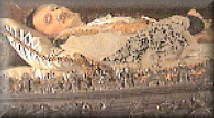 St. Vincent de Paul, founder of the Congregation of the Priests of the Mission (Lazarists), and the Society of the Sisters of Charity, while a young priest was held as a slave in Africa where he had been sold by pirates. On his return to France he became a parish priest. For a time he took the place of a galley slave. His parish was a country parish; his experience led him to found the Priests of the Mission, bound by special vow to undertake this special work. At one time he was entrusted by St. Francis de Sales with the spiritual direction of the nuns of the Visitation. Assisted by St. Louise de Marillac he founded the Sisters of Charity. The authority exercised by St. Vincent was immense, and was undisputed throughout the kingdom. He was a member of the king's Privy Council, and thus had control over the appointments to the episcopal sees and to the richest benefices of the Church of France. Yet Vincent, meek and humble of heart, ascended the magnificent stairs of the palace and took part in the royal councils with the same evangelical simplicity, and clothed in the same poor and shabby garments in which he traversed the streets of Paris rescuing abandoned waifs and strays and succoring the helpless sick and suffering. He died in 1660 at St. Lazarus, the motherhouse of his Congregation. His body remains incorrupt behind and above the altar bearing his name in Paris. Pope Leo XIII declared him the Patron of all charitable associations.
For more, see Saint Vincent de Paul St. Vincent de Paul, founder of the Congregation of the Priests of the Mission (Lazarists), and the Society of the Sisters of Charity, while a young priest was held as a slave in Africa where he had been sold by pirates. On his return to France he became a parish priest. For a time he took the place of a galley slave. His parish was a country parish; his experience led him to found the Priests of the Mission, bound by special vow to undertake this special work. At one time he was entrusted by St. Francis de Sales with the spiritual direction of the nuns of the Visitation. Assisted by St. Louise de Marillac he founded the Sisters of Charity. The authority exercised by St. Vincent was immense, and was undisputed throughout the kingdom. He was a member of the king's Privy Council, and thus had control over the appointments to the episcopal sees and to the richest benefices of the Church of France. Yet Vincent, meek and humble of heart, ascended the magnificent stairs of the palace and took part in the royal councils with the same evangelical simplicity, and clothed in the same poor and shabby garments in which he traversed the streets of Paris rescuing abandoned waifs and strays and succoring the helpless sick and suffering. He died in 1660 at St. Lazarus, the motherhouse of his Congregation. His body remains incorrupt behind and above the altar bearing his name in Paris. Pope Leo XIII declared him the Patron of all charitable associations.
For more, see Saint Vincent de Paul

 Three years ago, amidst all the emotional angst of the Terri Shiavo tragedy, some took offense to the strict moral theological stance of a few well-respected Traditional clerics. Tom asks Fr. Martin Stepanich to weigh in on whether the reaction of some in boycotting their Masses was wise.
 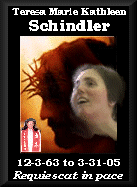 Dr. Thomas A. Droleskey has always been one to get to the truth and one he relies on greatly is a priest who has been around longer than anyone: Father Martin Stepanich, OFM S.T.D. Tom asked Fr. Martin Stepanich to weigh in concerning the death of Terri Schiavo three years ago. Because Bishop Donald Sanborn and Fr. Anthony Cekada considered the case from an objective practical, moral theological viewpoint rather than subjective, emotional view, some protested by no longer going to "their Masses." Fr. Martin illustrates quite clearly the folly of such action of reacting emotionally without understanding these good clerics are not being schismatic or unCatholic in anyway and for those who won't attend "their Masses" they should realize they have walked away from the truest gift they could have: the holy Sacraments merely because these good traditional sacerdotes differ on an opinion, not dogma or doctrine, but an opinion. Fr. Martin puts it so clearly and charitably in his letter to Tom Fr. Martin on Terri Schiavo Dr. Thomas A. Droleskey has always been one to get to the truth and one he relies on greatly is a priest who has been around longer than anyone: Father Martin Stepanich, OFM S.T.D. Tom asked Fr. Martin Stepanich to weigh in concerning the death of Terri Schiavo three years ago. Because Bishop Donald Sanborn and Fr. Anthony Cekada considered the case from an objective practical, moral theological viewpoint rather than subjective, emotional view, some protested by no longer going to "their Masses." Fr. Martin illustrates quite clearly the folly of such action of reacting emotionally without understanding these good clerics are not being schismatic or unCatholic in anyway and for those who won't attend "their Masses" they should realize they have walked away from the truest gift they could have: the holy Sacraments merely because these good traditional sacerdotes differ on an opinion, not dogma or doctrine, but an opinion. Fr. Martin puts it so clearly and charitably in his letter to Tom Fr. Martin on Terri Schiavo
Groomed by St. Philip Neri, today's Saint devoted his life to the care of the sick in healing body and soul where today he is co-patron saint of the medical profession
 Saint Camillus of Lellis was born in 1550 of a noble family at Bacchianico in Naples. He tried twice to enter the Capuchin Order, but each time had to leave on account of a sore on his leg. He then spent his life in ministering to the sick in the hospitals of St. Giacomo degli Incurabili, and of the Santo Spirito. He instituted a congregation of regular Clerics, devoted to the care of the sick. St. Philip Neri, who at one time was his confessor, saw in a vision that the angels themselves inspired the Religious instituted by him with the words best suited to comfort the dying. Pope Leo XIII appointed him the celestial patron of those who are at the point of death; his name is in the Litany of the Dying. He died at Rome, July 14, 1614.
For more, see Saint Camillus de Lellis Saint Camillus of Lellis was born in 1550 of a noble family at Bacchianico in Naples. He tried twice to enter the Capuchin Order, but each time had to leave on account of a sore on his leg. He then spent his life in ministering to the sick in the hospitals of St. Giacomo degli Incurabili, and of the Santo Spirito. He instituted a congregation of regular Clerics, devoted to the care of the sick. St. Philip Neri, who at one time was his confessor, saw in a vision that the angels themselves inspired the Religious instituted by him with the words best suited to comfort the dying. Pope Leo XIII appointed him the celestial patron of those who are at the point of death; his name is in the Litany of the Dying. He died at Rome, July 14, 1614.
For more, see Saint Camillus de Lellis

 The Principal Points of the Principles holy Mother Church requires All to follow, and which must be applied to the Issue of Baptism of Blood and Baptism of Desire, Prove the Fallacies of Feeneyism
 Continuing our surge of wiping out the insurgent heresy of Feeneyism, we launch today an old reliable that always hits its target with devastating and definite detonation. That would be the irrefutable artilllery, so fully packed and loaded with infrangible Catholic truth as compiled by one of the masters of Church Militant warfare, Father Anthony Cekada. Indeed, he was one of the first to counter the nasty guerilla tactics of those floundering in Feeneyism in the cult camp Feeney had festered while alive. In publishing on these pages last week the official excommunication decree of Feeney from the Holy Office under Pope Pius XII, we included the link where Fr. Cekada proves without a shadow of a doubt that the bell, book and candle was authentic. Since His Holiness never rescinded it, a good man-gone wrong died canonically (1917 Pio-Benedictine Codex Iuris) outside the Church he had so stubbornly and narrowly, and defiantly defended as needing Baptism of water to be saved with no exception. Let us pray that God made an exception and that Feeney's pride and stubbornness did not exclude him from passage to either the Church Suffering or the Church Triumphant. Today we provide an article Fr. Cekada wrote eight years ago this week detailing the Principles the Church requires us to follow in resolving the issue of Baptism of Blood and Baptism of Desire. He lays it out succinctly in Baptism of Desire and Theological Principles Continuing our surge of wiping out the insurgent heresy of Feeneyism, we launch today an old reliable that always hits its target with devastating and definite detonation. That would be the irrefutable artilllery, so fully packed and loaded with infrangible Catholic truth as compiled by one of the masters of Church Militant warfare, Father Anthony Cekada. Indeed, he was one of the first to counter the nasty guerilla tactics of those floundering in Feeneyism in the cult camp Feeney had festered while alive. In publishing on these pages last week the official excommunication decree of Feeney from the Holy Office under Pope Pius XII, we included the link where Fr. Cekada proves without a shadow of a doubt that the bell, book and candle was authentic. Since His Holiness never rescinded it, a good man-gone wrong died canonically (1917 Pio-Benedictine Codex Iuris) outside the Church he had so stubbornly and narrowly, and defiantly defended as needing Baptism of water to be saved with no exception. Let us pray that God made an exception and that Feeney's pride and stubbornness did not exclude him from passage to either the Church Suffering or the Church Triumphant. Today we provide an article Fr. Cekada wrote eight years ago this week detailing the Principles the Church requires us to follow in resolving the issue of Baptism of Blood and Baptism of Desire. He lays it out succinctly in Baptism of Desire and Theological Principles
To so many Saint Alexius, though beloved by many, was nothing but a beggar. But to those he ministered to in the streets, Alexius was Christ personified in his Christlike way with Christ's children. He could truly be called the patron saint of the homeless and destitute.
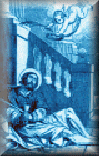 Saint Alexius, whose semi-double feast we celebrate today, was the only son of a wealthy Roman noble. For our Lord and Savior's sake he left his home disguised as a poor beggar so that he might do God's will in reaching the most destitute. Even his own parents didn't recognize him, but because they had taught him the Corporal and Spiritual Works of Mercy, which they practiced all their lives, took a poor stranger in and didn't recognize him as their own son for seventeen years. That was not because Alexius was trying to deceive them, but rather that they saw Christ in every creature and Alexius felt he would be treated more favorably if they knew this poor beggar was their son. His intent was to devote his life to others, teaching the truths and fruits of the Faith particularly to the most wretched of God's children and little children as well. He died early in the Fifth Century and his memory is venerated in many lands.
For more, see Saint Alexius Saint Alexius, whose semi-double feast we celebrate today, was the only son of a wealthy Roman noble. For our Lord and Savior's sake he left his home disguised as a poor beggar so that he might do God's will in reaching the most destitute. Even his own parents didn't recognize him, but because they had taught him the Corporal and Spiritual Works of Mercy, which they practiced all their lives, took a poor stranger in and didn't recognize him as their own son for seventeen years. That was not because Alexius was trying to deceive them, but rather that they saw Christ in every creature and Alexius felt he would be treated more favorably if they knew this poor beggar was their son. His intent was to devote his life to others, teaching the truths and fruits of the Faith particularly to the most wretched of God's children and little children as well. He died early in the Fifth Century and his memory is venerated in many lands.
For more, see Saint Alexius
 Does anyone know the day, hour or minute of their visitation when they'll have no choice but to face the Supreme Judge and account for their stewardship on earth? Whenever that time arrives, and it definitely will, it will be too late to correct things if they did not choose wisely when they should have. Knowing how the Brown Scapular will protect souls entails knowing why. Ah, there's the wooly rub.
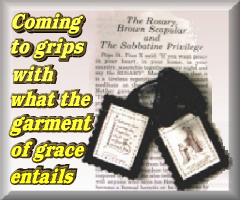 We've all heard the axiom, "there but for the grace of God go I", but how many of us really understand this? Today's guest contributor, Ava Bell, now a committed Traditional Catholic, relates how this hit home for her in her earlier days before her awakening, if you will, in the same manner that Saint Augustine wrote about when confiding his past sins in his landmark book "Confessions." Her experience is pertinent for our times, especially in this day and age when so many worship at the altar of the world, the flesh and the devil, not really thinking about each's own visitation when each one of us will stand before God at his or her Particular Judgment. Ava ties in the theme of this past Sunday's Gospel, the visitation of the Mother of God to the children of Fatima, and the significance of our Lady's promise for those who wear her Brown Scapular. Yes, it is most pertinent for this era, for this very week and day. While hordes of clueless Catholics with hormones at a peak gather for the conciliar version of Woodstock: Worldy Youth Days in Sydney this week, she presents a sobering story that should shake the timbers of our souls and wake the echoes of those who assume security when, in truth, there is only one way to secure eternal salvation and no amount of superstitions will stay the inevitable truth that for any sacramental to be effective, the one receiving it must be of good will and open to the grace of God, specifically Sanctifying Grace. Without this protection, all else is futile, fateful. She candidly explains in her article
The Brown Scapular is Not a Good Luck Charm
We've all heard the axiom, "there but for the grace of God go I", but how many of us really understand this? Today's guest contributor, Ava Bell, now a committed Traditional Catholic, relates how this hit home for her in her earlier days before her awakening, if you will, in the same manner that Saint Augustine wrote about when confiding his past sins in his landmark book "Confessions." Her experience is pertinent for our times, especially in this day and age when so many worship at the altar of the world, the flesh and the devil, not really thinking about each's own visitation when each one of us will stand before God at his or her Particular Judgment. Ava ties in the theme of this past Sunday's Gospel, the visitation of the Mother of God to the children of Fatima, and the significance of our Lady's promise for those who wear her Brown Scapular. Yes, it is most pertinent for this era, for this very week and day. While hordes of clueless Catholics with hormones at a peak gather for the conciliar version of Woodstock: Worldy Youth Days in Sydney this week, she presents a sobering story that should shake the timbers of our souls and wake the echoes of those who assume security when, in truth, there is only one way to secure eternal salvation and no amount of superstitions will stay the inevitable truth that for any sacramental to be effective, the one receiving it must be of good will and open to the grace of God, specifically Sanctifying Grace. Without this protection, all else is futile, fateful. She candidly explains in her article
The Brown Scapular is Not a Good Luck Charm
O Henry! What a King. If only we had leaders today of his caliber for while many were subject to him, he subjected himself to the only King Who counts in promoting the Social Reign of Christ.
 The name of St. Henry, Emperor of Germany, is held in veneration by all. He spread Christianity and advanced piety and religion among his subjects. Born in 972, he defended the Church and the Holy See. He came down repeatedly into Italy in order to defend the rightful Pontiff against opposing factions. Detained at Monte Cassino by illness he was miraculously cured through the intercession of St. Benedict. He asked to be accepted as a monk in the Abbey of St. Vanne at Verdun; the abbot commanded him in the name of religious obedience to reascend the throne. He spent a great part of his treasure in founding episcopal sees, enriching churches, and endowing monasteries. On one occasion he sent his imperial insignia to the Abbey of Cluny in order that they should be offered up to our Lord and Redeemer Jesus Christ. St. Henry died on July 13, 1024, and was canonized by Pope Eugenius III in 1145.
For more, see Saint Henry the King The name of St. Henry, Emperor of Germany, is held in veneration by all. He spread Christianity and advanced piety and religion among his subjects. Born in 972, he defended the Church and the Holy See. He came down repeatedly into Italy in order to defend the rightful Pontiff against opposing factions. Detained at Monte Cassino by illness he was miraculously cured through the intercession of St. Benedict. He asked to be accepted as a monk in the Abbey of St. Vanne at Verdun; the abbot commanded him in the name of religious obedience to reascend the throne. He spent a great part of his treasure in founding episcopal sees, enriching churches, and endowing monasteries. On one occasion he sent his imperial insignia to the Abbey of Cluny in order that they should be offered up to our Lord and Redeemer Jesus Christ. St. Henry died on July 13, 1024, and was canonized by Pope Eugenius III in 1145.
For more, see Saint Henry the King
When speaking in terms of "One", we have to keep in mind those Catholic truths that certain Entities are "Three in One" such as the Holy Trinity, the Communion of Saints and Baptism.
  Griff Ruby continues his comprehensive series "The Art of Scholastic Dishonesty" for he realizes the responsibility to educate, inform and rebuke as St. Paul entreats in 2 Timothy 4: 2-5 and to be faithful to the Word and what holy Mother Church teaches and to be on guard for what the Apostle warns in Galatians 1: 8-10. There is but One God, One Church, One Baptism but within One God is Three Persons, Father, Son and Holy Ghost; and within One Church the church Militant, Church Suffering and Church Triumphant; and, keeping in mind God's Communion of Saints there is within One Baptism the Baptism of Water alone for the Church Militant on earth, but there is also the Baptism of Blood and/or the Baptism of Desire for those who would, through their death, become members of the Church Suffering or Church Triumphant, Purgatory and Heaven respectively. The "Three in One" application preserves and strengthens the First Dogma of the Church that there is no salvation outside the Church (Extra Ecclesiam Nulla Salus) because those receiving BOB or BOD would be in the Church, not outside. This is something that such luminaries as Peter Abélard, Fr. Leonard Feeney, S.J. and radical Peter Dimond did not or do not honestly admit. Maybe that's why the idiom applies so aptly to such 'intellectuals' as these: A small amount of knowledge can cause people to think they are more expert than they really are. In other words, as has been proven by their condemnation by holy Mother the Church: a little knowledge can be a dangerous thing! Griff explains in Part Three Three who dare challenge Church Teaching
 From the "Century of Saints" came a holy giant among the sanctified giants whose feast holy Mother celebrates in mid July in the midst of the Church In medio Ecclesiae
 Today is the Double Feast of The Seraphic Doctor, Saint Bonaventure. Satan is indeed furious and we need today men of the caliber of St. Bonaventure who was a man full of "good fortune" from his earliest years. Humility was his virtue; his role model was St. Francis of Asissi, the holy founder who named him. He followed this man, continuing the ideals of the Franciscans, guiding them during turbulent times when growing pains created problems in the ranks and with various ecclesial authorities opposed to the Friars Minor. This Universal Doctor was one of the first saintly Cardinals of the Church. He was close friends with "The Angelic Doctor" St. Thomas Aquinas and the saintly king of France King Louis IX. He was the architect of the 2nd Council of Lyons and, fittingly, was called home by God immediately following completion of the Council. His work done on earth but continued through his writings and example; so much so that Saint Bonaventure is known as The Seraphic Doctor
Today's holy pontiff was converted and ordained by St. Peter himself in becoming the next Vicar of Christ following the head Apostle's successor St. Linus.  There is a commemoration at Sunday Low Masses for the holy martyr Pope Saint Anacletus. According to the list of Popes furnished us by St. Irenaeus, Pope Saint Anacletus is
probably the same person as Pope Saint Cletus, the successor of Pope Saint Linus and the
predecessor of Pope Saint Clement on the papal throne. Some say that he was banished from Rome and returned to rule the Holy See a second time. He completed the tomb of St. Peter at the Vatican, near which he was himself interred. To him is assigned the decree that bishops should be consecrated by two or more bishops; that clerics should be publicly ordained by their own bishop and that they all should receive Holy Communion after the consecration in the mass of ordination. He was martyred under the Emperor Trajan, For more on this third Successor of Peter, see Pope Saint Anacletus
There is a commemoration at Sunday Low Masses for the holy martyr Pope Saint Anacletus. According to the list of Popes furnished us by St. Irenaeus, Pope Saint Anacletus is
probably the same person as Pope Saint Cletus, the successor of Pope Saint Linus and the
predecessor of Pope Saint Clement on the papal throne. Some say that he was banished from Rome and returned to rule the Holy See a second time. He completed the tomb of St. Peter at the Vatican, near which he was himself interred. To him is assigned the decree that bishops should be consecrated by two or more bishops; that clerics should be publicly ordained by their own bishop and that they all should receive Holy Communion after the consecration in the mass of ordination. He was martyred under the Emperor Trajan, For more on this third Successor of Peter, see Pope Saint Anacletus
 Since we do not know the hour of our visitation, should we not be on guard at all times?
To enhance each Sunday's Epistle and Gospel we present this special feature provided by John Gregory with the Haydock Commentary found at the bottom of each page of the Douay-Rheims Bible. We publish it here in conjunction with the Epistle and Gospel for the Sunday Mass, with the cogent comprehensive Catholic Commentary penned by Father George Leo Haydock because the type size is normally so hard to read and not everyone has access to the Commentary, let alone the authentic Catholic edition of Holy Writ. For the Ninth Sunday after Pentecost the theme is that one does not know the hour of one's visitation, in other words, when he has to make an account before God of all he has done on earth. That is why St. Paul warned not to tempt Christ and why our Lord wept and then, in righteous anger, chased those out of the house of God who put more weight in worldly things. How we see this today in the once Catholic churches that call themselves 'Catholic' but are anything but. The time will come when they will be chased out by means known only to God and they will be restored to true houses of God where the Holy Sacrifice of the Mass, the Mass of All Ages will once again summon the angels and His abundant graces for those willing to abandon a civilization currently in slavery to the world, the flesh and the devil. You can better understand this in the Ninth Sunday after Pentecost Haydock Commentary

Though the SSPX and other Recognize-Yet-Resist groups differ on various theological opinions with those who do not recognize Ratzinger as Catholic and will make no concessions whatsoever to the counterfeit church of conciliarism, they are of one mind when it comes to opposing the heresy of Feeneyism
 Some think that there are only a few Traditional Catholics such as Griff Ruby and Fr. Martin Stepanich who have decided to go after Feeneyism, and that it is only "those crazy sedevacantists." Au contraire, mes amis. It is a fact that every major visible Traditional Bishop stands staunchly against the errors of Feeneyism. This would include the four Society of St. Piux X Bishops as well as Bishops Dolan, Giles, McKenna, Pivarunas, Sanborn and Vezelis in the U.S. not to even mention those overseas and in Mexico or deceased esteemed diseased prelates such as Archbishop Lefebvre and Archbishop Thuc, Bishops des Lauriers, Carmona, Zamora, Martinez, and Musey. To bring this point home we point you to three articles today; two from ten years ago that appeared in the SSPX official publication The Angeles which states the Society's position with Fr. Joseph Pfeiffer's initial volley in 1998 titled, Three Baptisms and Fr. Francois Laisney's follow-up piece, The Three Errors of the Feeneyites . Three years later Fr. Peter Scott, then District Superior of the SSPX in the United States followed up with
Follow-up on Feeneyism
Some think that there are only a few Traditional Catholics such as Griff Ruby and Fr. Martin Stepanich who have decided to go after Feeneyism, and that it is only "those crazy sedevacantists." Au contraire, mes amis. It is a fact that every major visible Traditional Bishop stands staunchly against the errors of Feeneyism. This would include the four Society of St. Piux X Bishops as well as Bishops Dolan, Giles, McKenna, Pivarunas, Sanborn and Vezelis in the U.S. not to even mention those overseas and in Mexico or deceased esteemed diseased prelates such as Archbishop Lefebvre and Archbishop Thuc, Bishops des Lauriers, Carmona, Zamora, Martinez, and Musey. To bring this point home we point you to three articles today; two from ten years ago that appeared in the SSPX official publication The Angeles which states the Society's position with Fr. Joseph Pfeiffer's initial volley in 1998 titled, Three Baptisms and Fr. Francois Laisney's follow-up piece, The Three Errors of the Feeneyites . Three years later Fr. Peter Scott, then District Superior of the SSPX in the United States followed up with
Follow-up on Feeneyism
Conversions come in many ways. For today's saint it was when St. John Gualbert at the foot of the altar, with sword in hand, was merciful to his own brother's killer. His forgiveness moved John to turn his back on the world and seek everlasting life, taking as many with him to Heaven as he could through his holy example. His forgiveness moved John to turn his back on the world and seek everlasting life, taking as many with him to Heaven as he could through his holy example.
Born at Florence at the end of the 10th Century, John Gualbert was trained
in the school of St. Benedict. He stamped out simony and brought back order
and peace to the land of Tuscany. At Vallombrosa he founded a monastery,
whence came many saints and which still flourishes. On one occasion meeting
the murderer of his brother he pardoned him in the name of the Redeemer. For
this act he received a singular recognition from Our Crucified Lord. He died
on July 12, 1073, and was canonized in 1193.
See Saint John Gualbert
 Had Feeney only relented and repented, he might very well have been remembered for the great things he did rather than the cultish company he kept in Bean town
  We all know that were Pope Pius XII physically on the throne in 1965 or today, he would have excommunicated practically the entire hierarchy who advanced the heresies of Vatican II, so much so that the least offender against the Church who was excommunicated by His Holiness would be the Jesuit Fr. Leonard Feeney. Be that as it may, the fact of the matter is well illustrated by Pope Leo XIII in the oft-quoted article 9 from his encyclical Satis Cognitum, "There can be nothing more dangerous than those heretics who admit nearly the whole cycle of doctrine, and yet by one word, as with a drop of poison, infect the real and simple faith taught by our Lord and handed down by Apostolic tradition." So also with Fr. Feeney. He did many, many good things, upheld 98% of Catholic truth and spoke out courageously and with flair when others shied away. He wrote many excellent books, such as "Fish on Friday". For those attributes of course he is to be commended. Sadly, however, by his stubborn refusal to obey a true Pope in spreading the heresy that there could be no Baptism of Blood or Desire, he injected that "drop of poison" and infected the rest of what he stood for. Who was Fr. Feeney? In the interest of balance and to provide one of the more comprehensive accounts of the man and his cult, we point you to the three part biography by Third Order M.I.C.M. John Neumann. Keep in mind that his title is an oxymoron for St. Athanasius never stood against Church teaching. Fr. Feeney, by evidence of his excommunication by a true Pope, did. You can read about Feeney and his cult at Father Leonard Feeney
Oh, what the early martyrs endured rather than offending God. Today's Catholics have so much to learn from their example and stand firm against the collapsing counterfeit church of conciliarism which has caved to the world, the flesh and the devil.
 Speaking of Pope Pius XII, today there is a commemoration of the very first in the line of Piuse - Pope Saint Pius I, Martyr and great Pope of the Second Century. He is believed by tradition to have established a baptistery in the house of the Pudenti or de Pastore. His brother is the author of the Shepherd of Hernias which has been styled "a vast examination of the conscience of the Roman Church at the end of the first half of the Second Century." To St. Pius is attributed the fixation of the feast of the Resurrection on Sunday, which day then became the central Sunday of the year. He was martyred A.D. 157 and buried on Vatican Hill with his remains later moved to the Vatican proper.
For more, see Pope Saint Pius I Speaking of Pope Pius XII, today there is a commemoration of the very first in the line of Piuse - Pope Saint Pius I, Martyr and great Pope of the Second Century. He is believed by tradition to have established a baptistery in the house of the Pudenti or de Pastore. His brother is the author of the Shepherd of Hernias which has been styled "a vast examination of the conscience of the Roman Church at the end of the first half of the Second Century." To St. Pius is attributed the fixation of the feast of the Resurrection on Sunday, which day then became the central Sunday of the year. He was martyred A.D. 157 and buried on Vatican Hill with his remains later moved to the Vatican proper.
For more, see Pope Saint Pius I
Catholics need to understand the serious consequences of the heresy of Feeneyism for it was no mere slap on the wrist His Holiness Pope Pius XII administered on February 13, 1953, but the dreaded decree of excommunication when it still carried weight.
 In our Contra haereses Feeneyism, we want to provide more background on the Jesuit priest Father Leonard Feeney and the cult of Saint Benedict Center in the Boston Archdiocese. Therefore to assuage the controversy over the whole Feeneyism issue, we turn to what holy Mother Church decreed when the Holy See was still Catholic and under the protection of God's graces by republishing the severe warnings and final decree of excommunication. Keep in mind Fr. Feeney had four years to respond and did not provide sufficient proof to stave off certain excommunication. Thus, we republish the Official Decrees confirming that Rome has spoken, the subject is finished. Herein is proof of the licit and valid Excommunication of Fr. Leonard Feeney, S.J. for his stubborn persistence to the heresy of Baptism by water only which you will find in our Reality Check feature,Roma locuta est, Causa finita est
Oh, what the early martyrs endured rather than offending God. Today's Catholics have so much to learn from their example and stand firm against the collapsing counterfeit church of conciliarism which has caved to the world, the flesh and the devil.
  Though St. Felicitas' feast is later this year, today we remember her seven sons who were put to death for the Faith, about the year 162, under Marcus Aurelius. The sons preceded their mother to Heaven; she followed them four months afterwards. In order to strike terror into the hearts of the Christians the death sentences were not all carried out in the same place, for Januarius was beaten to death with leaden scourges and was buried in the Cemetery of Prætextatus. Felix and Philip died under the whip and received burial in that of Priscilla. Silanus was thrown from a precipice and was interred with his mother in the Cemetery of Maximus. Alexander, Vitalis and Martial were beheaded and were given the honor of sepultare in the Cemetery of the Giordani. 100 years later two sisters St. Rufina and St. Secunda, rather than lose their consecrated virginity accepted martyrdom. The forest in which they were put to death, hitherto called the dark wood, soon was called the bright wood in their honor. For more, see Seven Brothers and Two Sisters Though St. Felicitas' feast is later this year, today we remember her seven sons who were put to death for the Faith, about the year 162, under Marcus Aurelius. The sons preceded their mother to Heaven; she followed them four months afterwards. In order to strike terror into the hearts of the Christians the death sentences were not all carried out in the same place, for Januarius was beaten to death with leaden scourges and was buried in the Cemetery of Prætextatus. Felix and Philip died under the whip and received burial in that of Priscilla. Silanus was thrown from a precipice and was interred with his mother in the Cemetery of Maximus. Alexander, Vitalis and Martial were beheaded and were given the honor of sepultare in the Cemetery of the Giordani. 100 years later two sisters St. Rufina and St. Secunda, rather than lose their consecrated virginity accepted martyrdom. The forest in which they were put to death, hitherto called the dark wood, soon was called the bright wood in their honor. For more, see Seven Brothers and Two Sisters

Sancta Maria, Regina Pacis, ora pro nobis.
 Traditionally ever since July 9, 1906 when Pope Saint Pius X gave his papal approval for the Litany to the Blessed Mother as Our Lady Queen of Peace in the Chapel of the Motherhouse of the Sisters of the Sacred Heart this devotion has spread and now in 2008 it is as urgent as ever to pray for peace - the peace only her divine Son Jesus can provide, not man or temporal organizations such as the U.N. or any secular government. That is the reason there can be no peace today because the world has forgotten Christ and forsaken His role as our Sovereign King - our only Sovereign King! We can see the effects of this turmoil because of that as satan assaults every soul from Europe to Iraq to Afghanistan to Hollywood to modern Rome and everywhere in between, and with our soldiers enmeshed in a war with infidels in the Middle East and sodomy being elevated to a virtue where anyone speaking against it must be subjected to 'sensitivity training' because the sinner is offended and courts mandating sin now, we had better pray that God will stay His hand for the time of mercy has long passed and we are living on borrowed time - time one would think has only been provided by the intercession of the Blessed Virgin Mary because of the Rosaries said in reparation. Let us continue those marching orders and pray from the foxholes her holy Litany and the most powerful weapon we have in our possession: her Holy Rosary.
The first saint to ever have her mother as well as her very own murderer present at her canonization and one of the most recent authentic saints considering the null and void 'saints factory' insanity of the counterfeit church of conciliarism.
 There is a commemoration today of the feast of Saint Maria Goretti, the twelve-year old virgin martyr who was the child of poor Italian farmers in the marshy flatlands of central Italy. When nearly twelve a young man, who lived in the same complex as she and her family, was overcome with fierce passion and made lustful advances towards her. When she refused him, reminding him that it was a sin and that chastity was so precious to her, the devil overcame him and he stabbed her several times with a knife. This young martyr was beatified by Pope Pius XII in 1947 and three years later on June 25, 1950 Maria became the first saint in the history of the Church to have her mother present at her canonization as well as her very murderer who had converted. For more, see Saint Maria Goretti There is a commemoration today of the feast of Saint Maria Goretti, the twelve-year old virgin martyr who was the child of poor Italian farmers in the marshy flatlands of central Italy. When nearly twelve a young man, who lived in the same complex as she and her family, was overcome with fierce passion and made lustful advances towards her. When she refused him, reminding him that it was a sin and that chastity was so precious to her, the devil overcame him and he stabbed her several times with a knife. This young martyr was beatified by Pope Pius XII in 1947 and three years later on June 25, 1950 Maria became the first saint in the history of the Church to have her mother present at her canonization as well as her very murderer who had converted. For more, see Saint Maria Goretti
 Do we heed Heaven's advice and turn our backs on the world and its lures, no matter the siren that surrounds and beckons us, or do we cave and link up with Mammon to satisfy our instant gratification at the expense of our immortal soul?
To enhance each Sunday's Epistle and Gospel we present this special feature provided by John Gregory with the Haydock Commentary found at the bottom of each page of the Douay-Rheims Bible. We publish it here in conjunction with the Epistle and Gospel for the Sunday Mass, with the cogent comprehensive Catholic Commentary penned by Father George Leo Haydock because the type size is normally so hard to read and not everyone has access to the Commentary, let alone the authentic Catholic edition of Holy Writ. For the Eighth Sunday after Pentecost and the Feria days this week, the theme is giving an account of one's stewardship, one's responsibilities over those things and duties God has entrusted each with. This means abiding by His laws and not being slaves to the world, the flesh and the devil for to give in to that triumverate of trouble will punch one's almost sure ticket to accommodations with Mammon who is so cunning, especially in the midst of those children of the light who are not on their guard, not tending to their duties and not vigilant to the Holy Ghost's promptings. You can better understand this in the Feria for the Eighth Sunday after Pentecost Haydock Commentary
 The Peacemaker from womb to tomb, her Majesty Elizabeth of Portugal sought to serve her subjects for she realized she was subject to a far greater Majesty of an endless Kingdom. The Peacemaker from womb to tomb, her Majesty Elizabeth of Portugal sought to serve her subjects for she realized she was subject to a far greater Majesty of an endless Kingdom.
Today is the feast of the holy Queen of Portugal, Saint Elizabeth who was born in 1271 and died July 4. 1336. She was distinguished for her devotion to the poor and her heroic acts of charity. Her special grace was that of making peace. The joy caused at the Aragonese Court by the birth of Elizabeth brought about the reconciliation of her father and her grandfather; death surprised the good queen whilst on a journey which she had undertaken for the purpose of procuring peace between her son and her son-in-law. For more on this holy monarch, see Saint Elizabeth of Portugal
In defending the treasure of the Sacred Deposit of the Faith, one must glean the gems that are presented to verify the authenticity and veracity of what they reflect in the prisms of polemics.
   Griff Ruby continues his comprehensive series in which he must do what St. Paul entreats in 2 Timothy 4: 2-5 and to be faithful to the word and what holy Mother Church teaches in accordance with the Apostle's words in Galatians 1: 8-10. In an effort not to mix metaphors, but to mine for the gems the Church has always held sacrosanct as divine truth, we hold a Ruby up to a Dimond to show the obvious imperfections in the latter's seemingly brilliant refractions of promoting Feeneyism. However, when looking closer one can see the gaps in the quartz that make its claim to being reliable totally bogus and extremely harmful to the investment of souls. The Extra Ecclesiae Nulla Salus dogmatic argument stands true as always, but the denial of Baptism of Blood and Baptism of Desire holds no light in the spectrum of the Communion of Saints and, does, in fact, dull the senses and leads to grave error and a serious detriment to unity within the Traditional Catholic movement. To understand how an omission can easily be a commission of error, see Part Two Ellipses can Eclipse Ecclesial Intent
|
The Cyrillic Alphabet helped effect the conversion of the Slavic nations thanks to the commitment and perseverance of two holy bishops from the East loyal to Rome.
 Today is the feast of the holy bishops and brothers Sts. Cyril and Methodius, two celebrated apostles of the East who are bound by more than one tie to the history of Papal Rome. The Slav nations are indebted to St. Cyril and Methodius for their civilization, their faith, and their original communion with the See of Peter. To this day the Slav pilgrim who visits Rome and kneels at the sepulchre of the Prince of the Apostles sees upon that tomb a painting representing the Savior between St. Peter and St. Paul. That venerated icon, on which is traced an inscription in the Slavonic tongue, is said to have been placed there by Sts. Cyril and Methodius as a mark of their homage and devotion to the Apostolic See. They were consecrated bishops by Pope Adrian II. They invented a writing for the language of the Slav; translated the Scriptures and made use of this language in the Liturgy. Cyril, worn out by the mission, returned to Rome and prepared a tomb for himself in the shadow of St. Clement's. He died in 869 at the age of 42. Methodius died in 885. For more on these holy Slav prelates, see Saints Cyril and Methodius Today is the feast of the holy bishops and brothers Sts. Cyril and Methodius, two celebrated apostles of the East who are bound by more than one tie to the history of Papal Rome. The Slav nations are indebted to St. Cyril and Methodius for their civilization, their faith, and their original communion with the See of Peter. To this day the Slav pilgrim who visits Rome and kneels at the sepulchre of the Prince of the Apostles sees upon that tomb a painting representing the Savior between St. Peter and St. Paul. That venerated icon, on which is traced an inscription in the Slavonic tongue, is said to have been placed there by Sts. Cyril and Methodius as a mark of their homage and devotion to the Apostolic See. They were consecrated bishops by Pope Adrian II. They invented a writing for the language of the Slav; translated the Scriptures and made use of this language in the Liturgy. Cyril, worn out by the mission, returned to Rome and prepared a tomb for himself in the shadow of St. Clement's. He died in 869 at the age of 42. Methodius died in 885. For more on these holy Slav prelates, see Saints Cyril and Methodius
A man for all seasons and all reasons was not reason enough for the ruthless Henry VIII to stay his hand of execution and seal his own soul in a vortex of further sin by condemning the innocent St. Thomas More to death
 Though it is not commemorated in the Mass for today, it is the traditional feast of Saint Thomas More, the Chancelor of England and one of only two of the aristocracy that stood against the schismatic Henry VIII in his marriage to the wench Anne Boleyn which tore the marriage vows of Henry and his lawful wife Catherine of Aragon asunder. Thomas is also known for his literary and law works, most notably Utopia and The History of Richard III which was the source William Shakespeare relied on for his plays which have been proven to be pure propaganda and lies badly maligning a good king, an excellent Catholic King more in the mold of one of his ancient predecessors St. Edward the Confessor and likened quite a bit to another monarch - St. Louis IX. For better understanding how Sir Thomas More was a saint for his martyrdom and not his writings as much, see Saint Thomas More Though it is not commemorated in the Mass for today, it is the traditional feast of Saint Thomas More, the Chancelor of England and one of only two of the aristocracy that stood against the schismatic Henry VIII in his marriage to the wench Anne Boleyn which tore the marriage vows of Henry and his lawful wife Catherine of Aragon asunder. Thomas is also known for his literary and law works, most notably Utopia and The History of Richard III which was the source William Shakespeare relied on for his plays which have been proven to be pure propaganda and lies badly maligning a good king, an excellent Catholic King more in the mold of one of his ancient predecessors St. Edward the Confessor and likened quite a bit to another monarch - St. Louis IX. For better understanding how Sir Thomas More was a saint for his martyrdom and not his writings as much, see Saint Thomas More
It was one thing for the dogmatic Council of Trent to decree the reforms of the Counter-Revolution, it is another to carry them out. For that the Church needed foot soldiers for the Church Militant and St. Anthony Zaccaria was God's ideal candidate as a doctor of souls and apostle of reform.
 Today is the feast of St. Anthony Mary Zaccaria, Confessor: This famous Lombard preacher was one of that band of saints whom the Lord, in the Sixteenth Century, sent to carry out in Italy that ecclesiastical reform which had indeed been long desired, but which the Canons of the Council of Trent alone could not effect. It was necessary that they should be put into practice with heroic zeal, and this could be done only by a saint. He founded the order of Regular Clerks who from the Church of St. Barnabas near which they lived are called "Barnabites." They gave much assistance to St. Charles Borromeo in his work of reform. Anthony died at the age of 36 on this day in 1539, and was canonized by Pope Leo XIII. For more details, see Saint Anthony Mary Zaccaria Today is the feast of St. Anthony Mary Zaccaria, Confessor: This famous Lombard preacher was one of that band of saints whom the Lord, in the Sixteenth Century, sent to carry out in Italy that ecclesiastical reform which had indeed been long desired, but which the Canons of the Council of Trent alone could not effect. It was necessary that they should be put into practice with heroic zeal, and this could be done only by a saint. He founded the order of Regular Clerks who from the Church of St. Barnabas near which they lived are called "Barnabites." They gave much assistance to St. Charles Borromeo in his work of reform. Anthony died at the age of 36 on this day in 1539, and was canonized by Pope Leo XIII. For more details, see Saint Anthony Mary Zaccaria
St. Leo II was a man not afraid to say "anathema sit" in condemning heresy. When was the last time you heard those words from Rome? None from Modern Rome. None since they were echoed frequently from Eternal Rome in protecting the Sacred Deposit of the Fath during the pontificate of Pope Pius XII over 50 years ago.
 Today is the feast of Pope Saint Leo II. His feast was originally the second commemoration of St. Leo the Great, who was the object of very marked devotion in the Middle Ages. It was celebrated on the anniversary of the removal of his body from the porch to the interior of St. Peter's. Later it became the feast of Pope Leo II who approved the acts of the Sixth Ecumenical Council which condemned the heresy of those who asserted that Christ had only one will. In his brief pontificate he gave an example of earnest preaching and devotion to the poor. He died in 683. For more on the patron saint of seminarians, see Pope Saint Leo II Today is the feast of Pope Saint Leo II. His feast was originally the second commemoration of St. Leo the Great, who was the object of very marked devotion in the Middle Ages. It was celebrated on the anniversary of the removal of his body from the porch to the interior of St. Peter's. Later it became the feast of Pope Leo II who approved the acts of the Sixth Ecumenical Council which condemned the heresy of those who asserted that Christ had only one will. In his brief pontificate he gave an example of earnest preaching and devotion to the poor. He died in 683. For more on the patron saint of seminarians, see Pope Saint Leo II

 Each time we worthily assist at the Holy Sacrifice of the Mass in person, we gain graces that are placed in a "golden chalice", so to speak, and is offered to God to be weighed in substance when we stand before Him at our Particular Judgment. The more we have filled this chalice, the better will it go for our spiritual welfare in eternity.
|
|
|

 In this time of Epikeia when the true Church is in eclipse and so few true Masses available, when we pray the Mass prayers and make a spiritual act of Communion at home, graces are also received and placed in a "silver chalice", as it were, which, of course, is not as valuable as the gold one, yet is efficacious when the time comes to make an accounting for our lives.
|
|


After listening to Father Anthony Cekada's poignant sermon from last Sunday Trads, Why Can't We All Just Get Along? we could just throw up our hands and say 'what's the use, we'll never unite' or we can initiate a major effort to expose and debunk those issues that prevent a unification, such as Feeneyism. With the SSPX in the throes of a chaotic confusion as the Novus Ordo presbyters infiltrate the Society to try to coerce parishioners to go along with the Modernist program and try to force an ultimatum that is, in truth, a ticket for apostasy, it is time to take off the gloves and disprove once and for all such aberrations as Baptism by water only as Father Leonard Feeney erroneously and deliberately taught in defiance of His Holiness Pope Pius XII and the Ordinary, infallible and perennial Magisterium of the Church. Yesterday Griff Ruby began a comprehensive series on this very subject titled, "The Art of Scholastic Dishonesty" and that's exactly what Feeneyism and those who stubbornly identify themselves as Feeneyites have been: Dishonest. The esteemed traditional Franciscan theologian Father Martin Stepanich, O.F.M., S.T.D. reveals, in his words below, the shameful sieve that is Feeneyism. Therefore, in order to begin to effect unity within the Traditional movement we need to address the issues that divide Traditional Catholics and, through loyal adherence to what the true Successors of the Apostles have counseled, arrive at a resolution of agreement with what God wills for His faithful remnant and His One, Holy, Catholic and Apostolic Church. And so we provide proof that the First Dogma of the Church Extra Ecclesiae Nulla Salus holds true for...

 The Fallibility of Father Feeney and his 'Feeneyites' is in full view how they failed to hold fast to tradition and Catholic truth in interpreting for themselves what they think and not what holy Mother Church has consistently upheld on Baptism of Blood and Baptism of Desire.
On this first day of July we bring you a letter written by Father Martin Stepanich, O.F.M., S.T.D., the esteemed elder statesman and theologian of the true Church and dauntless pioneer for Catholic truth. First run in the Four Marks it is now available at christorchaos.com for all to read. In it Fr. Martin takes no prisoners and well he shouldn't for there is no one living today who defended the Church teaching against Feeney and his cockeyed and dangerous conclusions than this noble traditional Franciscan. In order to educate all, including the misguided band of stubborn followers, he has released this powerful letter, concluding that "The Church’s teaching on Baptism of Desire and Baptism of Blood, as already repeatedly made clear in this letter, is the teaching of the Ordinary Magisterium of the Church, of which it is true to say according to Pope Pius XII, 'He who hears you, hears me.' If that is not good enough for the difficult Feeneyites, and if some of them insist that there must be a special solemn declaration on Baptism of Desire and Baptism of Blood by the Supreme Authority of the Church, that could very easily come when we once again have a true Catholic pope on the Chair of Peter. And you can be sure that the Feeneyites will not be comfortable in hearing an anathema pronounced against them." For the full letter, see
The "UnBaptized Saints" Deception
When words are omitted or added they can alter the entire message. This has been a favorite trick of satan for eons, especially with the diverse and intentional interpretations forged by multi-thousands of Protestant sects.
  Griff Ruby begins a comprehensive series in which he must do what St. Paul entreats in 2 Timothy 4: 2-5 and to be faithful to the word and what holy Mother Church teaches in accordance with the Apostle's words in Galatians 1: 8-10. They say sticks and stones can break bones, but names will never hurt, however words can hurt souls when they are deceived and it has been done for ages by those who are hellbent on cramming square pegs into round holes. It is how the Arian heresy gained such prominence; how Luther altered Christian belief to apostasize from the true Church and take billions since with him; how one side has forced their ideology on others by twisting words and meaning to indicate something totally different than the authority conveying said words intended. This intentional twisting is done all the time and it is wrong. With that in mind, this first installment in this series "The Art of Scholastic Dishonesty" revs up with some obvious dishonesty in Sacred Scripture that has resulted in a chaotic array of over 34,000 sects that have apostasized from Christ's True Church. Griff deciphers the differences and how one can tell so clearly what is true and what is slanted to deceive as he points out in installment one, Word Twisting to Change the Meaning
Today we celebrate the Apostle of the Gentiles who best represents the manner Christ mandated to preach the Gospel to every creature and with Saint Paul we have that chronicled thanks to the Holy Ghost.
 While June 29 is mainly devoted to the honoring of Saint Peter, even though the feast includes the Apostle of the Gentiles, holy Mother Church saw fit to assign this following day as the special feast of Saint Paul. The Mass of today according to ancient Roman traditions was that of the second station of yesterday. As Peter still lives and governs through his successors, so does Paul continue to preach the Gospel every day throughout the world by means of his writings which the Church reads almost invariably at Holy Mass. The Acts and the Epistles tell us enough about the life of Paul to give us a rule and model
of what a truly pastoral and apostolic life should be. On this model, under the rule of St. Benedict for more than fourteen hundred years, the disciples of the Patriarch of Monte Cassino have lived in a monastery in the shadow of the Basilica, and carried on the Divine Office. There is a commemoration of St. Peter as well as a commemoration within the Octave of the Feast of Sts. Peter and Paul and within the Octave of the Nativity of St. John the Baptist. For much more on the man once known as Saul, forever redeemed as the mighty Saint Paul
While June 29 is mainly devoted to the honoring of Saint Peter, even though the feast includes the Apostle of the Gentiles, holy Mother Church saw fit to assign this following day as the special feast of Saint Paul. The Mass of today according to ancient Roman traditions was that of the second station of yesterday. As Peter still lives and governs through his successors, so does Paul continue to preach the Gospel every day throughout the world by means of his writings which the Church reads almost invariably at Holy Mass. The Acts and the Epistles tell us enough about the life of Paul to give us a rule and model
of what a truly pastoral and apostolic life should be. On this model, under the rule of St. Benedict for more than fourteen hundred years, the disciples of the Patriarch of Monte Cassino have lived in a monastery in the shadow of the Basilica, and carried on the Divine Office. There is a commemoration of St. Peter as well as a commemoration within the Octave of the Feast of Sts. Peter and Paul and within the Octave of the Nativity of St. John the Baptist. For much more on the man once known as Saul, forever redeemed as the mighty Saint Paul
 Peter is the rock, the foundation stone for Christ's Church and we see today how our foundation is firm and solid if we cling to that Rock and not stray onto the unstable soil of the counterfeit church of conciliarism and all its protestant predecessors.
To enhance each Sunday's Epistle and Gospel we present this special feature provided by John Gregory with the Haydock Commentary found at the bottom of each page of the Douay-Rheims Bible. We publish it here in conjunction with the Epistle and Gospel for the Sunday Mass, with the cogent comprehensive Catholic Commentary penned by Father George Leo Haydock. This week the Double of the First Class Feast of the Holy Apostles Saints Peter and Paul supersedes the Seventh Sunday after Pentecost this year. The Gospel for today's Holy Mass is one of the most powerful for Christians in asserting the four marks of the Church and the supremacy of the Primacy of Peter and that the gates of hell shall never prevail against Christ's Church. It is a reassurance that in this time of the Great Apostasy foretold by St. Paul in the second chapter of 2 Thessalonians and reiterated in the Epistle of 2 Timothy 4: 3 that Christ's Church remains the spotless Bride of Christ and proof that the conciliar church formed from the bowels of Vatican II is a false church which has tried to ape the true Church, but true to our Lord's words in St. Matthew 7: 15-20, we know by their fruits that they are ravenous wolves and what true successors of Peter have bound and loosed still hold true as Jesus so ordered as we see in the First Class Feast of the Holy Apostles Saints Peter and Paul Haydock Commentary
Today we celebrate the two cornerstones of the Church - Pope and Bishop in the persons of Christ's chosen ones: Saint Peter and Saint Paul. The former was given the Keys of the Kingdom, the latter the key to converting souls in building upon the rock.
  Today is the Double of the First Class Feast of the Holy Apostles SAINT PETER and SAINT PAUL with an Octave. It is one of the key feasts in the Church and one which emphasizes that St. Peter, the first Vicar of Christ, speaks for Christ Who has communicated to him His doctrine of infallibility. He is not guided by flesh and blood, but by the heavenly Father Who does not permit the gates of hell to prevail against the Church the Son of God instituted on earth and of which He remains the Foundation, the Head. In receiving the keys of the Kingdom, St. Peter is placed at the head of the kingdom on earth - the Church and he reigns in the name of Christ Who has invested him with the power and supreme authority as the Gospel illustrates. In the holy Canon of the Mass, Sts. Peter and Paul head the list of names in the Communicantes. Knowing that Peter rules still from Heaven as do all legitimate successors united with Christ in the Church Triumphant we can take comfort that, during this interminable interregnum since the death of His Holiness Pius XII, the gates of hell have not prevailed, true to our Lord's promise in St. Matthew 16: 18-19. Were we to accept that the conciliar 'popes' since were or are legitimate, then we would have to admit that that the Church of Christ is not the Spotless Bride of Christ for those who have usurped the throne have preached error. We know the True Church cannot do that for Christ "cannot deceive nor be deceived." For more, see Saints Peter and Paul
 You can't have it both ways. Either you turn and cling to Eternal Rome or forever foresake the true Church Christ founded and follow the false man-made church of Modern Rome ruled by the conciliar false prophet Ratzinger and his pack of ravenous wolves.
 With all the rumors running rampant of whether, indeed, the Superior General of the beleaguered Society of St. Pius X Bishop Bernard Fellay is about to cave to the wiles of the wily wolf BeneRatz and sell out the SSPX in the same manner the Campos Priests were undermined, Dr. Thomas A. Droleskey files a poignant piece that entreats His Excellency to take stock of what is at stake. If he does indeed do what many fear, than the Society will be wrent asunder for there will be nearly half who will refuse to make concessions to the conciliar heretics. Conversely, if Fellay realizes that and comprehends that any compromise is akin to imbibing the poison Pope Leo XIII warned of in Satis cognitum, he must then connect the dots and realize there can be only one position to take; one founder Archbishop Marcel Lefebvre publicly feared and expressed: that to deviate from the Faith would render Benedict XVI not Catholic and since he has deviated from the Sacred Deposit of the Faith for well over 50 years, as have his predecessors from Angelo Roncalli through Karol Wojtyla in contradicting the infallible, perennial Magisterium of the Church, then he could not possibly be a pope and no allegiance or recognition can be afforded him. Tom lays it out in black and white: You can't recognize Ratzinger as a true pope if you are in agreement with all the Church taught before Vatican II. It is a simple question Dr. Droleskey asks that Fellay, who has a grave duty to be honest with his flocks and has no choice but to answer:
Is He or Isn't He? With all the rumors running rampant of whether, indeed, the Superior General of the beleaguered Society of St. Pius X Bishop Bernard Fellay is about to cave to the wiles of the wily wolf BeneRatz and sell out the SSPX in the same manner the Campos Priests were undermined, Dr. Thomas A. Droleskey files a poignant piece that entreats His Excellency to take stock of what is at stake. If he does indeed do what many fear, than the Society will be wrent asunder for there will be nearly half who will refuse to make concessions to the conciliar heretics. Conversely, if Fellay realizes that and comprehends that any compromise is akin to imbibing the poison Pope Leo XIII warned of in Satis cognitum, he must then connect the dots and realize there can be only one position to take; one founder Archbishop Marcel Lefebvre publicly feared and expressed: that to deviate from the Faith would render Benedict XVI not Catholic and since he has deviated from the Sacred Deposit of the Faith for well over 50 years, as have his predecessors from Angelo Roncalli through Karol Wojtyla in contradicting the infallible, perennial Magisterium of the Church, then he could not possibly be a pope and no allegiance or recognition can be afforded him. Tom lays it out in black and white: You can't recognize Ratzinger as a true pope if you are in agreement with all the Church taught before Vatican II. It is a simple question Dr. Droleskey asks that Fellay, who has a grave duty to be honest with his flocks and has no choice but to answer:
Is He or Isn't He?
In addition, Tom has immediately followed up the above with an expose of the deceit being carried on by the harbingers of the heresies, several Novus Ordo sites who strive with every fiber of their being to fib to the faithful that two plus two equals five; never four despite the obvious. Tom takes them to task to tell the truth or shut up for they will be held responsible before God for aiding and abetting Christ's enemies: heretics. He explains in
What Does the Faith Really Teach? (WDTFRT)
Two Christian soldiers who lived up to what the Church Militant really means
 Today is the Double of the Feast of the holy bishop and martyr Saint Irenaeus. He was born at Smyrna in Asia Minor and was a pupil of the Martyr St. Polycarp, Bishop of that city, and himself a favorite disciple of St. John the Evangelist. Later he became Bishop of Lyons in Gaul, where, with many other Christians, he was put to death for the Faith, 202. In his writings, many of which are still extant, St. Irenaeus bears eloquent testimony to the primary in the Church of St. Peter's See. His words are memorable: "It is necessary that the whole Church - that is to say, all the faithful scattered throughout the world - be in agreement with this Church by reason of her primacy for the Apostlic tradition was ever preserved in her."
This is also the Vigil of the Feasts of the holy Apostles Sts. Peter and Paul. On this vigil in the Divine Office, the last lesson with the homily on the Gospel was sung by the Pope himself. At one time this vigil was kept with equal solemnity in the Basilicas of St. Peter and of St. Paul. Later the celebration at St. Paul's became monastic; the people attended the Mass at St. Peter's and the vestments were, for a vigil, violet. In today's Mass St. Irenaeus takes precedence with a commemoration of the Vigil tomorrow at the Collect, Secret and Postcommunion. For more, see Saint Irenaeus
Today is the Double of the Feast of the holy bishop and martyr Saint Irenaeus. He was born at Smyrna in Asia Minor and was a pupil of the Martyr St. Polycarp, Bishop of that city, and himself a favorite disciple of St. John the Evangelist. Later he became Bishop of Lyons in Gaul, where, with many other Christians, he was put to death for the Faith, 202. In his writings, many of which are still extant, St. Irenaeus bears eloquent testimony to the primary in the Church of St. Peter's See. His words are memorable: "It is necessary that the whole Church - that is to say, all the faithful scattered throughout the world - be in agreement with this Church by reason of her primacy for the Apostlic tradition was ever preserved in her."
This is also the Vigil of the Feasts of the holy Apostles Sts. Peter and Paul. On this vigil in the Divine Office, the last lesson with the homily on the Gospel was sung by the Pope himself. At one time this vigil was kept with equal solemnity in the Basilicas of St. Peter and of St. Paul. Later the celebration at St. Paul's became monastic; the people attended the Mass at St. Peter's and the vestments were, for a vigil, violet. In today's Mass St. Irenaeus takes precedence with a commemoration of the Vigil tomorrow at the Collect, Secret and Postcommunion. For more, see Saint Irenaeus
  Click the graphic above for the Prayers and Meaning of the magnificent icon of the Madonna and Christ Child

 We want to take this opportunity to extend our heartfelt congratulations to three professed traditional religious women of the Congregation of Mary Immaculate Queen who took their solemn vows on the Feast of Our Mother of Perpetual Help. They are Sister Alice Marie, CMRI, who made her solemn profession of final vows before His Excellency Bishop Mark Pivarunas, CMRI at a special 4:30 p.m. Mass along with Sister Giovanna Marie, CMRI who made her triennial profession. In addition Sister Mary Veronica, CMRI and Sister Michael Marie, CMRI, having completed their novitiate, took their first profession of vows. We ask your prayers for these dedicated Brides of Christ.
  For all those dunderheads who think cafeteria Catholicism or Protestantism will get them to Heaven, wise up. There is no room for opinion when it comes to dogmatic truth. To put it more bluntly: It's dogma, dummy!
 With the buzz that is accompanying the release of the poll of 35,000 by PewForum.org that 79% of Catholics believe the heresy that there is salvation outside the Church, we have decided to bring you a series of articles that treats that subject and sets the record straight for those numbskulls who have been so dumbed down thanks to Vatican II and all that has followed. We remind you that Extra Ecclesiam Nulla Salus is a thrice-defined DOGMA of the Church. Thus we reach back to Ash Wednesday in 2004 - the very same day The Passion of The Christ debuted in theaters - to bring you the cogent documentation provided by Jacob Michael in defending the First Dogma of the Church in which he also applies Old Testament passages as well as expanding New Testament passages and including early Fathers, Doctors and Popes of the Church to verify the infallibility of this rock-solid Dogma in his column
Outside the Church, there is No Salvation With the buzz that is accompanying the release of the poll of 35,000 by PewForum.org that 79% of Catholics believe the heresy that there is salvation outside the Church, we have decided to bring you a series of articles that treats that subject and sets the record straight for those numbskulls who have been so dumbed down thanks to Vatican II and all that has followed. We remind you that Extra Ecclesiam Nulla Salus is a thrice-defined DOGMA of the Church. Thus we reach back to Ash Wednesday in 2004 - the very same day The Passion of The Christ debuted in theaters - to bring you the cogent documentation provided by Jacob Michael in defending the First Dogma of the Church in which he also applies Old Testament passages as well as expanding New Testament passages and including early Fathers, Doctors and Popes of the Church to verify the infallibility of this rock-solid Dogma in his column
Outside the Church, there is No Salvation
A Father of the Church who gave his all from defending the holy Faith to giving his life for Christ. If one acknowledges the robber barons of the conciliar church as authentic, then Saint Irenaeus died in vain. Just think, he could have coexisted with the heretics and everybody would have been happy. Not!
 Today is the Double of the Feast of Saints John and Paul, who were both Christian officers in the army under Julian the Apostate. They suffered martyrdom in their own house, on the Coelian Hill.They spent ten days allowed them to deliberate about renouncing their
devotion to Christ in distributing all their goods to the poor. The fact
that, unlike other martyrs who were buried outside the walls, they had their
place of burial in the very heart of the Eternal City, was looked upon by
the early Christians as a special honor granted to them and to Rome by
Divine Providence. Archeological discoveries have fully confirmed the truth
of the Acts of their martyrdom. Their dwelling-house, the place of their
execution, the graves, and important paintings have been brought to light.
The two brothers when on earth possessed one home and one Faith, and now in
Heaven possess the same immortal crown. For more, see Saints John and Paul
Today is the Double of the Feast of Saints John and Paul, who were both Christian officers in the army under Julian the Apostate. They suffered martyrdom in their own house, on the Coelian Hill.They spent ten days allowed them to deliberate about renouncing their
devotion to Christ in distributing all their goods to the poor. The fact
that, unlike other martyrs who were buried outside the walls, they had their
place of burial in the very heart of the Eternal City, was looked upon by
the early Christians as a special honor granted to them and to Rome by
Divine Providence. Archeological discoveries have fully confirmed the truth
of the Acts of their martyrdom. Their dwelling-house, the place of their
execution, the graves, and important paintings have been brought to light.
The two brothers when on earth possessed one home and one Faith, and now in
Heaven possess the same immortal crown. For more, see Saints John and Paul
  Nearly a year later we can see that those who bought into the Motu Mess are the poorer for it today as each day the fact becomes all the more obvious: It's a hoax, a fraud. There is only one way to be faithful to what Christ established and promised to be with until the consummation of the world.
 We present today Cyndi Cain's final Symphony of Suffering column that ran on the Feast of the Immaculate Heart last year. Three months later she returned with her University of Virtue series. In her final piece, she urged readers not be stained by caving to the pressures of the counterfeit church of conciliarism and their Motu madness that causes our Lady to weep and to ask why have we forgotten what her divine Son died for, why He instituted His Church upon the Rock of Peter? Why have we allowed yourselves to be deceived by the glitter of convenience and the lure of peace on man's terms? It can only be accomplished when her Immaculate Heart triumphs, and that can only be accomplished through our fiat to follow her beloved Son on the narrow path in the catacombs of His true Church. Accept no substitutes but the authentic Holy Sacrifice of the Mass. Accept no less than your promise to participate and to pray the holy Rosary, do penance and offer it as a glorious bouquet in reparation for the offenses against her Immaculate Heart. That is how we can stand firm and hold the traditions passed down. We must daily surrender our hearts to God, but never can we surrender our faith! Cyndi sends out her heartfelt plea to stand firm to the Faith and stand behind those apostolates which seek to preserve the True, unadulterated Faith in her column
"Stand firm; and hold the traditions..." Surrender Not! We present today Cyndi Cain's final Symphony of Suffering column that ran on the Feast of the Immaculate Heart last year. Three months later she returned with her University of Virtue series. In her final piece, she urged readers not be stained by caving to the pressures of the counterfeit church of conciliarism and their Motu madness that causes our Lady to weep and to ask why have we forgotten what her divine Son died for, why He instituted His Church upon the Rock of Peter? Why have we allowed yourselves to be deceived by the glitter of convenience and the lure of peace on man's terms? It can only be accomplished when her Immaculate Heart triumphs, and that can only be accomplished through our fiat to follow her beloved Son on the narrow path in the catacombs of His true Church. Accept no substitutes but the authentic Holy Sacrifice of the Mass. Accept no less than your promise to participate and to pray the holy Rosary, do penance and offer it as a glorious bouquet in reparation for the offenses against her Immaculate Heart. That is how we can stand firm and hold the traditions passed down. We must daily surrender our hearts to God, but never can we surrender our faith! Cyndi sends out her heartfelt plea to stand firm to the Faith and stand behind those apostolates which seek to preserve the True, unadulterated Faith in her column
"Stand firm; and hold the traditions..." Surrender Not!
  Those Daring Men with their Diabolical Disorientation Agendas are Judges, Politicians and Prelates who have gone too far in playing God.
 We bring you the last article that ran on these pages by Dr. Frank Joseph, a retired physician who is probably one of the most zealous pro-life crusaders in the country. His final piece three years ago dealt with the 8th U.S. Circuit Court of Appeals decision to reject the Partial Birth Abortion Ban, Dr. Frank Joseph registered his indignation that this judicial tyranny is running amok, which we have subsequently seen similar decisions as abhorent. He points to the culprits who are responsible for this - the judges, politicians and 'bishops'. Frank gets down to basics like the Constitution of the United States and Declaration of Independence and Ten Commandments to show the absolute diabolical disorientation of these men in their maddening agendas and that it is time for the common man to rise up and say, "enough! God is in charge, not you!" Of course, as Frank illustratd, few know this because those entrusted with the spiritual welfare of souls long ago abrogated their responsibility because they are curs of the Democratic Party and a curse to the sanctity of life. Frank explained in his column The Gall! How Dare They!?!
The Gall! How Dare They?!? We bring you the last article that ran on these pages by Dr. Frank Joseph, a retired physician who is probably one of the most zealous pro-life crusaders in the country. His final piece three years ago dealt with the 8th U.S. Circuit Court of Appeals decision to reject the Partial Birth Abortion Ban, Dr. Frank Joseph registered his indignation that this judicial tyranny is running amok, which we have subsequently seen similar decisions as abhorent. He points to the culprits who are responsible for this - the judges, politicians and 'bishops'. Frank gets down to basics like the Constitution of the United States and Declaration of Independence and Ten Commandments to show the absolute diabolical disorientation of these men in their maddening agendas and that it is time for the common man to rise up and say, "enough! God is in charge, not you!" Of course, as Frank illustratd, few know this because those entrusted with the spiritual welfare of souls long ago abrogated their responsibility because they are curs of the Democratic Party and a curse to the sanctity of life. Frank explained in his column The Gall! How Dare They!?!
The Gall! How Dare They?!?
  The signs are all around us and yet so few truly see the omens as Satan positions the Antichrist and his legions of lackeys for his last hurrah!
 We bring you an article on the nature and purpose of a being every God-fearing soul should fear and be aware of - Antichrist. This is illustrated in the signs that will signal the arrival of the beast spoken of in Apocalypse and of which the Mother of God has warned against as recently as her approved apparitions at LaSalette. It is not who it is right now that is paramount, but why and what to be on guard for. The signs are all around us. Look at the further corruption of the counterfeit church of conciliarism, engineered further by one of the chief architects of the heresies of Vatican II...none other than one Fr. Joseph Ratzinger. Since this piece was written back in 2004, look at the advances of perversion, ecumania and outright squalor in the world today and yet so few truly see the omens. The prince of the world has indeed staked his claim for countless souls, more evidence of how desperate he is in his last hurrah, before he uses his final trump card in manifesting the himself incarnate as as the Antichrist. We can see four years later how true this is from what was elaborated on in 2004, titled
Antichrist - His Nature and Purpose We bring you an article on the nature and purpose of a being every God-fearing soul should fear and be aware of - Antichrist. This is illustrated in the signs that will signal the arrival of the beast spoken of in Apocalypse and of which the Mother of God has warned against as recently as her approved apparitions at LaSalette. It is not who it is right now that is paramount, but why and what to be on guard for. The signs are all around us. Look at the further corruption of the counterfeit church of conciliarism, engineered further by one of the chief architects of the heresies of Vatican II...none other than one Fr. Joseph Ratzinger. Since this piece was written back in 2004, look at the advances of perversion, ecumania and outright squalor in the world today and yet so few truly see the omens. The prince of the world has indeed staked his claim for countless souls, more evidence of how desperate he is in his last hurrah, before he uses his final trump card in manifesting the himself incarnate as as the Antichrist. We can see four years later how true this is from what was elaborated on in 2004, titled
Antichrist - His Nature and Purpose
  The enemy, true to Sacred Scripture and evidenced from documentation of the masonic Alta Vendita, has truly produced a "Revolution in Tiara and Cope" where even today both have been expunged for a more modern look as the conciliar church tries to mask itself as Catholic.
 His Excellency Bishop Mark Pivaranus traces the history of the papacy and illustrates clearly that, faithful to Christ's promise, Holy Mother Church cannot preach error and yet they have preached mega-errors over the past 40 years. That alone would suffice to come to the conclusion the conciliar popes are not Catholic, but he shows not only did the holy Apostle Paul foretell the Great Apostasy in 2 Thessalonians 2: 3-4, but the very enemy, true to Sacred Scripture and evidenced from documentation of the masonic Alta Vendita, has truly produced a "Revolution in Tiara and Cope" where even today both have been expunged for a more modern look as the counterfeit church of conciliarism tries to mask itself as 'Catholic'. Christ has given us the barometer of how we will know the true popes from the false prophets: "By their fruits you shall know them" (Matthew 7: 20) The Bishop shows that, thanks to abandoning the absolutes of Christ's truths and compromising those very truths which no pope had ever done before, they have abandoned control of the Primacy of Peter and yet the Papacy continues, albeit, in a state of extended sedevacantism. He explains in his Pastoral Letter
The Papacy His Excellency Bishop Mark Pivaranus traces the history of the papacy and illustrates clearly that, faithful to Christ's promise, Holy Mother Church cannot preach error and yet they have preached mega-errors over the past 40 years. That alone would suffice to come to the conclusion the conciliar popes are not Catholic, but he shows not only did the holy Apostle Paul foretell the Great Apostasy in 2 Thessalonians 2: 3-4, but the very enemy, true to Sacred Scripture and evidenced from documentation of the masonic Alta Vendita, has truly produced a "Revolution in Tiara and Cope" where even today both have been expunged for a more modern look as the counterfeit church of conciliarism tries to mask itself as 'Catholic'. Christ has given us the barometer of how we will know the true popes from the false prophets: "By their fruits you shall know them" (Matthew 7: 20) The Bishop shows that, thanks to abandoning the absolutes of Christ's truths and compromising those very truths which no pope had ever done before, they have abandoned control of the Primacy of Peter and yet the Papacy continues, albeit, in a state of extended sedevacantism. He explains in his Pastoral Letter
The Papacy
 There is nothing fishy about today's Gospel for if we cooperate fully with Christ's graces we can be assured of the Bread of Life for nourishment of body and soul.
To enhance each Sunday's Epistle and Gospel we present this special feature provided by John Gregory with the Haydock Commentary found at the bottom of each page of the Douay-Rheims Bible. We publish it here in conjunction with the Epistle and Gospel for the Sunday Mass, with the cogent comprehensive Catholic Commentary penned by Father George Leo Haydock. For the Sixth Sunday after Pentecost we are reminded that through baptism we die to sin and are crucified with Christ, confident in knowing that if we are faithful to Him He will always be faithful to us, and, as St. Mark's Gospel illustrates in the loaves and the fishes, there is no end to His mercy and promises through the two great sacraments which our Lord has placed as the priority for salvation: Baptism and the Holy Eucharist, assuring we will always have nourishment for the soul as we see in Fr. Haydock's cogent comments for the Sixth Sunday after Pentecost Haydock Commentary
  The lengths the conciliar newchurch has gone to destroy the true message of Fatima shows only too clearly how much it hates Fatima
 Though he has not written for several years, we present today a 'blast from the past' in which Mario Derksen could see so clearly the connivance of the counterfeit church of conciliarism over the facade they have so sinisterly erected over the holy shrine of Fatima by choking out the sacred and replacing it with the profane as has been proven. Five years ago Mario pulled no punches in documenting the Newchurch's relentless, blatant and blasphemous efforts to destroy Fatima and its importance in Church annals for, like any criminal, they must destroy the evidence or else be caught for the deceiving liars they are and their agenda which is, pure and simple, dictated by the prince of the world - the winged warrior of all evil who directs the obliteration of the beautiful Fatima basilica so that the most mundane monstrosities of the new age can be erected to all the gods who serve at the altar of lucifer. Mario outlined how this subterfuge was able to gain legs as he explained in his column
Finishing with Fatima - How much Newchurch Hates Fatima Though he has not written for several years, we present today a 'blast from the past' in which Mario Derksen could see so clearly the connivance of the counterfeit church of conciliarism over the facade they have so sinisterly erected over the holy shrine of Fatima by choking out the sacred and replacing it with the profane as has been proven. Five years ago Mario pulled no punches in documenting the Newchurch's relentless, blatant and blasphemous efforts to destroy Fatima and its importance in Church annals for, like any criminal, they must destroy the evidence or else be caught for the deceiving liars they are and their agenda which is, pure and simple, dictated by the prince of the world - the winged warrior of all evil who directs the obliteration of the beautiful Fatima basilica so that the most mundane monstrosities of the new age can be erected to all the gods who serve at the altar of lucifer. Mario outlined how this subterfuge was able to gain legs as he explained in his column
Finishing with Fatima - How much Newchurch Hates Fatima
  A theological treatise to be given to Novus Ordo "priests" ordained after 1970. Where does your parish "priest" stand?
 Father Trinchard, esteemed author of the books, "New Mass" Is Conclusively Invalid, Latin Mass Prayers Explained, and Apocalypse of the Mass to mention just a few, provides unmitigated proof that the chances are if you or your parish "priest" were ordained less than 37 years ago, you or he are not truly a Catholic priest. That is the sad fact as Father delineates what the New Order purposely did to alter the divinely-ordained rite of Holy Orders to give the world a plethora of presiders with no power to forgive sins or confect the bread and wine into the Body and Blood of Jesus Christ, Soul and Divinity at the Canonical Consecration of the Holy Sacrifice of the Mass. The consequences are catastrophic for souls and speaks volumes of the enemy's intent to destroy Christ's Mystical Body: for without the sacraments grace is lacking and without grace there is little adherence to the constituted evangelic traditions and necessary disciplines for living and perpetuating the holy Faith, outside of which there is no salvation. No wonder there have been no fruits (cf. St. Matthew 7: 15-21). If you are one of those ordained after 1968 or 1970, call Fr. Paul. We know it takes a humble heart to admit you've been duped, but what price pride when the salvation of your own soul and the souls of those you are responsible for are at stake? Please, think very seriously about what Father documents below and ask the Holy Ghost for guidance to come back home to the true Catholic Church.
???AM I A PRIEST??? Father Trinchard, esteemed author of the books, "New Mass" Is Conclusively Invalid, Latin Mass Prayers Explained, and Apocalypse of the Mass to mention just a few, provides unmitigated proof that the chances are if you or your parish "priest" were ordained less than 37 years ago, you or he are not truly a Catholic priest. That is the sad fact as Father delineates what the New Order purposely did to alter the divinely-ordained rite of Holy Orders to give the world a plethora of presiders with no power to forgive sins or confect the bread and wine into the Body and Blood of Jesus Christ, Soul and Divinity at the Canonical Consecration of the Holy Sacrifice of the Mass. The consequences are catastrophic for souls and speaks volumes of the enemy's intent to destroy Christ's Mystical Body: for without the sacraments grace is lacking and without grace there is little adherence to the constituted evangelic traditions and necessary disciplines for living and perpetuating the holy Faith, outside of which there is no salvation. No wonder there have been no fruits (cf. St. Matthew 7: 15-21). If you are one of those ordained after 1968 or 1970, call Fr. Paul. We know it takes a humble heart to admit you've been duped, but what price pride when the salvation of your own soul and the souls of those you are responsible for are at stake? Please, think very seriously about what Father documents below and ask the Holy Ghost for guidance to come back home to the true Catholic Church.
???AM I A PRIEST???
  A Primer to help your friends trapped in the conciliar establishment to better understand why the NOM or "eucharistic celebration" is not from Christ nor from the Church He established! It is not Catholic!
 Timothy Duff, who taught Traditional Catholicism for decades and is also a consummate expert on Venerable Mary Agreda's masterful work Mystical City of God, provided a primer on how to help our friends trapped in the Novus Ordo establishment to see the truths of the True Mass, the True Faith and to better understand why the New Order 'Mass' is not from Christ nor from the Church He established! It is not Catholic! The title of this article seems obvious enough, does it not? What Catholic could be found who would not agree that the Church is not above Christ? Yet the belief that the Catholic Church has more authority than Jesus Christ Himself is actually the very core of the error of those who attend the Novus Ordo Missae or "New Order Mass" (NOM). It is a sacred duty of charity for those whom the Sacred Heart of Jesus has mercifully called to attend exclusively the Traditional Latin Mass to desire the same grace for others. That is why Tim shares this "how to explain why" to help our friends truly understand Catholic truth as he explains so clearly in his magnificent essay The Church is Not Above Christ
The Church is Not Above Christ Timothy Duff, who taught Traditional Catholicism for decades and is also a consummate expert on Venerable Mary Agreda's masterful work Mystical City of God, provided a primer on how to help our friends trapped in the Novus Ordo establishment to see the truths of the True Mass, the True Faith and to better understand why the New Order 'Mass' is not from Christ nor from the Church He established! It is not Catholic! The title of this article seems obvious enough, does it not? What Catholic could be found who would not agree that the Church is not above Christ? Yet the belief that the Catholic Church has more authority than Jesus Christ Himself is actually the very core of the error of those who attend the Novus Ordo Missae or "New Order Mass" (NOM). It is a sacred duty of charity for those whom the Sacred Heart of Jesus has mercifully called to attend exclusively the Traditional Latin Mass to desire the same grace for others. That is why Tim shares this "how to explain why" to help our friends truly understand Catholic truth as he explains so clearly in his magnificent essay The Church is Not Above Christ
The Church is Not Above Christ
  One cannot possibly be "in communion with the 'holy See'" when such 'See' has been commandeered by conciliarists and submerged. In her place has been positioned an unholy sea of pathetic pirates determined to apostasize the true faith with no intention of obeying Christ. Forty years have proven the futility of their tricks and illusions of putting faith in the folly of the feckless frigate known as Vatican II. The sooner the latter sinks the better so that the mighty Barque of Peter can resurface and once again, through God's graces, be visible to all as the true Holy See.
 Because her duties as wife and mother take precedence up to the present time, Catharine Lamb has been on hiatus from writing for a few years now and we at The Daily Catholic miss her contributions which always simplified what conciliarists strove to complicate and confuse. We bring you such an article she wrote in the summer of 2002 on her frustration, shared by so many committed Catholics, that had it not been for the media, the conciliar church wouldn't have done diddly. As it is, it was all cosmetic spin which Catharine railed about. In retrospect it has since been proven that the bafflegab posited by Modernist Rome and the Masonic potentates posing as bishops was not just deliberate spin for damage control but outright lies and from the top on down in the counterfeit church not one of the robber barrons of the Novus OrdonArian bent cared one hoot of the collateral damage done to countless souls. It is the price of pride and power that men who should be uncompromising in their fidelity to the faith have long ago sold their souls and have proven to be what Jesus Christ warned against: "wolves in sheep's clothing" who have caused great scandal to the flocks. Catharine's column "Shears and Tears of a Lamb" captures the betrayal of the sheep in
Painful Illusions Because her duties as wife and mother take precedence up to the present time, Catharine Lamb has been on hiatus from writing for a few years now and we at The Daily Catholic miss her contributions which always simplified what conciliarists strove to complicate and confuse. We bring you such an article she wrote in the summer of 2002 on her frustration, shared by so many committed Catholics, that had it not been for the media, the conciliar church wouldn't have done diddly. As it is, it was all cosmetic spin which Catharine railed about. In retrospect it has since been proven that the bafflegab posited by Modernist Rome and the Masonic potentates posing as bishops was not just deliberate spin for damage control but outright lies and from the top on down in the counterfeit church not one of the robber barrons of the Novus OrdonArian bent cared one hoot of the collateral damage done to countless souls. It is the price of pride and power that men who should be uncompromising in their fidelity to the faith have long ago sold their souls and have proven to be what Jesus Christ warned against: "wolves in sheep's clothing" who have caused great scandal to the flocks. Catharine's column "Shears and Tears of a Lamb" captures the betrayal of the sheep in
Painful Illusions
At a time when the Roman Empire was crumbling and decaying from within, God rose up a Rock-Solid Column of the Church in the holy Deacon and Doctor Saint Ephrem to preserve souls from the perversion that consumed so many.
 Today is the feast of the holy Doctor of the Church Saint Ephrem the Deacon, and in honor of this saintly Syrian, who was the second chronologically to receive such a title following Saint Athanasius, we present a brief profile of this early luminary of the Church. St. Ephrem was beloved by his people and one called the "Prophet of his people" and a deacon who combated heretical sects and Roman emperors, not by raising his voice in anger, but through Syriac poetry in winning the people to the Faith. His works are integral to the Syrian Church. In adherence to yesterday's gospel, Ephrem reached out and cared for the least of his brethren leaving the 99 to go in search of the one who was lost. This dedication to the will of God and uncompromisingly living the Gospel to win souls to the Lord show why he was a clarion of clarity to those suffering from the confusion of the Arian heresy. He is affectionately known as the Harp of the Holy Ghost
  The meaning of Fatima is intricately linked with the prophesies Our Lady of Good Success bestowed on a simple Spanish Conceptionist nun in Quito, Ecuador hundreds of years before the Mother of God appeared at the Cova. Our Lady foretold that these messages would only be made widely known in these times of the Great Apostasy.
 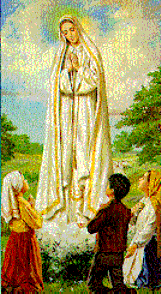 The Messages of Fatima are well known (despite the verbal engineering by the conciliar con men to alter our Lady's words and warning), but few realize that late in the 16th century in the throes of the aftermath of the devastating Protestant revolt in Europe, the Mother of God was putting a bookend, if you will, on here appearances in the New World. Just as she appeared to Juan Diego in 1513 as Our Lady of Guadalupe, so also she appeared further south in Quito, Ecuador to a holy nun as Our Lady of Good Success. Her messages were more for these times than then and, true to the Blessed Virgin's words, they would not become well known or circulated until now. Thanks to Dr. Marian Therese Horvat's tireless research and literary excellence the importance of Our Lady of Good Success in our modern times is reaching more through her eye-opening accounts she has produced with her numerous books on it, the visionary Mother Mariana de Jesus Torres, and the faithful Franciscan priest who perpetuated her legacy Fr. Manuel Sousa Pereira. In case anyone is not familiar with these books, we provide her article she wrote for The Daily Catholic back in early 2002 before the second printing of Our Lady of Good Success: Prophecies for Our Times and release later that same year of Stories and Miracles of Our Lady of Good Success. She titled her article back then so appropiately,
The Secret of Success The Messages of Fatima are well known (despite the verbal engineering by the conciliar con men to alter our Lady's words and warning), but few realize that late in the 16th century in the throes of the aftermath of the devastating Protestant revolt in Europe, the Mother of God was putting a bookend, if you will, on here appearances in the New World. Just as she appeared to Juan Diego in 1513 as Our Lady of Guadalupe, so also she appeared further south in Quito, Ecuador to a holy nun as Our Lady of Good Success. Her messages were more for these times than then and, true to the Blessed Virgin's words, they would not become well known or circulated until now. Thanks to Dr. Marian Therese Horvat's tireless research and literary excellence the importance of Our Lady of Good Success in our modern times is reaching more through her eye-opening accounts she has produced with her numerous books on it, the visionary Mother Mariana de Jesus Torres, and the faithful Franciscan priest who perpetuated her legacy Fr. Manuel Sousa Pereira. In case anyone is not familiar with these books, we provide her article she wrote for The Daily Catholic back in early 2002 before the second printing of Our Lady of Good Success: Prophecies for Our Times and release later that same year of Stories and Miracles of Our Lady of Good Success. She titled her article back then so appropiately,
The Secret of Success
  Even before Vatican II convened, the con was on in selling out the Church and betraying millions and millions of souls behind the Iron Curtain; a curtain whose dark exegis has been expanded far beyond what even Marx could have hoped for just as our Lady foretold at Fatima.
 Just as we brought you the first article ever published on these pages by Dr. Thomas A. Droleskey last week, so also today we republish the very first article submitted by the noted Traditional Catholic author and polemicist Atila Sinke Guimarães back in the Fall of 2001. He was one of the first to expose the devastation of the repercussions of the nefarious Pact of Metz, conducted secretly just before the opening of the Second Vatican Council in 1962. John XXIII was willing to sell his soul to have the Russian Orthodox church represented at the council. What price pride? Atila explored why even to this day the conciliar church has continued to be so silent regarding this devastating formal appeasement that went against all that was Catholic, against all predecessors of the See of Peter, against God Himself in giving credence to the atheistic creed of communism. This article was written after the release of his excellent book The Murky Waters of Vatican II. Since then he and Dr. Marian Therese Horvat have gone on to publish several more books and established a solid website for their ministry Tradition in Action which can be accessed each day in the upper right hand corner of this page. Atila delves into the deviousness of the progressivist program of the counterfeit church in his piece, The Pact of Metz Just as we brought you the first article ever published on these pages by Dr. Thomas A. Droleskey last week, so also today we republish the very first article submitted by the noted Traditional Catholic author and polemicist Atila Sinke Guimarães back in the Fall of 2001. He was one of the first to expose the devastation of the repercussions of the nefarious Pact of Metz, conducted secretly just before the opening of the Second Vatican Council in 1962. John XXIII was willing to sell his soul to have the Russian Orthodox church represented at the council. What price pride? Atila explored why even to this day the conciliar church has continued to be so silent regarding this devastating formal appeasement that went against all that was Catholic, against all predecessors of the See of Peter, against God Himself in giving credence to the atheistic creed of communism. This article was written after the release of his excellent book The Murky Waters of Vatican II. Since then he and Dr. Marian Therese Horvat have gone on to publish several more books and established a solid website for their ministry Tradition in Action which can be accessed each day in the upper right hand corner of this page. Atila delves into the deviousness of the progressivist program of the counterfeit church in his piece, The Pact of Metz
 A true priest as an alter Christus, in the manner of Melchisedech, offers to God "a holy sacrifice, a spotless victim - sanctum sacrificium, immaculatam hostiam." It is the essence of the priesthood, the essence of being a father to his flock.
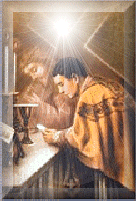 Father James F. Wathen, the pioneering traditional author of The Great Sacrilege, worked tirelessly for perpetuating the one holy Faith, continuing his mission as a priest until God finally called him home on November 7, 2006. He left behind many treasures of the Faith, in particular several articles or letters, if you will, to his flocks. One such we bring you today is the august privilege of being a priest, of being called "Father." Thus, on this Father's Day we take time to honor all our dedicated traditional priests and provide what Father James shared on why he became a priest and why being a priest was so precious to him even when he was undergoing his own Calvary. It is an encouraging short piece that will hopefully perk vocations in young men to follow in his footsteps for we desperately need good and holy Traditional priests as you'll see in A Priest Forever Father James F. Wathen, the pioneering traditional author of The Great Sacrilege, worked tirelessly for perpetuating the one holy Faith, continuing his mission as a priest until God finally called him home on November 7, 2006. He left behind many treasures of the Faith, in particular several articles or letters, if you will, to his flocks. One such we bring you today is the august privilege of being a priest, of being called "Father." Thus, on this Father's Day we take time to honor all our dedicated traditional priests and provide what Father James shared on why he became a priest and why being a priest was so precious to him even when he was undergoing his own Calvary. It is an encouraging short piece that will hopefully perk vocations in young men to follow in his footsteps for we desperately need good and holy Traditional priests as you'll see in A Priest Forever
 Without Reconciliation with God and our fellow man we could Raca n' Roll right into hell.
To enhance each Sunday's Epistle and Gospel we present this special feature provided by John Gregory with the Haydock Commentary found at the bottom of each page of the Douay-Rheims Bible. We publish it here in conjunction with the Epistle and Gospel for the Sunday Mass, with the cogent comprehensive Catholic Commentary penned by Father George Leo Haydock. For the Fifth Sunday after Pentecost the theme is that if one is reconcilied with his fellow man then he will always be reconciled with God for he will remain in the state of grace,which is necessary for participating in the sacramental fullness of the Holy Sacrifice of the Mass. If we do not comply with our Lord's commands, the consequences are catastrophic as we see in Fr. Haydock's cogent comments for the Fifth Sunday after Pentecost Haydock Commentary
  A Tribute to the editor's father on this Father's Day when we honor all family patriarchs living and dead
 On this day we honor our Father Who gave us life, the fathers who gave us spiritual life through the grace of the sacraments in wiping away sin, both original and mortal, and the fathers who reared us and molded us in the Faith of our fathers, the editor asks your indulgence in republishing the tribute he wrote one year and and a few weeks ago in honoring the man who raised him as cradle Catholic and laid the foundations for his son to perpetuate the holy faith his dad converted to before marrying his mother back in that eventful year 1939 when World War loomed on the horizon. It was during the last year of Lowell Cain's life that his oldest son helped him rediscover the faith he remembered before Vatican II. Michael Cain shares his heartfelt tribute on this day we salute fathers everywhere with "Come, ye, blessed of My Father" On this day we honor our Father Who gave us life, the fathers who gave us spiritual life through the grace of the sacraments in wiping away sin, both original and mortal, and the fathers who reared us and molded us in the Faith of our fathers, the editor asks your indulgence in republishing the tribute he wrote one year and and a few weeks ago in honoring the man who raised him as cradle Catholic and laid the foundations for his son to perpetuate the holy faith his dad converted to before marrying his mother back in that eventful year 1939 when World War loomed on the horizon. It was during the last year of Lowell Cain's life that his oldest son helped him rediscover the faith he remembered before Vatican II. Michael Cain shares his heartfelt tribute on this day we salute fathers everywhere with "Come, ye, blessed of My Father"
Because the Modernist jihad of Vatican II was so stealth, few saw it coming, even fewer see it now. It paved the way for another jihad. Yet 9-11 was not nearly as devastating as 10-11 for the latter has killed bodies, but the former has taken its toll in souls.
 In the many editorials by Michael Cain over the years, the one chosen for this issue dates back over six years. Ever since September 11, 2001 it's been all about security; the loss of security, if you will and it has continued, not only in America but in conciliar-secular circles the world over. It's really nothing new as Cain first wrote back on the first anniversary of 9-11. The only security is in total fidelity to Christ and His One, Holy, Catholic and Apostolic Church. The rest is false security for he asks how secure have souls been for the past forty years? He lays out the conspiracy perpetrated by the Revolution within the Church in the 20th Century, the greatest, most devestating in the history of mankind and the sad fact that most Catholics are playing right into the hands of the Modernists in the 21st Century. During all this time right up to the present today in 2008 while attention was been diverted by the tragedy of 9-11, Catholics the world over have failed miserably to see, due to the smoke and mirrors erected so cleverly, the far, far worse holocaust - the Bargain of Baal - that has claimed millions, yea, billions of souls over the last four decades. He explains in his editorial from late summer of 2002, Well Before 9-11, There Was 10-11! In the many editorials by Michael Cain over the years, the one chosen for this issue dates back over six years. Ever since September 11, 2001 it's been all about security; the loss of security, if you will and it has continued, not only in America but in conciliar-secular circles the world over. It's really nothing new as Cain first wrote back on the first anniversary of 9-11. The only security is in total fidelity to Christ and His One, Holy, Catholic and Apostolic Church. The rest is false security for he asks how secure have souls been for the past forty years? He lays out the conspiracy perpetrated by the Revolution within the Church in the 20th Century, the greatest, most devestating in the history of mankind and the sad fact that most Catholics are playing right into the hands of the Modernists in the 21st Century. During all this time right up to the present today in 2008 while attention was been diverted by the tragedy of 9-11, Catholics the world over have failed miserably to see, due to the smoke and mirrors erected so cleverly, the far, far worse holocaust - the Bargain of Baal - that has claimed millions, yea, billions of souls over the last four decades. He explains in his editorial from late summer of 2002, Well Before 9-11, There Was 10-11!
Nearly 1,700 years ago St. Basil the Great defined the condition of the counterfeit church of conciliarism today: "You have the Bishops against you. That proves that they are all against the Church."
 Today's Doctor of the Church is another of the magnificent luminaries God rose up in the 4th century. The holy bishop and Doctor of the Church Saint Basil the Great also faced the intense persecutions and calumnies of the Arian bishops and suffered greatly, never complaining and living a life of austerity while his fellow Arian bishops lived high on the hog. Like his good life-long friend and fellow Doctor of the Church St. Gregory Nazianzen, he,too, came from holy stock and had two brothers who became bishops; a father, mother and sister who became saints. This Bishop of Caesarea is one of the few, along with Popes St. Leo I and St. Gregory I and St. Albert to be given the august title "Magnus" - great. For a profile of this holy Bishop and Doctor, see Orator of Orthodoxy
  On this feast of the Church's holy "Hammer of Heretics" Saint Anthony of Padua, we illustrate how the world's most prolific true Catholic writer has been hammering modern heretics for many years.
 Today we present the very first article Dr. Thomas A. Droleskey filed with The Daily Catholic way back in March 2001 when both Tom and this editor were still trapped in our own ignorance to the satanic wiles of the counterfeit church of conciliarism. Since that time God has shed many graces upon us and Tom, primarily the grace of understanding the situation in the Church today. Since those days Tom has gone on to become the most prolifi Catholic writer in the world through his well-documented journey to the fullness of the Faith. It began back at the beginning of this millenninum and he identifies many of the same culprits who today continue to run amok unchecked by corrupt regimes at the highest echelons in both congressional and conciliar circles. Silence is supposed to be golden, but in his very first piece on The Daily Catholic he showed that by silent consent of sin Blood Money Talks Today we present the very first article Dr. Thomas A. Droleskey filed with The Daily Catholic way back in March 2001 when both Tom and this editor were still trapped in our own ignorance to the satanic wiles of the counterfeit church of conciliarism. Since that time God has shed many graces upon us and Tom, primarily the grace of understanding the situation in the Church today. Since those days Tom has gone on to become the most prolifi Catholic writer in the world through his well-documented journey to the fullness of the Faith. It began back at the beginning of this millenninum and he identifies many of the same culprits who today continue to run amok unchecked by corrupt regimes at the highest echelons in both congressional and conciliar circles. Silence is supposed to be golden, but in his very first piece on The Daily Catholic he showed that by silent consent of sin Blood Money Talks
One of the most beloved saints in the entire Church Triumphant, many consider him a gentle saint as he is so often depicted in his love for the Christ Child. Because of his love for Jesus and His Church, St. Anthony was anything but gentle on those who sought to deceive the faithful through heresy.
  Today is the Double Feast of the holy Franciscan and Doctor of the Church Saint Anthony of Padua who died on this date in 1231 at the early age of 36. Upon his death church bells rang throughout Italy, in many with no human person ringing the bells. People attributed the bellringers to the angels who had come to earth to ring them as children wailed in the streets crying aloud, "Our dear father, Anthony is dead." But his spirit and on-going miraculous wonders have lived on for nearly eight centuries. He is the patron saint of the poor and oppressed and the one to whom so many pray to when something or someone is lost. He so wanted to convert the Moors and was willing to be martyred. Where are the St. Anthonys today when the infidels are overrunning Christianity? For more on St. Anthony, see Hammer of Heretics
  The conciliar church is the naked church. There are millions of stories of those who cling to a new institution which cannot see that their emperor is not wearing any clothes. This is just one of those stories of one who had the courage to go against the grain, to upset the apple cart, and cry out to the blind-obedience robots of the Novus Ordo Village what is so obvious: You're going the wrong way!
 John Gregory files an account of his own personal journey to Truth. He hopes that by sharing the obstacles and questions he faced, others will have the courage to get up out of their rut and challenge those who cannot give honest answers. As long as those in the conciliar church continue to be mindless robots blindly obeying whatever they're told, they will not realize they are being greatly deceived and their own salvation in peril. The path John took parallels many others who have discovered what was wrong and got off their duffs because they valued the welfare of their souls. It is a difficult journey, a lonely one, and one that leads inevitably back to the catacombs where the Truths and Traditions remain the same for the truth can never be altered and never has been or will be at the Altars where the True Latin Mass is said. John presents his candid account of The Journey to Truth John Gregory files an account of his own personal journey to Truth. He hopes that by sharing the obstacles and questions he faced, others will have the courage to get up out of their rut and challenge those who cannot give honest answers. As long as those in the conciliar church continue to be mindless robots blindly obeying whatever they're told, they will not realize they are being greatly deceived and their own salvation in peril. The path John took parallels many others who have discovered what was wrong and got off their duffs because they valued the welfare of their souls. It is a difficult journey, a lonely one, and one that leads inevitably back to the catacombs where the Truths and Traditions remain the same for the truth can never be altered and never has been or will be at the Altars where the True Latin Mass is said. John presents his candid account of The Journey to Truth
 The Roman historian Tertullian said, 'From the Blood of the Martyrs come the seeds of Christianity' and indeed martyrdom has become a lost art thanks to the homogonized compromise consciousness of the conciliar church. If only more realized that from the loving lactose of martydom come unending, pure graces flowing like milk and honey over souls. Need we say more? Got Milk?
 We hear a lot about martyrdom which doesn't seem to phase the Modernists today. To the conciliar church it is not about suffering for souls, but rather establishing "peace and justice" in a temporal world that will end. Thus we present Gabriel Garnica's excellent piece first presented in early November of 2005 on martyrdom. In it he outlined the three truths of martyrdom. There are close to 2000 canonized saints and yet the holy martyrs who gave their lives for Christ in the first three centuries number close to 11 million or more. Those martyred for the Faith went straight to Heaven to join the Church Triumphant. They are an inspiration to every Catholic and Gabriel pointed out that we should pay attention because with the situation the way it is today, it could very well not be if we might suffer martyrdom for the Faith, but when and how. Traditional Catholics are well aware of the Dry Martyrdom they undergo in keeping the Faith in the face of abuse, slander and other kinds of mental and even physical persecution. In his artile, Gabriel lists the various kinds of martyrdom and if we are not willing to carry our cross all the way to Calvary, we cannot be His disciples. Gabriel explained in his column The Milk of Martyrdom We hear a lot about martyrdom which doesn't seem to phase the Modernists today. To the conciliar church it is not about suffering for souls, but rather establishing "peace and justice" in a temporal world that will end. Thus we present Gabriel Garnica's excellent piece first presented in early November of 2005 on martyrdom. In it he outlined the three truths of martyrdom. There are close to 2000 canonized saints and yet the holy martyrs who gave their lives for Christ in the first three centuries number close to 11 million or more. Those martyred for the Faith went straight to Heaven to join the Church Triumphant. They are an inspiration to every Catholic and Gabriel pointed out that we should pay attention because with the situation the way it is today, it could very well not be if we might suffer martyrdom for the Faith, but when and how. Traditional Catholics are well aware of the Dry Martyrdom they undergo in keeping the Faith in the face of abuse, slander and other kinds of mental and even physical persecution. In his artile, Gabriel lists the various kinds of martyrdom and if we are not willing to carry our cross all the way to Calvary, we cannot be His disciples. Gabriel explained in his column The Milk of Martyrdom
  Has anyone ever realized why Mary has been seen weeping by visionaries? Could it be because they have strayed so far from her divine Son? Could it also be that she cries because so many souls are heading to perdition?
 On the feast of Our Lady of the Miraculous Medal, Cyndi Cain reaches ahead sixteen years to 1846 to share the significance of the apparition of Our Lady of LaSalette. The Blessed Mother's Church-approved message has been, for the most part, hidden and dismissed by operatives of the counterfeit church of conciliarism. Cyndi points out how, from early in the 19th Century, Heaven provided all the help necessary to stave off the Great Apostasy and still we didn't listen. From the Miraculous Medal to our Lady's copious tears to the Sun spinning it would seem man has been deaf and dumb to all Heaven has warned. Now we face exactly what our laxity has asked for: Rome has lost the faith and become the seat of the antichrist. Will we continue in the perilous path or turn back to God before it is too late? Have we not learned from the mistakes of the Jews of the Old Testament, even when we have the powerful aid of God's Own Mother to guide us? Our Lady of Perpetual Help is perpetually trying to help. The problem lies with those she's seeking to protect and warn. Cyndi shares why, at LaSalette, Our Lady Wept for a Reason On the feast of Our Lady of the Miraculous Medal, Cyndi Cain reaches ahead sixteen years to 1846 to share the significance of the apparition of Our Lady of LaSalette. The Blessed Mother's Church-approved message has been, for the most part, hidden and dismissed by operatives of the counterfeit church of conciliarism. Cyndi points out how, from early in the 19th Century, Heaven provided all the help necessary to stave off the Great Apostasy and still we didn't listen. From the Miraculous Medal to our Lady's copious tears to the Sun spinning it would seem man has been deaf and dumb to all Heaven has warned. Now we face exactly what our laxity has asked for: Rome has lost the faith and become the seat of the antichrist. Will we continue in the perilous path or turn back to God before it is too late? Have we not learned from the mistakes of the Jews of the Old Testament, even when we have the powerful aid of God's Own Mother to guide us? Our Lady of Perpetual Help is perpetually trying to help. The problem lies with those she's seeking to protect and warn. Cyndi shares why, at LaSalette, Our Lady Wept for a Reason
 Though a blur to most, and snuck in so seditiously and secretly at Vatican II by none other than Fr. Joseph Ratzinger, what subsisted in Lumen Gentium caused the spark of aggiornamento and ecumenism that has raged into a holocaust of souls, responsible for the scorched faith of billions for well over four decades.
  Because of its vital importance, we bring you this benchmark masterpiece by Griff Ruby so that you may revisit again or read for the first time all he has presented. To so many this piece presents one of the greatest arguments to expose the very point of how, when, what, where, who and especially why modern Rome broke away from Eternal Rome. We have compiled his six-part installments into one compendium that ran as one back in September 2005 so you can see all the components and nuances and undeniable facts that prove Griff's point. The title itself best describes the subterfuge as Griff takes us past the spin right through the skin to the bare bones and then fleshes out what really happened in 1964. Griff lays it all out in his series we've entitled for this issue Down the Yellow Brick Road to Apostasy: The Lumen Gentium Syndrome Because of its vital importance, we bring you this benchmark masterpiece by Griff Ruby so that you may revisit again or read for the first time all he has presented. To so many this piece presents one of the greatest arguments to expose the very point of how, when, what, where, who and especially why modern Rome broke away from Eternal Rome. We have compiled his six-part installments into one compendium that ran as one back in September 2005 so you can see all the components and nuances and undeniable facts that prove Griff's point. The title itself best describes the subterfuge as Griff takes us past the spin right through the skin to the bare bones and then fleshes out what really happened in 1964. Griff lays it all out in his series we've entitled for this issue Down the Yellow Brick Road to Apostasy: The Lumen Gentium Syndrome
  A true fisher of men would never weaken his net by weaving it with anything but the strong hemp of grace and virtue and the uncompromising fiber of the Truths and Traditions of Holy Mother Church. Dialogue and Compromise weaken the strands of faith and unravel in the face of turbulence, causing countless souls to become prey to the infernal predators of the deep.
 In Father Louis Campbell's sermon for the Fourth Sunday After Pentecost, he speaks of today's Gospel and points to the very difference between those 'caught in Peter's net' - those souls who have been landed for Christ by true 'fishers of men' - and those who refuse to listen to the Word of God and swim in their own current of thought where they create torrents of agitation and upset the schools of men, mucking up the waters so much that the True Barque of Peter, sailing the waters of the world and trolling the inviting 'net of salvation' for all to see the infallible truths of the perennial Magisterium of the Church, has been attacked by the barnacles of false doctrine on the surface while beneath the sharks of compromise and dialogue have gnawed away at the webbing of the net, causing more souls to be loosened from the salvific netting and doomed to the denizens of the deep - bait for lucifer and his legions. Father points out how one who should be scoping the waters to make sure the predators are kept at a safe distance, has instead allowed the prey to weaken the hull and sabotage the nets through the obvious contradictions of conciliar 'popes' and now Benedict XVI's own heresy, which is obvious in light of what the Sacred Scriptures and St. Ambrose teach that those who do not recognize Christ as the Admiral of the true ship are shipwrecked on the sands of dissolution. This refers especially to the Jews who long ago abandoned ship. Now, according to the conciliarists, it is time to compromise Christ and His teachings for the sake of not offending the sensibilities of man. This is outright mutiny and Christ teaches us to wipe the dust from our sandals and leave them to the fishes. Our Lord has also acknowledged that 'many are called, few chosen.' Those who are chosen and remain loyal are those who, through grace and as Jesus Christ intended, have been
Caught in Peter's Net In Father Louis Campbell's sermon for the Fourth Sunday After Pentecost, he speaks of today's Gospel and points to the very difference between those 'caught in Peter's net' - those souls who have been landed for Christ by true 'fishers of men' - and those who refuse to listen to the Word of God and swim in their own current of thought where they create torrents of agitation and upset the schools of men, mucking up the waters so much that the True Barque of Peter, sailing the waters of the world and trolling the inviting 'net of salvation' for all to see the infallible truths of the perennial Magisterium of the Church, has been attacked by the barnacles of false doctrine on the surface while beneath the sharks of compromise and dialogue have gnawed away at the webbing of the net, causing more souls to be loosened from the salvific netting and doomed to the denizens of the deep - bait for lucifer and his legions. Father points out how one who should be scoping the waters to make sure the predators are kept at a safe distance, has instead allowed the prey to weaken the hull and sabotage the nets through the obvious contradictions of conciliar 'popes' and now Benedict XVI's own heresy, which is obvious in light of what the Sacred Scriptures and St. Ambrose teach that those who do not recognize Christ as the Admiral of the true ship are shipwrecked on the sands of dissolution. This refers especially to the Jews who long ago abandoned ship. Now, according to the conciliarists, it is time to compromise Christ and His teachings for the sake of not offending the sensibilities of man. This is outright mutiny and Christ teaches us to wipe the dust from our sandals and leave them to the fishes. Our Lord has also acknowledged that 'many are called, few chosen.' Those who are chosen and remain loyal are those who, through grace and as Jesus Christ intended, have been
Caught in Peter's Net
 A Fishing Expedition for the Ages...All Ages for All Ages
To enhance each Sunday's Epistle and Gospel we present this special feature provided by John Gregory with the Haydock Commentary found at the bottom of each page of the Douay-Rheims Bible. We publish it here in conjunction with the Epistle and Gospel for the Sunday Mass, with the cogent comprehensive Catholic Commentary penned by Father George Leo Haydock. Today for the Fourth Sunday after Pentecost, the theme is those creatures swimming in the sea of fallen human nature in this world and who can only be rescued through the grace of God via those He has sent to reel in souls as fishers of men. St. Peter is the chief fishermen and, despite his temerity, our Lord knew the mettle of the man He tabbed to head His Church on earth and had no compuntion in commanding His disciples to "launch out into the deep" for souls, not fish as we see in Fr. Haydock's cogent comments for the Fourth Sunday after Pentecost Haydock Commentary
Tempest in a Teampot: Mama mia, Italian conciliarists much more clever and cunning in concealing sodomite pedophilia and the conciliar Modernist Vatican is well aware of the cover up.
 Atila Sinke Guimarães delves beneath the rhetoric to reveal the facts that the conciliar hierarchy in Italy is a tempest of tenacity and terror in harming souls as bad as America's sorry lot of potentates posing as bishops, albeit even posturing that they are 'Catholic.' We know from Catholic truth that they cannot possibly be by their actions and our Lord's stern remander in St. Luke 17: 2. He shows that it's not just an 'American problem' but a conciliar-wide problem in concert with the bad tree Christ refers to in St. Matthew 7: 15-20 The difference, as Atila points out in his most recent piece on TIA, is the fact that the Italian press and civic authorities can be bought off and do not possess the tenacity of the voracious media in the U.S. Nevertheless, the same criminal acts continue to be committed, raping innocent bodies and souls of their innocence. Woe be unto those who have allowed it from BeneRatz down. Atila lays out the evidence and devastation in his article Priestly Pedophilia Concealed in Italy Atila Sinke Guimarães delves beneath the rhetoric to reveal the facts that the conciliar hierarchy in Italy is a tempest of tenacity and terror in harming souls as bad as America's sorry lot of potentates posing as bishops, albeit even posturing that they are 'Catholic.' We know from Catholic truth that they cannot possibly be by their actions and our Lord's stern remander in St. Luke 17: 2. He shows that it's not just an 'American problem' but a conciliar-wide problem in concert with the bad tree Christ refers to in St. Matthew 7: 15-20 The difference, as Atila points out in his most recent piece on TIA, is the fact that the Italian press and civic authorities can be bought off and do not possess the tenacity of the voracious media in the U.S. Nevertheless, the same criminal acts continue to be committed, raping innocent bodies and souls of their innocence. Woe be unto those who have allowed it from BeneRatz down. Atila lays out the evidence and devastation in his article Priestly Pedophilia Concealed in Italy
The Assault on Catholic Tradition continues unabated as the conciliar ecumaniacs bend over backward to placate and justify the sins of Christ's enemies, planting their poison in the malleable youth purposely for a world media event that will give concession to the world, the flesh, and the devil. It will not be the "Way of the Cross" but rather the "Way of the Crossed"...which, in fact will be for those who buy into the watered-down pabulum the "Way of the Cursed"!?! 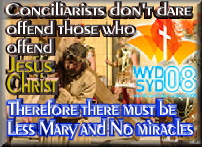 Dr. Marian Therese Horvat has filed more evidence that nothing is sacred to conciliarists as those fully in charge condone the total deCatholicization of the meaning of the Stations of the Cross with the new Oceania13 stations that will be unveiled in August. As Marian documents this action is not Catholic and causes great scandal. In the ecumaniacal bent BeneRatz continues on there is no consideration for offending Christ and His holy Mother Mary. Instead the Blessed Mother is de-emphasized with omission of the moving meditative 4th station and the 13th, a station that inspired quite possibly the most magnificent masterpiece in marble - Michelangelo's Pieta. How exactly now will the Modernists explain that statue residing in St. Peter's? "Oh, it didn't really happen that way,' they'll rationalize just as they've rationalized everything else in destroying the Faith and souls. Can't have anything that would indiate Catholics believe in importance of sacrifice and the signifiance of miracles. That's another reason the station where Veronia wipes the face of Jesus has been eliminated. What needs to be countermanded is the whole conciliar catastrophe that has produced no good fruit because it is a bad tree governed by men who are against Christ and cause so much scandal. Sadly there aren't enough mill-stones to go around. See Marian's article, Stations of the Cross Changed for WYD-2008 Dr. Marian Therese Horvat has filed more evidence that nothing is sacred to conciliarists as those fully in charge condone the total deCatholicization of the meaning of the Stations of the Cross with the new Oceania13 stations that will be unveiled in August. As Marian documents this action is not Catholic and causes great scandal. In the ecumaniacal bent BeneRatz continues on there is no consideration for offending Christ and His holy Mother Mary. Instead the Blessed Mother is de-emphasized with omission of the moving meditative 4th station and the 13th, a station that inspired quite possibly the most magnificent masterpiece in marble - Michelangelo's Pieta. How exactly now will the Modernists explain that statue residing in St. Peter's? "Oh, it didn't really happen that way,' they'll rationalize just as they've rationalized everything else in destroying the Faith and souls. Can't have anything that would indiate Catholics believe in importance of sacrifice and the signifiance of miracles. That's another reason the station where Veronia wipes the face of Jesus has been eliminated. What needs to be countermanded is the whole conciliar catastrophe that has produced no good fruit because it is a bad tree governed by men who are against Christ and cause so much scandal. Sadly there aren't enough mill-stones to go around. See Marian's article, Stations of the Cross Changed for WYD-2008
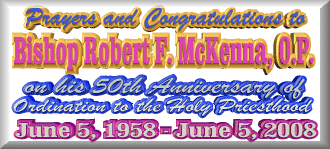 

While Palonium-210 is deadly, it can only kill the body. Just as our Lord warned, beware of he who can kill both the body and the soul. You might call the one that can kill the soul the most dangerous venom out there. It's a viral strain of the lethal toxin: Conciliarium-666 carried by the deadly contagion VaticanusSecundus contra Catholicos.
 We wanted to feature the latest article by Dr. Thomas A. Droleskey for it addresses the key problem today, the real crux of the issue that no one is willing to confront within conciliar circles. After all, what exactly can ever be good about poison? Absolutely nothing! Tom brings this home only too well in treating the causes and effects of mammon's revenge with the deadly dose of Polonoium-210 that eliminated a former KGB agent Colonel Alexander Litvenko, no doubt ordered by another former KGB head Vladimir Putin. Our Lady specifically zeroed in on Russia in 1917. Since then Russia's errors have run amok in the world and, as many are realizing, are so prevalent in the highest echelons of the conciliar church. Recall Roncalli's clandestine Pact of Metz just prior to the opening of Vatican II in 1962, which essentially sold out to the Soviet hammer and sickle and caused the martyrdom of Catholics behind the iron curtain, well over triple the number who died at Auschwitz. Then you had Cardinal Konig who sided with the Reds against Cardinal Mindzenty and betrayed so many Catholics in the Eastern Bloc. And, of course, who can forget that the seditious subterfuge continued with solid suspicions that Karol Wojtyla was a Communist Secret agent himself? Makes sense when you dissect his history and the devastation he wrought in perpetuating Vatican II's heretical reforms. Regardless, Tom re-emphasizes over and over a simple fact that St. Augustine brought home and Pope Leo XIII reminded all that with one drop of poison anyone can be infected and fall not only from grace, but fall into the abyss without full repentance. You'll note how many conciliarist hierarchs have repented over the last forty-plus years. Right. Practically nada. Typical behavior of one who, like Litvinenko, lived by deceit and died by deceit traits only two obvious in the two men at the top of the Kremlin and conciliar church today, respectively (not to be confused with respectfully). Tom ties it all in with his article No Cure for Polonium-210 We wanted to feature the latest article by Dr. Thomas A. Droleskey for it addresses the key problem today, the real crux of the issue that no one is willing to confront within conciliar circles. After all, what exactly can ever be good about poison? Absolutely nothing! Tom brings this home only too well in treating the causes and effects of mammon's revenge with the deadly dose of Polonoium-210 that eliminated a former KGB agent Colonel Alexander Litvenko, no doubt ordered by another former KGB head Vladimir Putin. Our Lady specifically zeroed in on Russia in 1917. Since then Russia's errors have run amok in the world and, as many are realizing, are so prevalent in the highest echelons of the conciliar church. Recall Roncalli's clandestine Pact of Metz just prior to the opening of Vatican II in 1962, which essentially sold out to the Soviet hammer and sickle and caused the martyrdom of Catholics behind the iron curtain, well over triple the number who died at Auschwitz. Then you had Cardinal Konig who sided with the Reds against Cardinal Mindzenty and betrayed so many Catholics in the Eastern Bloc. And, of course, who can forget that the seditious subterfuge continued with solid suspicions that Karol Wojtyla was a Communist Secret agent himself? Makes sense when you dissect his history and the devastation he wrought in perpetuating Vatican II's heretical reforms. Regardless, Tom re-emphasizes over and over a simple fact that St. Augustine brought home and Pope Leo XIII reminded all that with one drop of poison anyone can be infected and fall not only from grace, but fall into the abyss without full repentance. You'll note how many conciliarist hierarchs have repented over the last forty-plus years. Right. Practically nada. Typical behavior of one who, like Litvinenko, lived by deceit and died by deceit traits only two obvious in the two men at the top of the Kremlin and conciliar church today, respectively (not to be confused with respectfully). Tom ties it all in with his article No Cure for Polonium-210
The storm warnings are everywhere. It's time to batten the hatches, strap in and ride the rough waves ahead as the winds of change - read apostasy, tolerance, perversion and outright rebellion against Christ and His holy Church - whip against the soul of man. If you are not anchored in the truths and traditions passed down, you will be capsized and engulfed in the volatile vortex leading to the infernal abyss. Don't say you weren't warned.
 To make a tree grow straight and tall, it needs a lot of wind. Well, you asked for it because we're in for a storm to end all storms. You know the signs, the very ones Christ identified in St. Matthew 24. Are you ready? Let's hope and pray your roots are firmly planted on firm foundation, deeply embedded in the rocksolid truths and traditions of holy Mother Church. The operation of error engulfs more every day, satan has satiated consciences. The lukewarm continue to languish in ever greater numbers, seemingly oblivious to what is so obvious on the near horizon. It's coming faster than you may think as events, not to mention consequences, spiral out of control, knocking common sense, decency and goodness off its proverbial axis. That wobble you've felt from Rome to Beijing to Washington D.C. to San Francisco to Sydney and all points in between, should shake you into hying yourself to the nearest traditional priest to cleanse your soul and light your lamp before the Bridegroom cometh and all else is plunged into darkness. The times we are in and the even more ominous period we are entering are not to be taken lightly. Editor Michael Cain identifies the more obvious signs in his commentary
Preparing for the Perfect Storm To make a tree grow straight and tall, it needs a lot of wind. Well, you asked for it because we're in for a storm to end all storms. You know the signs, the very ones Christ identified in St. Matthew 24. Are you ready? Let's hope and pray your roots are firmly planted on firm foundation, deeply embedded in the rocksolid truths and traditions of holy Mother Church. The operation of error engulfs more every day, satan has satiated consciences. The lukewarm continue to languish in ever greater numbers, seemingly oblivious to what is so obvious on the near horizon. It's coming faster than you may think as events, not to mention consequences, spiral out of control, knocking common sense, decency and goodness off its proverbial axis. That wobble you've felt from Rome to Beijing to Washington D.C. to San Francisco to Sydney and all points in between, should shake you into hying yourself to the nearest traditional priest to cleanse your soul and light your lamp before the Bridegroom cometh and all else is plunged into darkness. The times we are in and the even more ominous period we are entering are not to be taken lightly. Editor Michael Cain identifies the more obvious signs in his commentary
Preparing for the Perfect Storm

To enhance today's Epistle and Gospel we present this special feature provided by John Gregory with the Haydock Commentary found at the bottom of each page of the Douay-Rheims Bible. We publish it here in conjunction with the Epistle and Gospel for the Sunday Mass, with the cogent comprehensive Catholic Commentary penned by Father George Leo Haydock. Today for the Third Sunday after Pentecost, we encounter one of the most oft quoted passages of Sacred Scripture, the eighth verse of chapter five of the first epistle of St. Peter whereby Christ's chosen first Pope employs the imagery of the devil being like a roaring lion always on the prowl to devour souls. That is why it ties in so well with today's Gospel of the rejoicing of one sinner returning to the fold. With satan roaming it truly is a victory worth celebrating when a soul is saved from this savage unearthly beast. Third Sunday after Pentecost Haydock Commentary
 Yep, we've corralled the problems with the computer. Despite all the refurbishments, labor hours and costs put into it by the technicians, they finally informed us there is only so much that can be done with the Windows 98 configuration in these times when the horses have been let out of the barn, so to speak, and few software programs support the "maverick" Win98SE systems any more. Nevertheless, the old "mule" has served us well and we're not ready to put her out to pasture just yet, so we'll continue to plod along with old reliable as best we can. She's been washed, all systems groomed and defragged, pumped up with extra RAM added to her stable. So far in test runs out of the gate her gait is encouraging, no thanks to Bill Gates. It might take some time to get the bridle broken in and the reins back in form and much longer to sort through the thousands upon thousands of e-mails that clogged the roundup and delayed our progress. We also have to answer the hundreds of viable e-mails that are backlogged as a result of the delays. So please be patient, pardners, and enjoy daily publication once again as The Daily Catholic continues to focus on seriously herding souls for our Lord and our Lady and holy Mother Church.Michael Cain, editor
|
|
|