|
Events that happened Today in Church History
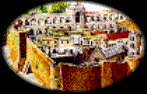   Today is the 800th anniversary of the death of Saint Hugh of Lincoln in the year 1200 in London, England. Long before Abraham Lincoln came along there was another who exhibited the same character, the same principles and the same virtues of upholding the rights of a people greatly persecuted. That was St. Hugh of Lincoln who was not only the abbot of the first Carthusian abbey in England, but also the Bishop of the Diocese of Lincoln during a time of great political upheaval during the era of the Plantagenet kings. This was a time when intrigue and prejudices were running amok. There was great persecution against the Jews living in the British Isles and it was St. Hugh who came to their defense in much the same manner Pope Pius XII helped the Jews in clandestinely providing all he could in shelter, visas, and other influences without the Third Reich's knowledge. For him to have spoken out strongly would have imperiled the Vatican to the point where Pius and the Church would not have been able to do anything and put even more Jews and Catholics in danger. So also St. Hugh who passed away at the age of 80 greatly reverred by the Jewish people. In fact he died while at the Old Temple in London and the Jewish people mourned his passing. For other time capsule events that happened Today in Church history, see MILLENNIUM MILESTONES AND MEMORIES Today is the 800th anniversary of the death of Saint Hugh of Lincoln in the year 1200 in London, England. Long before Abraham Lincoln came along there was another who exhibited the same character, the same principles and the same virtues of upholding the rights of a people greatly persecuted. That was St. Hugh of Lincoln who was not only the abbot of the first Carthusian abbey in England, but also the Bishop of the Diocese of Lincoln during a time of great political upheaval during the era of the Plantagenet kings. This was a time when intrigue and prejudices were running amok. There was great persecution against the Jews living in the British Isles and it was St. Hugh who came to their defense in much the same manner Pope Pius XII helped the Jews in clandestinely providing all he could in shelter, visas, and other influences without the Third Reich's knowledge. For him to have spoken out strongly would have imperiled the Vatican to the point where Pius and the Church would not have been able to do anything and put even more Jews and Catholics in danger. So also St. Hugh who passed away at the age of 80 greatly reverred by the Jewish people. In fact he died while at the Old Temple in London and the Jewish people mourned his passing. For other time capsule events that happened Today in Church history, see MILLENNIUM MILESTONES AND MEMORIES
 The canvas of memories is filled by the brushstroke of our actions The canvas of memories is filled by the brushstroke of our actions
They say a picture is worth a thousand words, but the words of Bishop Fulton J. Sheen have been known to launch a thousand images in one's mind, one of the ways this late luminary did so much to evangelize the faith. Because of the urgency of the times and because few there are today who possess the wisdom, simplicity and insight than the late Archbishop who touched millions, we are bringing you daily gems from his writings. The good bishop makes it so simple that we have dubbed this daily series: "SIMPLY SHEEN".
"With some measure of pessimism, Shakespeare makes one of his characters say: 'The evil that men do lives after them, the good is oft interred with their bones" (Julius Caesar, Act III, Scene ii, Line 79). More hopeful was the poet who wrote: 'Full lasting is the song, though he the singer passes' (George Meredith, The Thrush in February, st. 17). Both, however, are in agreement on the importance of influence, either for evil or for good. Some can look back and fix the day when a good influence began and say with Dante: 'In that part of the book of my memory, before which is little that can be read, there is a rubric, saying 'The new life begins.'' " (La Vita Nuova, tr. by Dante Gabriel Rossetti). In the gallery of memory, some portrait is hanging to which one can acknowledge a debt of formation, or a fresh vision of life."
|