
 Second Vatican Council
Rather than re-open Vatican I, Pope John XXIII shocked the world and launched the slippery slope the Church has been on ever since when he announced on January 25, 1959 at St. Paul's Outside-the-Walls that he would convene the Second Vatican Council. After sending out the original schemas to every diocese in the world and wading through all the feedback that greatly diluted the original content, the Council opened on October 11, 1962. A dying John XXIII closed it on December 8, 1962 and, on his death bed, begged, "Stop the Council! Stop the Council!" But his successor Paul VI reopened it on September 29, 1963 - just three months after his election - and closed it on December 4, 1963. The third session was opened on September 14, 1964 and closed on November 21, 1964. The fourth and final session convened a year later on September 14, 1965 - where non-Catholics and women were given a greater say than ever in the history of the Church as the progressivists completed the hijacking of the largest, and, what will go down in history, as the most damaging Council in Church History. The Council closed on December 8th of the same year. For all these documents see Vatican II


 Pope John XXIII
Proclamations of post-Vatican II Popes
Though he was beatified last year on September 3rd in a balance of Traditionalist (Blessed Pio Nono) and Liberals, make no mistake Pope John XXIII was a liberal. He was also full of love, tremendous love for everyone and trusted too much. Elected on October 28, 1958 as an interim Pope because the Conclave was deadlocked and settled on this loveable Patriarch of Venice. He wrote eight encyclicals during his 4-year pontificate. His first "Ad Petri Cathedram" illustrates the love and his belief that all could live in harmony. Two of his more famous encyclical were "Mater et Magistra" and "Pacem in Terris". It was not until he lay on his deathbed, dying from lukemia that he realized how he had been used by the modernists, progressivists, communists and masons to undermine the one obstacle in their way: Holy Mother Church. Sadly, his successor did not heed his plea, "Stop the Council! Stop the Council!" He passed away on June 3, 1963 and the entire world mourned the 'good' Pope.
For his writings, see Blessed Pope John XXIII
 Pope Paul VI
Proclamations of post-Vatican II Popes
The jury is still out on Cardinal Giovanni Battista Montini who, though exiled by Pope Pius XII returned to Rome to be elected Roman Pontiff and, rather than following Pope John XXIII's cautions, plunged even deeper into the malaise that Vatican II became as factions greatly embittered all camps and those progressivists from the northern regions of Europe were allowed to run freely and rule liberally as the Rhine flowed into the Tiber. Paul's pontificate lasted 15 years and yet he wrote one less encyclical than his predecessor. He will forever be remembered for the one great encyclical that was so widely rejected "Humanae Vitae". It was ignored because the modernists had already gained a strong foothold after Vatican II in almost every chancery worldwide. With this infiltration in place the cancer began to grow even deeper as the devil recruited more to help him in deconstructing his greatest enemy on earth - Holy Mother Church. Paul died on August 6, 1978, admitting that satan was now in the sanctuary. For his Encyclicals, Apostolic Letters
Constitutions, and Exhortations see Pope Paul VI
 Pope John Paul I
Proclamations of post-Vatican II Popes
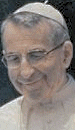
Albino Cardinal Luciani was elected the 263rd Sovereign Pontiff on August 26, 1978 on the third ballot on the first day of Conclave. He chose the name John Paul to continue the progressive, liberal policies of his two predecessors. He might have advanced his liberalism ever more considering his agenda that he espoused as Patriarch of Venice. His leanings were more marxist than masonic and that could have been what fell him in his attempts to expose the ecclesial Masons within the Vatican and break open the Vatican Bank scandal. Yet he died mysteriously after only 33 days as Pope with many strong indications, even proof that he was murdered by members of the P-2 (Propaganda Due) with help from the inside from Jean Cardinal Villot and Archbishop Paul Marcinkus. For his brief audiences and homilies during his 33-day tenure, see
see Pope John Paul I


 Pope John Paul II
Proclamations of post-Vatican II Popes
Now in the 23rd year of his pontificate, Pope John Paul II was elevated to the Papal Throne as the 264th successor of Peter on October 16, 1978 No Sovereign Pontiff has been more well known, has traveled to more countries as he has become the "Pilgrim Pope." It has been left to this Polish Pontiff to try to salvage Vatican II. He has tried to please all sides in calling for unity and peace. That is the greatest problem. If he is truly to be the Pope we so hope and pray he would be, then he can no longer compromise - especially in the ecumenical movement where he has betrayed so many faithful Catholics in an effort to please others. The Holy See today is a riddle for there are so many intent on destroying the Church from within and sadly seek to undermine the authority of the Primacy of Peter. Are these members of the hierarchy trying to paint the Pope into a corner so that he will lessen the temporal and spiritual powers of the Keeper of the Keys or is he willingly going along with it? Perhaps only history will know the full truth. At 81, we pray he has the strength to resist them. Now in the twilight years of an illustrious life, John Paul II will go down as one of the most prolific writers among the Popes. He has written volumes and volumes. We present a compilation of our Holy Father's many works, including his Encyclicals, Apostolic Letters
Constitutions, Exhortations, Angeleses, General Audiences and Homilies see Pope John Paul II

 The New Catechism
For those who have read the new Catechism of the Catholic Church cover to cover, please let us know if it is as clear and concise as the Baltimore Catechism. While it is definitely more thorough, many believe it is follows the same ambiguous path Vatican II has taken and this 'new' catechism is too much so for it discourages the common Catholic from reading more because it is written, so often, above everyone's heads - such a thorough job have these 'knowledgable theologians' done. Nevertheless, because it is an approved work by the conciliarChurch, we present this as a comparison to something that was perfectly fine before the periti decided to publish the following tome.
The Catechism of the Catholic Church

 Code of Canon Law
We present here the Code of Canon Law of 1983 developed and changed by John Paul II. Canon Law is the ecclesiastical rule for the Church in establishing the norms and standards for all to follow. We don't really expect all to use this link unless you are looking up something specific. But it will help you if you are interested in various canons. See
Code of Canon Law
For documents that support and comprise the Sacred Deposit of Faith in Divine Revelation, see SACRED DEPOSIT OF THE FAITH
|


