
|
WHAT YOU MIGHT HAVE MISSED:
Exspectans exspectavimus Ecclesia Dei  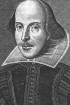
Tuesday, we presented a piece by Bishop Richard Williamson on the "Closet Catholicism" of William Shakespeare on the 438th anniversary of the birth of the Bard in 1564 and the 386th commemoration of his death in 1616, both at Stratford-on-the-Avon. This literary genius gave the world the God-given treasures of great literature for generations to come. Shakespeare was torn by the torment of the Reformation; his heart and soul were aligned with Rome while his life and political needs were tied to the Church of England and its rulers. This is evident as Bishop Williamson gave insight into the Catholicity of this greatest of English writers. In "Hamlet" he found a microcosm of what the great poet faced, what modern man faces today, and, in a sense, what faithful Catholics echo in the refrain of Richard III's words "O call back yesterday, bid time return" as the Bishop explained in Hamlet - Alien amidst apostates.
Traditional Thought 
On Tuesday we presented the second of an excellent three-part commentary by Michael Matt, editor of The Remnant, who has given us permission to bring this insightful piece to our readers. In it he dissected how what might look good on the surface, such as the "Campos Compromise," is, in effect, a web of deceit in which those who are willing to compromise could very well be engulfed by the insatiable Modernists who are bent on auto-demolition in their relentless effort to eradicate Traditional Catholicism and its Heavenly liturgies. He explained in part two of Vatican II: Weapon of Mass Destruction
White Smoke, Black Fire!
Tuesday we continued with the third episode of chapter seven in Part III - "The Shadowing" as Cardinal Macelli and Cardinal Vendhem plot the Legion of the Basilisk's next move within the hallowed halls of St. Peter's as Father Niki finds shelter in a flat on the other side of Rome, a plain hovel provided by Dr. Makuta Ogidi.
Defending Catholic Truth and Tradition  
Monday we continued with the third installment of a series by Atila Sinke Guimarães, with Dr. Marian Therese Horvat assisting in translation and editing an orthodox, traditional, true Roman Catholic response in seven installments to the flawed document "The Hebrew People..." by the Vatican's Pontifical Biblical Commission. It created quite a stir with a horror story in the New York Times in late January. Guess what? Those horror stories are true! Atila critiqued part one of the document, pointing out Imprecise Language and Suspicious Texts in the third installment of an essay that should truly alarm you regarding the Changes in Doctrine and New Anathemas
Catholic PewPOINT 
Monday editor Michael Cain borrowed from Shakespeare to illustrate how his tragic figure of Hamlet portends ill-winds ahead for those who do not act swiftly, do not come clean and purify their houses thoroughly for they are parties to the slaughter of all that is holy. He cited the meeting between the Pope and Cardinals this week as a crucial crossroads. There can be no delay, no compromises, no stay of sentences. The offenders and pretenders must go as he emphasized in his commentary O holy Mother Church, Thy honor they besmirch!
Doctors of the Church 
Monday's Doctor of the Church was another from the fourth century who encountered great rebellion and persecution from the Arian bishops. He was the first Doctor chronologically of what is today France, eldest Daughter of the Church. Born in 315 and died at the age of only 53, he was the Aquitaine Bishop - the Laborer for God - Saint Hilary of Poitiers.

|
|
|
|

|
Had we listened to the following, quite possibly the Sacred Deposit might not have been compromised so. Quite possibly our good priests would not have been so sullied by men who were not seeking holiness but a platform pulpit to spew their heresies.
"All these Popes before John XXIII have resisted the union of the Church with the Modernist Revolution. It is an adulterous union and from such a union only bastards can come. The rite of the new mass is a bastard rite, the sacraments are bastard sacraments. We no longer know if they are sacraments which give grace or do not give it. The priests coming out of the seminaries are bastard priests, who do not know what they are. They are unaware that they are made to go up to the altar, to offer the sacrifice of Our Lord Jesus Christ and to give Jesus Christ to souls."
Archbishop Marcel Lefebvre
An Open Letter to Confused Catholics, 1986, page 116

|
|
 Today in Church History

 Birth of Saint Vincent de Paul
 On this date 426 years ago in 1576 a young man was born in Gascony, France to a poor family. He would translate that poverty into helping countless others in the same straits after becoming a priest and then being captured by pirates on the Mediterranean and thrown into slavery in Tunisia where he converted the prison warden to Christianity. Freed, he returned to France and in 1625 founded the Vincentians. This man was, of course, Saint Vincent de Paul whose charitable works are legend and a man who, though born poor, died a man rich in graces beyond any worldly wealth on September 27, 1660. H was canonized by Pope Clement XII in 1737 and Pope Leo XIII proclaimed him patron of all charitable works. The dividends of his fruit live on today in the Society of St. Vincent de Paul, his Order and the fact his body remains incorrupt today.

In each issue we will feature a special prayer to enhance your Catholic devotions
  
Prayer for the Feast of Saint Fidelis of Sigmaringen
O God, Who didst vouchsafe to inflame the heart of blessed Fidelis with seraphic ardor and to adorn him with the palm of martyrdom and with glorious miracles in spreading the true Faith: we beseech Thee, by his merits and intercession, so to strengthen us by the might of Thy grace in faith and in charity, that we may deserve to be found faithful in Thy service even unto death. Through our Lord Jesus Christ, Thy Son, Who liveth and reigneth with Thee in the unity of the Holy Ghost, world without end. Amen.
From the Collect for today's Mass
For prayers posted thus far, see Devotions and Reflections

 LITURGY OF SAINTS
WEDNESDAY, April 24:
Feast of Saint Fidelis of Sigmaringen, Priest who was martyred in 1622. Historical feast of Saint Euphrasia Pelletier, Foundress of the Good Shepherd Sisters. She died in 1868.
THURSDAY, April 25:
Feast of Saint Mark, Evangelist. Patron Saint of Notaries. Also Traditionally it is the Feast of The Greater Litanies.
FRIDAY, April 26:
Traditional Feasts of Our Lady of Good Counsel and the Martyred Popes Saint Cletus in 88 and Saint Marcellinus in 304. Historical feast of Saint Alda (Aldobrandesca), Widow who died in 1309.
SATURDAY, April 27:
Feast of Saint Peter Canisius, Priest and Doctor of the Church who died in 1579. Historical feast of Saint Zita of Lucca, Virgin who died in 1278. She is the Patron Saint of Domestic Workers.
SUNDAY, April 28:
Fourth Sunday after Easter. In the new the feast of Saint Louis Marie de Montfort, Priest, Founder of the Montfort Fathers. He died in 1716. Traditional Feast of Saint Paul of the Cross, Priest who died in 1775.
For reflections on the Sunday Liturgy, see Fr. Cusick's reflections
|
 The Rosary of Mary is our most powerful weapon. Click on the Rosary button to recite the full Rosary in either English or Latin. The Rosary of Mary is our most powerful weapon. Click on the Rosary button to recite the full Rosary in either English or Latin.
|
|