
|
|
|
|
|

   To enhance each Sunday's Epistle and Gospel we present this special feature provided by John Gregory with the Haydock Commentary found at the bottom of each page of the Douay-Rheims Bible. We publish it here in conjunction with the Epistle and Gospel for the Sunday Mass, with the cogent comprehensive Catholic Commentary penned by Father George Leo Haydock. For the Thirteenth Sunday after Pentecost Father continues with the Samaritan, this time in respect to the ten lepers and the only one to return and give thanks for his healing by the miracle of Jesus Christ is a Samaritan. Christ exhibits surprise that this Samaritan is the only one left, but the Son of God knew and it was another manifestation that He had come for all, not just the Jews. He conveys this by assuring this man that the faith he had is what healed him, made him whole.
The Faith of the Samaritan for the Thirteenth Sunday after Pentecost
  
As noted above, we present the best of Mario Derksen's works this month to acquaint readers with the Catholicity of this young Traditional Catholic. On this 10th Commisseration of 9/11 we bring you an article he wrote in 2003 where Mario reflected on the devastation that has been visited upon the Church. Just as we are discovering more each day, 9-11 was not an isolated, spur of moment passionate terrorist act, so also it was no happenstance or inspiration from above that triggered the outbreak of Vatican II and a new religion. And since then the epidemic has spread from "Ground Zero," a virus affecting the soul that was engineered by the very "technicians" and "spiritual physicians" we should have been able to trust. Looking back over 50 years, we can clearly see the only antivirus to the venom of this new doctrine is to hold to the traditions handed down in doctrine and liturgy, and realize that Christ will triumph in the end just as His Mother's Immaculate Heart shall triumph and the Revolution defeated. Until then, realize that the revolutionists are in charge as Mario points out in Ground Zero.
Also see:
|
|
|
|


This feast of the Most Holy Name of Mary was originally instituted by Pope Innocent XI in memory of the great victory won over the Turks before the walls of Vienna (September 13, 1683), was fixed for this date under Pope St. Pius X. It was Pope Innocent XII who had ordered that it should be kept on the Sunday within the Octave of the Nativity of ...More
|
|
|

  Mario Derksen continued his seven part series on "Vatican II and the Gospel of Man" as he meticulously peeled off the skin-deep layers of rhetoric, exposing the tightening muscles of modernism that seek to squeeze the bones of doctrine. This prevents the living organs of Truth and Tradition from fully being able to function, thus allowing the cancer of humanism to penetrate the pores of the Mystical Body of Christ. Mario showed how the Pastoral Constitution Gaudium et spes took the smoke of satan and torched the Truths and Traditions upheld by previous pontiffs by diminishing man's dignity by elevating him to something he can never attain - divinity. Mario explained in part two of his column Towards the Deification of Man.
|
|
|
|

 The liturgy for the preceding Sunday - the Thirteenth Sunday After Pentecost - shows us that by faith we put all our hope in Jesus, for He is our Refuge and we ask for the virtue of charity, which renders us lovers of the divine law and practitioners of it. Let us pray for ...More
|
|
|

 
In continuing his seven-part series on "Vatican II and the Gospel of Man" first published in early 2002, Mario Derksen illustrated how the First Vatican Council assured there would be no novelty in Catholic doctrine. There wasn't any innovations until along came Vatican II and Paul VI who took it upon himself to tinker in areas previously considered sacrosanct from the time of Jesus Christ on. As we see today, the results allowed the infiltration of the enemy where Freemasonry to cast a giant, engulfing and suffocating shadow over the Council and beyond as Mario explained in part three of his column An Anthropocentric Church?
|
|
|
|

 In the Latin Roman Rite this feast is celebrated on September 14th each year to celebrate the Exaltation of the Holy Cross on which Jesus Christ, Our Lord and Savior, died. Historians record that the true cross was unearthed by the Empress Saint Helena, mother of the Emperor Constantine the Great in the year 326. With Constantine as emperor his mother had the funds and the visa so-to-speak to conduct an extensive expedition for the true cross for it was the sign of the cross in the sky that enabled her son to be victorious - "In hoc signo vinces." Though she was nearly 80 years old her mission was to uncover Christ's cross so that all the world could ...More
|
|
|
|
|
|


The Church commemorates by two Feasts the martyrdom suffered by Our Lady, one of two feasts devoted to this same devotion in union with the Passion of Her Divine Son Jesus and His Holy Cross. The First Feast, kept on Passion Friday before Palm Sunday especially commemorates "the Compassion of Mary;" while the second, kept today on September 15, the devotion to the Seven Sorrows. This feast commemorates the seven sorrows (Seven Dolors) of the Blessed Mother of God which are documented in ...More
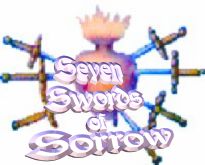 The VerbumQUO for the Feast of the Seven Dolors of the Blessed Virgin Mary is "Stabat Mater" meaning "The Mother stood" or "The Mother was standing" and is the well-known 13th century Gregorian Chant Hymn, taken from the Sequence Stabat Mater for the second of two feasts in the liturgical year for Our Lady of Sorrows; the September observance being the greater Double Feast of the Seven Sorrows with A Mother's Love that Knows No Bounds
|
|
|


This is the signature feast for the month of September dedicated to Our Sorrowful Mother. In Passion Week this feast precedes Holy Week and the Triumph of the Cross, but this month it is that triumph, the Exaltation of the Holy Cross which immediately precedes this Double of the Second Class Feast of the Seven Sorrows of the Blessed Virgin Mary. Tradition says that Mary, meeting her Divine Son Jesus bearing His cross, fell under the weight of her anguish. Upon the place of this awful meeting a chapel was raised, which took the name of St. Mary of the Spasm, and a feast was celebrated under the same name for several centuries. At the provincial Council of Cologne in 1413, to rebuke the audacity of the Hussites, who had laid sacrilegious hands upon the images of Jesus Christ crucified and His Holy Mother, was instituted the feast of the Commemoration of the Seven Dolors of the Blessed Virgin Mary, and its celebration was fixed for the Friday of Passion Week. This Feast, substituted for that of the Spasm, or rather blended with it, was eagerly accepted by the faithful. To represent the anguish of Mary, painters have shown her with her heart pierced with seven swords. Let Mary lead us and show us the combination that unlocks the door, possible only by the ultimate Sacrifice of the Cross Why is Our Lady so Sorrowful? She is a Mother and She continues to weep because so many do not believe, do not adore, do not trust, and do not love Her Divine Son. Wouldn't you weep too? Mater Dolorosa
   On the Ides of March back in 2002 Mario Derksen illustrated so well the ambiguities that have marked the post-conciliar church, specifically the long pontificate of one known as John Paul II in showing how difficult modern Rome has made it for Catholics to know their faith in what would seem to be a deliberate attempt to cloak the teachings of the Church in mystery and hide them under a cloud of nearly impenetrable gobbledygook as Mario explained in part five with his column The Razzmatazz of the Post-Conciliar Church.
|
|
|
|
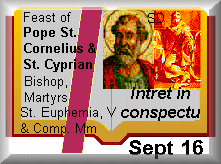
Pope Saint Cornelius succeeded St. Fabian as Pope in 251. He behaved with zeal and piety in his pastoral charge and adhered to his duty with courage and
steadfastness. The holy Pope suffered martyrdom, September 14, 252. Saint Cyprian, Archbishop of Carthage and Primate of Africa, laid down his life for Christ on September 14, 258, six years later, to the day, after his
friend St. Cornelius. St. Cyprian, one of the most famous of the earlier ...More
|
|
|

  On this next to the last installment of Mario Derksen's excellent seven-part series on "Vatican II and the Gospel of Man", he exposed back in 2002 the novelties of new theses which are couched in such ambiguity that he could only term it 'bafflegab' for the post-conciliar church (Also called Newchurch as Mario dubs it, or as Dr. Thomas A. Droleskey termed the "counterfeit church of conciliarism" or, as we coined in describing the robber barons who stole in: "VulgArians". One thing we do know: whatever you call it, it's false and not Catholic!) is determined to "dialogue" ad nauseum. All of this gab only baffles Catholics further, all playing into the hands of humanists as Mario explained in part six with his column The 'Bafflegab' of the Post-Conciliar Church: Razzmatazz II.
|
|
|
|
|
|
|

   We complete Mario's seven-part series on "Vatican II and the Gospel of Man" with this seventh installment first published on Good Friday of 2002. Mario illustrated how the razzmatazz, 'bafflegab', and skimble-skamble of the post-conciliar church, and especially in the pronouncements by John Paul II, left the faithful gasping for air and flying blind in a snowstorm of ambiguity and humanism that, as we can see since, has only gotten worse and more confusing as Mario explained in part seven with his column The Skimble-Skamble of the Post-Conciliar Church: Razzmatazz III
 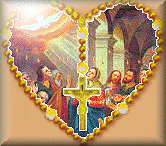 
John Gregory provides a comprehensive reflection/meditation and study on the Third Glorious Mystery in conjunction with the thirteenth Saturday of the fifteen week Rosary Crusade first introduced by His Excellency Bishop Robert McKenna a few years ago. Fifty days after our Lord Jesus Christ conquered death and ten days after He bodily ascended into Heaven, He made good on His promise to send His Spirit. The Holy Ghost came with a rush of grace and inspiration, transforming the formerly apprehensive Apostles into men of virtuous courage who were now ready to fully take up the command Christ had given them. The charism of the Church was born that day and the Faith spread rapidly with three thousand on the first day. A glorious day it was! The Third Glorious Mystery
For the Rosary Crusade, click the banner below
 For Last Week's Edition, click the banner below:

|
|
|
|
To be said three times a day at 6 a.m., noon and 6 p.m.
V. Angelus Domini nuntiavit Mariæ.
R. Et concepit de Spiritu Sancto.
Ave Maria, gratia plena, Dominus tecum. Benedicta tu in mulieribus, et benedictus fructus ventris tui, Iesus.
Sancta Maria, Mater Dei, ora pro nobis peccatoribus, nunc et in hora mortis nostræ. Amen.
V. Ecce Ancilla Domini.
R. Fiat mihi secundum Verbum tuum.
Ave Maria...
V. Et Verbum caro factum est.
R. Et habitavit in nobis.
Ave Maria...
V. Ora pro nobis, Sancta Dei Genetrix.
R. Ut digni efficiamur promissionibus Christi.
Oremus: Gratiam tuam quæsumus, Domine,
mentibus nostris infunde;
ut qui, angelo nuntiante,
Christi Filii tui Incarnationem cognovimus,
per passionem eius et crucem,
ad resurrectionis gloriam perducamur.
Per eumdem Christum Dominum nostrum. Amen.
V. The angel of the Lord declared unto Mary.
R. And she conceived by the power of the Holy Ghost.
Hail Mary, full of grace, the Lord is with thee. Blessed art thou amongst women, and blessed is the fruit of thy womb, Jesus.
Holy Mary, Mother of God, pray for us sinners, now and at the hour of our death. Amen.
V. Behold the handmaid of the Lord.
R. Be it done unto me according to thy Word.
Hail Mary...
V. And the Word was made flesh.
R. And dwelt amongst us.
Hail Mary...
V. Pray for us, O Holy Mother of God.
R. That we may be made worthy of the promises of Christ.
Let us pray: Pour forth, we beseech thee, O Lord, Thy grace into our hearts, that we to whom the incarnation of Christ Thy Son was made known by the message of an angel, may by His Passion and Cross be brought to the glory of His resurrection; through the same Christ our Lord. Amen.

|
|

|

 or you can send your tax-deductible contribution (check, cash or M.0.) by mail to:
SANCTUS/The DailyCatholic
4815 Calle Neil
San Diego, CA 92117
|
|
|
|