|
|
| ||||

   The Hidden Life of Christ |
After the Nativity, Epiphany and Flight into Egypt there is a gap until Jesus is twelve years old. Then after a brief initial encounter with the Scribes and Pharisees as a signal of where He is challenge the hypocrites by defining the Truths, the Scriptures merely say He returned with Mary and Joseph and was obedient to them. That's it. He doesn't surface again in divine Revelation until He ventures forth to fast for 40 days and nights in the desert, followed by the Temptation and subsequently His ringing rejection, Vade, Satanas!; something that should be on our lips in fending off the devil who, as St. Peter relates, "goes about like a roaring lion seeking whom he might devour." As protection against the devil, our Lord led by example, submitting to His cousin the Baptist to be baptized in the Jordan. Thus, the question always arises: So what do we know of those hidden years? The revelations to Venerable Maria Agreda, St. Gertrude the Great, St. Teresa of Avila, and St. John of God as well as St. Bridget among many saints without even counting other private, yet highly speculative disclosures, such as Poem of the Man-God, give us a hint, but only a hint for it was a time of formation to prepare the greatest Preacher of all time for His three-year ministry that has forever had an impact on civilization. God chose this time to be private, a testimony that the family came first and the importance of living the Fourth Commandment. Quite a change from today's topsy-turvy priorities that have so skewered the family unit, dedication to the divine will, virtue and morality.
Editor's Note: This series is an effort to return to basics since too often we all make the holy Faith complicated, whereas in reality the truths and traditions of the Catholic Faith are quite simple. God doesn't complicate things, man does. Realizing the fact that, for many generations indoctrinated by conciliar ambiguities, it all seems so confusing, we are introducing this series which is an adaptation of an earlier series titled "Appreciating the Precious Gift of the Faith" in utilizing a combination of the excellent compendium of the late Bishop Morrow's pre-Vatican II Manual of Religion My Catholic Faith and Dom Prosper Gueranger's incomparable The Liturgical Year as well as the out-of-print masterpieces The Catholic Church Alone The One True Church(1902) and the Cabinet of Catholic Information (1903). Through prayer and discussions, we've decided to employ this revised series to simplify the tenets of the Faith for those who continue to wallow in what they think is the 'Catholic Church' out of obedience to a man and his hierarchy who long ago betrayed Christ and His flocks. This then, is an affirmation of the basic truths the Spotless Bride of Christ has always taught and cannot change or evolve as "living documents" for truth is truth. As we say every day in the Act of Faith, "We believe these and all the truths which the holy Catholic Church teaches, because Thou hast revealed them, Who canst neither deceive nor be deceived." If you have been deceived, and the vast majority have been, then realize what you've been indoctrinated with over the past 50 years cannot be from God but from His adversary. Our advice: flee the conciliar confines as well as other man-made religions which do not teach these truths without compromise. Seek out a traditional chapel nearest to you. There is a list of churches you can absolutely trust at Traditional Latin Masses

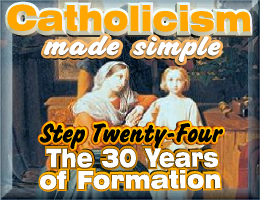
Jesus, God Himself, obeyed mortals, because He wanted to set an example for us. He lived a life of obedience, humility, and poverty in Nazareth till He was about thirty years old. This hidden life teaches us, among other things, the value in the eyes of God, of prayer, humility and obedience. The life of Christ may be divided into three parts: His childhood, to the time when He was twelve years old; His hidden life, to the time when He started His teaching; and His public life, to the thine of His death. After the murder of the Holy Innocents, the Child Jesus lived in Egypt with His mother the Blessed Virgin Mary and St. Joseph until the death of the ruthless Herod, then returned with them to the Holy Land. An angel appeared to Joseph and said, "Arise, and take the Child and His Mother, and go into the land of Israel" (St. Matthew 2:20). Just as the holy Joseph had obeyed without question when told to take the Child to Egypt, so now he obeyed, knowing that God, Who watches over the birds of the air, would watch over those given into his charge. After several years, the Holy Family returned from Egypt to live back in Nazareth. From there, every year Mary and Joseph went to worship at the Temple of Jerusalem. When Jesus was twelve years old, He went along with His parents to celebrate the Pasch at Jerusalem. Then Mary and Joseph left the city to return to Nazareth, but Jesus remained behind without their knowledge. "But thinking that He was in the caravan, they had come a day's journey before it occurred to them to look for Him among their relatives and acquaintances. And not finding Him, they returned to Jerusalem in search of Him" (St. Luke 2:44-45). We can only imagine the distress of Mary and Joseph upon having lost Jesus, most precious to them, the Child that had been entrusted to their care. And what was their joy when after three days' search they found Him in the Temple, in the midst of the wise men there, hearing and questioning them! Mary told how great had been her grief when she said, "Behold, thy father and I have been seeking Thee sorrowing" (St. Luke 2:48). But Jesus replied, "How is it that you sought Me? Did you not know that I must be about My Father's business?" (St.Luke 2:49). Some non-Catholic interpreters insist that Jesus had brothers, that He was not the only Son of Mary. These are, of course, ridiculous for Mary was ever Immaculate. Those spoken of in the Gospels as the "brethren" of Our Lord (St. Matthew 13:55), were His blood relatives; it was the practice among the Jews to call near relatives "brethren". So Abraham called his nephew Lot in this manner: "Let there be no quarrel between me and thee - for we are brethren" (Genesis 13:8). As St. John Chrysostom wrote, "Our Lord on the cross would not have needed to commend His Mother to His Apostle John, if she had had other children." The hidden life of Jesus Christ lasted from His return to Nazaraeth at the age of twelve until He entered into public life, at the age of thirty. Of this part of Christ's life all we directly read from Holy Scripture are two statements: "And He went down with them, and came to Nazareth, and was subject to them...And Jesus advanced in wisdom and age and grace before God and men" (St. Luke 2:51, 52). In these two sentences is contained the history of eighteen years of the life of Jesus Christ, the God-Man. In the Temple at the early age of twelve, Jesus had proved His wisdom before the doctors of the law. As St. Luke writes, "And all who were listening to Him were amazed at His understanding and His answers" (St. Luke 2:47). But did He continue after this unusual and favorable beginning; did He stay on to preach His doctrine? No; instead, He meekly followed His parents as a young child of that age, and went to live with them in obscurity in Nazareth.
The actions of Jesus Christ are intended for us as examples and instructions, as much as His words. As He said, By His hidden life Jesus Christ teaches us to learn holiness and wisdom before we presume to teach others. He teaches us, by living in obscurity, to fight against our vanity, which makes us desire to be doing only what seems great and important, which makes us desire to be praised and noticed. By His hidden life Our Lord teaches us to subdue our pride, to live day after day without impatience or complaint, unknown to the world, and even despised, if that is the will of God for us; then we shall have true peace of heart. And so Jesus teaches, "Learn from Me, for I am meek and humble of heart" (St. Matthew 11:29). For long years of obscurity in Nazareth, He was just "a carpenter's son." The hidden life of Jesus Christ is for us a perfect model of obedience: "And He was subject to them." The God of all created things, almighty and infinite, was subject to two poor and unknown mortals. He obeyed them in all things, promptly, constantly, cheerfully, and with great love. Let us model our obedience on this perfect pattern. Let us obey our superiors as representatives of God, giving them due respect and prompt obedience, disobeying their commands only when they teach anathema or disobey God in their commands. When our parents command us, and we go about doing what they want, but with murmuring and without spirit, is that the obedience that the Child Jesus gave in Nazareth? When we have to do some unpleasant or difficult task, let us imitate Jesus in His very words: "Yes, Father, for such was Thy good pleasure" (St. Matthew 11:26). In this way our obedience will be like that of Jesus, supernatural; we shall obey human beings for the love of God; we shall really be obeying God Himself, in the persons of those He has placed over us. By the example of His hidden life our Lord set the principle for the religious life, particularly for that in contemplative orders. What we cannot fall into is 'blind obedience', a trap that allowed progressive prelates and priests to overthrow the tenets of the true Faith so cleverly by playing on the people's trust. Had we been more responsive and responsible, perhaps we could have stemmed the tide before it flooded in, capsizing souls for the last half century. Jesus "advanced in wisdom and grace before God and men." Although He possessed all wisdom and grace from the first moment of His mortal life, He manifested them only gradually and in a way that was in keeping with His years and His human nature He willingly accepted along with His divine nature. We can obtain much merit before God without doing any striking actions, by merely being humble and obedient in the place of life in which it has pleased God to put us. If Christ the Son of God, God Himself, was content to be humble, poor, and unknown, to do common tasks day by day for the greater part of His earthly life, is there any reason why we should be ever trying to exalt ourselves, to attract admiration, ever to feed our vanity? Remember another who practiced this virtue with her Little Way - Saint Therese of Lisieux. We can learn much from other saints as well, all following the example first exemplified by the Son of God so that we may always imitate Christ in all we do.
Previously: Step Twenty-three: The Nativity Catholicism Made Simple |





