

As apostle and bishop St. Alphonsus sought to imitate Our Divine Redeemer in His evangelizing journeys through the villages of Galilee and Judea. Hence he founded his own society of missionaries whom he destined to labor among the poor peasants and mountaineers rather than the inhabitants of the towns. As founder of a new Order, the saint has the merit of having adapted the scope of his work to the needs of the time, and of having brought it to completion in spite of innumerable difficulties. Although approved by the Pope, the King of Naples refused to permit the new Order to establish itself. St. Alphonsus himself was excluded from the houses of his own Order in the Kingdom of Naples. This schism existed until his death. After his death the whole scene changes; the rejected founder is raised to the altars, and his Congregation extends its boundaries beyond the confines of Italy and of Europe. He was devoted in a special manner to...
More on St. Alphonsus Liguouri



August 3 is the feast of the Finding of the Body of Saint Stephen the Protomartyr. The body of this first martyr, with those of some other saints, was discovered near Jerusalem in the year 415. Later the body of the saint was taken to Constantinople and finally to Rome, where it now lies beside
that of St. Lawrence, whose feast we celebrate a week later on August 10. The many miracles that occurred on the finding of Saint Stephen's body led to the institution of this festival, besides that of December 26th.
A tradition states that Gamaliel, the teacher of Saint Paul, had buried the body of Saint Stephen at his country house; Nicodemus and Abibas, son of Gamaliel, and Gamaliel himself, were also buried there.
More on Finding St. Stephen's Body


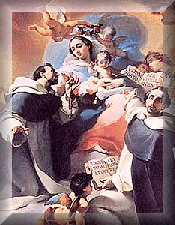
the founder of the Order of Friars Preachers, was born in Spain in 1170, and died at Bologna, Italy, in 1221. In 1208 while the saint was at prayer
Our Lady appeared to him, gave him the Rosary, and bade him go forth and preach. Beads in hand, he led the Catholic troops against the Albigensians. and crushed that heresy. Countless souls were brought to grace by his words. His parents attributed his birth to the prayers of the holy Benedictine Abbot, Dominic of Silos; his mother saw in a vision her child in the shape of a little dog, holding a torch in....
More on Saint Dominic
Second Day of the Novena to St. Philomena

John Gregory presents an inspiring piece on Saint Dominic, the extirpator of heresy, who is the ideal on how we can extrapolate today those heretics far worse than in the time when the founder of the Order of Preachers walked the earth for holy Mother Church. How do we know of the heretics today? The very words of Sacred Scripture expose these heretics such as Karol Wojtoya and Josef Ratzinger, both false popes, by their own words that makes them apostates far more devious than the Albigensians who ravaged the Church in the thirteenth century. Heaven bestowed the powerful weapon of the Rosary to St. Dominic to fight heresies. Today that weapon must be used all the more fervently if we are to defeat the Modernists who subscribe to what Pope St. Pius X called the "synthesis of all heresies." Below John elaborates in pinning the false shepherds against the wall just in regard to their caving on the sixth and ninth commandments. John provides the evidence and the inspiration of St. Dominic via Dom Prosper Gueranger's words. in
The Receptor of the Rosary to be the Extirpator of Heresies



August 5 is the feast of the Dedication of Our Lady of the Snows. Tradition tells us that during the pontificate of
Pope Liberius, in the Fourth Century, in the heat of August, the plan of the church of St. Mary Major was traced out in a miraculous fall of snow. For this reason that basilica is known as St. Mary-of-the-Snow, and the name is also given to the feast of its dedication. The stations at Christmas are held in this Church because some relics of the Crib of Bethlehem are preserved there. The Pope was also accustomed to officiate there on the first Sunday in Advent, at the beginning of...
More on the Feast of Our Lady of the Snows
Third Day of the Novena to St. Philomena


The feast of the Transfiguration of the Lord was originally commemorated on the Vigil of Ember Saturday in Lent. With the decline of liturgical understanding a special festival was instituted in its honor in order to arouse popular devotion to this mystery. It is now the patronal feast of the Lateran Basilica, and of all churches under the title of St. Savior. There is also a commemoration of Pope Saint Sixtus, Saints Felicissimus and Agapitus, Martyrs.
Pope St. Sixtus II, 24th Successor of St. Peter, effected the translation of the mortal remains of the man Christ chose as the first Sovereign Pontiff of His Church. Sixtus also introduced the Latin exclamation
Deo gratias into the Ordinary of the holy Mass. He is also referred to as...
More on the Transfiguration of Our Lord
Fourth Day of the Novena to St. Philomena


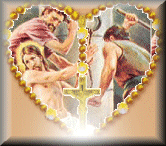
John Gregory provides a comprehensive reflection/meditation and study on the second Sorrowful Mystery in conjunction with the seventh Saturday of the fifteen week Rosary Crusade first introduced by His Excellency Bishop Robert McKenna a few years ago. By our sins we scourge our dear Lord anew. Do we take pleasure in such masochism to our souls and to pure Love that we would continue to beat Christ? By tending to our souls, and examining our words, actions and thoughts at the healing font of Divine Mercy - the Confessional - we receive the salve of salvific Sanctifying Grace. Through the Sacrament of Penance we can put a halt to the scourging, and apply dabs of sincere love to close and comfort those terrible wounds on His precious flesh; wounds we helped open.
The Second Sorrowful Mystery



To enhance each Sunday's Epistle and Gospel we present this special feature provided by John Gregory with the Haydock Commentary found at the bottom of each page of the Douay-Rheims Bible. We publish it here in conjunction with the Epistle and Gospel for the Sunday Mass, with the cogent comprehensive Catholic Commentary penned by Father George Leo Haydock. For the Eighth Sunday after Pentecost and the Feria days this week, the theme is giving an account of one's responsibilities, one's stewardship over those things God has entrusted each with. This means abiding by His laws and not being slaves to the world, the flesh and the devil for to give in to that triumverate of trouble will punch one's almost sure ticket to accommodations with Mammon who is so cunning, especially in the midst of those children of the light who are not on their guard, not tending to their duties and not vigilant to the Holy Ghost's promptings.
"Give an account of thy stewardship" for the
Eighth Sunday after Pentecost
Fifth Day of the Novena to St. Philomena
Second Day of the Novena in Preparation for the Assumption

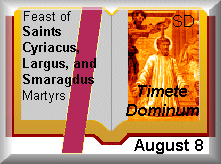

This week could well be called "Martyrs' Week" for with the exception of Friday's feast of St. Clare, six of the seven days this week are feasts or commemorations of holy martyrs. While we celebrated the commemoration of St. Donatus yesterday, today we commemorate the Simple feast of the holy martyrs St. Cyriacus, Largus and Smaragdus. Cyriacus was a holy deacon of Rome under Popes St. Marcellinus and Marcellus. With Largus, Smaragdus, and about twenty others he was crowned with martyrdom in 303, in the persecution of Diocletian. The occasion of the
translation of their remains many years later to a church dedicated to them led to...
More on today's holy martyrs
Sixth Day of the Novena to St. Philomena
Third Day of the Novena in Preparation for the Assumption

 John Gregory completes his three-part series with a brief brief on Sedevacantism. Bullfighting is often considered a sport, a brutal one at that. But there is a nobility in the matadors who stand against the charging bull. These matadors then are the sedevacantists who bravely enter the ring risking their own reputations and the consequences of being rejected by man, but do it for God. The picadores and banderilleros are those who stay on the fringe and will distract the bull, but have no answer how to deal with the bull. These are the resist-and-recognize forces who have no expertise on how to kill the bull. The spectators are those who realize something is wrong but don't really want to get involved. They are fine with their comfortable position where they think they won't get harmed but little do they know that a much more dangerous beast with horns has already gored their minds and souls, causing them to grow more lukewarm, perfect foils for the heretical bull that is being thrown around the ring with only the matador and his toreros willing to stand for the truth and face down the heretics and apostate beast with the sword and cape of Catholic truth. John explains in his final Part Three of No Bull, This is Serious


August 9 is the feast the holy Cure of Ars Saint Jean Marie Vianney with a commemoration for the Vigil of the holy martyr Saint Lawrence. St. John Mary Vianney was born at Dardilly, France, in 1786. He was a farm-hand until his nineteenth year, when he began his studies for the priesthood. His talents were poor, and his progress slow. He was ordained at Grenoble in 1815; he became parish priest of Ars in 1818. That little town was the scene of his marvelous labors until his holy death, August 4, 1859. He was canonized May 31, 1925, by Pope Plus XI. For forty years his food and sleep were insufficient to sustain human life; during the last ten years of his life he spent from sixteen to eighteen hours a day in the confessional. Enlightened by God, he could read hearts and soften the most hardened sinner. He healed the sick and cast out devils; like his Master he was openly persecuted, calumniated and hated by wicked men. His little parish...
attracted ....
More on St. Jean Marie Vianney Seventh Day of the Novena to St. Philomena
Fourth Day of the Novena in Preparation for the Assumption


After the feast of Sts. Peter and Paul this is the greatest festival in the ancient Roman Liturgy. The terrible martyrdom endured by the famous archdeacon deeply impressed the generations that came immediately after him, for whom Saint Lawrence became at Rome that which Saint Stephen had been at Jerusalem. During the persecutions under Valerian in 258, numerous priests and bishops were put to death, while Christians belonging to the nobility or the Roman Senate were deprived of their goods and exiled. Pope St Sixtus II was one of the first victims of this persecution, being beheaded on August 6. A legend cited by the holy Doctor of the Church and Bishop St Ambrose of Milan says that Lawrence met the His Holiness Sixtus II on his way to his execution. There Ambrose reports that Lawrence asked the Pope ...
More on St. Lawrence
Eighth Day of the Novena to St. Philomena
Fifth Day of the Novena in Preparation for the Assumption



August 11 is the Traditional historical feast of
Saint Philomena. The tomb of this virgin and martyr, unknown until the first years of the 19th century, was providentially discovered in 1802 in the catacombs. God by many miracles made the discovery of Saint Philomena’s body famous, and the cult of the young Saint spread everywhere with an extraordinary rapidity. She received such exceptional homage that she deserves to be placed in the first ranks of the virgin martyrs whom the Church venerates. The Holy Curé of Ars Saint John Mary Vianney whose feast was celebrated two days ago, called her his
"dear little Saint" and performed wonders, invoking her. Certain revelations having the character of authenticity say that Saint Philomena was the daughter of a Greek prince, who accompanied her parents to Rome on a journey, and that...
More on Saint Philomena
Ninth and Final Day of the Novena to St. Philomena
Sixth Day of the Novena in Preparation for the Assumption


On the feast of a traditional saint whom the counterfeit church of conciliarism tried to decertify, we bring you Griff Ruby's fifteenth installment of his excellent YouTube Series "Sedevacantism - A Catholic Perspective". He continues his dissection of the damage Lumen Gentium did in abdicating jurisdiction of every ecclesiastical authority who followed the new establishment formed at Vatican II and this included every priest, bishop and, yes, pope. He points out that
Traditional Bishops have an Apostolic mission from the lawful Catholic bishops even without a papal mandate. When dioceses combine, all lawful clerics of each automatically become lawful clerics of the new combined diocese. As Lumen Gentium dissolved all diocesan boundaries worldwide, there is remaining only a single, worldwide diocese, namely the Eternal diocese of Rome. The true canonical status of the Traditional bishops is that they are therefore assistant bishops to the Diocese of Rome. Lumen Gentium also, without realizing it, made the true Traditional Bishops of the Church a virtual "College", i.e. a legitimate "College of Cardinals" even if they do not receive the red hat, which would be impossible without a true Pope to authorize such. It was the false pope who mandated that they would remain such until Lumen Gentium itself is someday repealed and a true Pope again sits on the Seat of Peter.
True Authority in a Global Diocese.

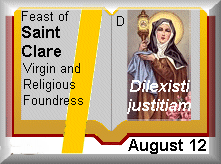

Saint Clare, born at Assisi in Umbria, was the first of the holy virgins whom
St. Francis, consecrating to God, bound to Christlike poverty. On a visit to
St. Francis, she expressed to him her desire to become a Spouse of
Christ. To St. Francis had been given a little chapel called the
Portiuncula by the Benedictine abbot of Monte Subasio. St. Francis gave to Clare the rule of St. Benedict to follow, as he desired to graft his new foundation on to the old Order, so as to give it a canonical basis, one already recognized by Holy Church. St. Francis determined that Clare should not imitate the rich convents of Benedictines then in Umbria, but should go back to the early traditions of Benedictine poverty; thus it was that Pope Gregory IX was able to write to them before they had a rule of their own: "Now you are worthy daughters of the blessed Benedict."
Her sister Agnes and other women soon joined her; they walked barefooted, slept on the ground, observed perpetual abstinence, and made poverty...
More on Saint Clare
Seventh Day of the Novena in Preparation for the Assumption


On the second Saturday of August of July we honor the Blessed Mother This observance of the Votive Mass of the Blessed Virgin Mary on Saturday comes just two days before her glorious Solemnity of the Assumption. The Mass today shows us Mary as Mother of our Savior. She was predestined from all eternity for the role of co-redemptrix (Epistle), for as the first Eve was the intermediary chosen by the angel of darkness to bring about the fall of Adam<, so also Mary is the second Eve, the intermediary to whom the angel Gabriel delivered the message of salvation from Heaven. She is also blessed since she...
More on the Blessed Virgin Mary on Saturday
Eighth Day of the Novena in Preparation for the Assumption


John Gregory provides a comprehensive reflection/meditation and study on the third Sorrowful Mystery in conjunction with the eighth Saturday of the fifteen week Rosary Crusade first introduced by His Excellency Bishop Robert McKenna a few years ago. Just as the Jews cried out in pride to patronize Pilate "We have no king but Caesar," so also we, who are true sons of God, must, in all humility, state unequivocally: "We have no King but Jesus." Where He is mocked, we offer humble prayer of reparation and expiation for these terrible sins against the Incarnate Word so cruelly tortured and disfigured. But do we or do we shrink for fear of the crowd and place respect or fear of man above respect and fear of God? See John's meditation on this in
The Third Sorrowful Mystery
For the Rosary Crusade, click the banner below


To enhance each Sunday's Epistle and Gospel we present this special feature provided by John Gregory with the Haydock Commentary found at the bottom of each page of the Douay-Rheims Bible. We publish it here in conjunction with the Epistle and Gospel for the Sunday Mass, with the cogent comprehensive Catholic Commentary penned by Father George Leo Haydock. For the Ninth Sunday after Pentecost the theme is that one does not know the hour of one's visitation, in other words, when he has to make an account before God of all he has done on earth. That is why St. Paul warned not to tempt Christ and why our Lord wept and then, in righteous anger, chased those out of the house of God who put more weight in worldly things. How we see this today in the once Catholic churches that call themselves 'Catholic' but are anything but. The time will come when they will be chased out by means known only to God and they will be restored to true houses of God where the Holy Sacrifice of the Mass, the Mass of All Ages will once again summon the angels and His abundant graces for those willing to abandon a civilization currently in slavery to the world, the flesh and the devil.
How Dare Thou Anger God for the
Ninth Sunday after Pentecost
Ninth and Final Day of the Novena in Preparation for the Assumption



The Double of the First Class Feast of the Assumption of the Blessed Virgin Mary into Heaven. Blessed Mary lived, cared for by St. John, for twelve years after
Our Lord's Resurrection. Her life was spent in helping the Apostles and in praying for the conversion of the world. On the third day after Mary's death, when the Apostles gathered around her tomb, they found it empty. The sacred body had been carried up to the celestial paradise. Jesus Himself came to conduct her thither the whole court of heaven came to welcome with songs of triumph the Mother of the Divine Word. Why was Mary's body received into heaven instead of remaining in the earth, like the rest of mankind? The grave had no power over one who was immaculate. Her flesh could not see corruption. Her body had been over shadowed by the Holy Ghost. It had been the sacred temple in which had dwelt God Incarnate, and so it had a claim to...
More on the Solemnity of the Assumption
Second Day of the Novena to the Immaculate Heart of Mary

 John Gregory has provided inspiring, thought-provoking meditations for the Joyful, Sorrowful and Glorious Mysteries of the Our Lady's Holy Rosary first bestowed to Saint Dominic early in the thirteenth century. Since then her holy psalter has served as the most powerful weapon outside the true Holy Sacrifice of the Mass, we could wield against the world, the flesh, and the devil.
  For the Fourth Glorious Mystery reflection John focuses on His Holiness Pope Pius XII's decree in proclaiming the Dogma of the Assumption on November 1, 1950 with his encyclical Munificentissimus Deus. John takes this papal decree and divides it with the first part applying to the Fourth Mystery of the Rosary on the Assumption of Our Lady into Heaven. The belief of this dogmatic fact was long held by the Magisterium of the Church from the very time of the Blessed Mother being lifted up into Heaven, yet never fully proclaimed as a definitive Dogma until His Holiness Pius XII, in complete harmony with all the authentic bishops of the Church, decreed it. This inspiring papal decree is the compendium of an ideal meditation on the Fourth Glorious Mystery. In honor of this month of the Immaculate Heart of Mary, he shares his reflection on
The Assumption of the Blessed Virgin Mary into Heaven
For the Fourth Glorious Mystery reflection John focuses on His Holiness Pope Pius XII's decree in proclaiming the Dogma of the Assumption on November 1, 1950 with his encyclical Munificentissimus Deus. John takes this papal decree and divides it with the first part applying to the Fourth Mystery of the Rosary on the Assumption of Our Lady into Heaven. The belief of this dogmatic fact was long held by the Magisterium of the Church from the very time of the Blessed Mother being lifted up into Heaven, yet never fully proclaimed as a definitive Dogma until His Holiness Pius XII, in complete harmony with all the authentic bishops of the Church, decreed it. This inspiring papal decree is the compendium of an ideal meditation on the Fourth Glorious Mystery. In honor of this month of the Immaculate Heart of Mary, he shares his reflection on
The Assumption of the Blessed Virgin Mary into Heaven


August 16 is the feast of Saint Joachim, father of the Blessed Virgin Mary and husband to Saint Anne. The excellence of a fruit is always a sign of the quality of the tree which bore it. In the case of St. Joachim, the Immaculate Conception of Mary reflects a splendid glory on the chaste union of her parents. The Gospels speak of a sister of Our Lady who accompanied her even to the foot of the cross. According to some authorities she too was a daughter of
St. Anne and of St. Joachim. His feast was first introduced into the Breviary by
Pope Julius II, who fixed the date of March 20. Pope Leo XIII (
Joachim Pecci) raised it to a double of the
second class. In the reform of the Breviary carried out by Pope Saint Pius X, August 16th was the date fixed.
The close relationship which existed between the his grandson Our Lord and Savior Jesus Christ and St. Joachim confers on the latter of great dignity, raising him above other saints, so that the honor paid to him is reflected upon...
attracted...
More on Saint Joachim
Third Day of the Novena to the Immaculate Heart of Mary



Saint Hyacinth, named the glorious Apostle of the North, was born of noble parents in Poland, about the year 1185. In 1218, as a Canon of Cracow he accompanied the bishop of that region to Rome. There he met Saint Dominic and soon afterward was one of the first to receive the habit of the Friar Preachers, in a group clothed by the patriarch himself. He became a living copy of his dear master. The church was his only chamber, and the ground his only bed. So wonderful was his progress in virtue that within a year Dominic sent him with a small group to preach and plant the Order in Poland, where he founded two houses. His apostolic journeys extended over numerous and vast regions. Austria, Bohemia, Livonia, the shores of the Black Sea, Tartary, Northern China in the east, Sweden, Norway and Denmark to the west, were evangelized by him, and he is said to have visited Scotland. Everywhere he traveled unarmed, without a horse, with no money, no interpreters, no furs in the severe winters, and often without a guide, abandoning to Divine Providence his mission in its entirety. Everywhere multitudes were...
More on St. Hyacinth
Fourth Day of the Novena to the Immaculate Heart of Mary



Within the Octave of the Assumption observes the Double of the First Class Feast of the Assumption of the Blessed Virgin Mary into Heaven. Blessed Mary lived, cared for by
St. John, for twelve years after Our Lord's Resurrection. Her life was spent in helping the Apostles and in praying for the conversion of the world. On the third day after Mary's death, when the Apostles gathered around her tomb, they found it empty. The sacred body had been carried up to the celestial paradise. Jesus Himself came to conduct her thither the whole court of heaven came to welcome with songs of triumph the
Mother of the Divine Word. Why was Mary's body received into heaven instead of remaining in the earth, like the rest of mankind? The grave had no power over one who was immaculate. There is also a commemoration of the holy martyr St. Agapitus...
More on Within the Octave
Fifth Day of the Novena to the Immaculate Heart of Mary


Saint John Eudes, forerunner of devotion both to the Sacred Heart and the Immaculate Heart of Mary, was born in 1601, some time after France had been torn apart by the revolt of the Huguenots. The rebels were calmed but relegated to western France by King Henry IV, after he himself returned to the Catholic faith. It was in that region that this young Saint spent his childhood, at Argentan in Normandy, and was educated with the Jesuits of Caen. The father of this firstborn of a family of solid and profound virtue, had himself desired the sacerdotal life, and he did not long oppose John’s desire to consecrate himself to God as a priest. At eighteen years of age Saint John had already composed a treatise on voluntary abnegation, which his confessor obliged him to publish.
He was ordained in Paris as a member of the recently founded French Oratory of Saint Philip Neri; his teachers there were...
More on Saint John Eudes
Sixth Day of the Novena to the Immaculate Heart of Mary


Saint Bernard was born at the castle of Fontaines, in Burgundy near Dijon, in 1090. The grace of his person and the vigor of his intellect filled his parents with the highest hopes, and the world lay bright and smiling before him. But Bernard renounced it forever to join the monks of Citeaux, a few miles distant. Four of his brothers and a group of friends, thirty young Christians in all, went when he did to Citeaux, leaving the youngest brother, Nivard, to be the mainstay of his father in his old age. “You will now be heir to everything,” they said to him as they departed. “Yes,” said the boy; “you leave me the earth, and keep Heaven for yourselves; do you consider that fair?” And he too left the world. At length their aged father came also, exchanging wealth and honor for the poverty of a monk in the monastery of Clairvaux, which Bernard with a band of monks founded in...
More on St. Bernard of Clairvaux
Seventh Day of the Novena to the Immaculate Heart of Mary

John Gregory provides a comprehensive reflection/meditation and study on the Fourth Sorrowful Mystery in conjunction with the ninth Saturday of the fifteen week Rosary Crusade first introduced by His Excellency Bishop Robert McKenna a few years ago. The time continuum between the Praetorium where the Jews screeched 'Crucify Him!', and the moment He arrived at the summit of Calvary could well have taken thirty minutes to an hour and a half. In this time, we have in the
Via Crucis, several lessons we can garner from this interval, including His reunion with His Sorrowful Mother, the aid of Simon of Cyrene, the gentle charity of Veronica, the weeping of the women of Jerusalem, and three cruel falls along the way; each more crushing and exhausting. Despite all this, the question arises: do we have the spiritual stamina to keep up with Him? See John's meditation on this in
The Fourth Sorrowful Mystery
For the Rosary Crusade, click the banner below


To enhance each Sunday's Epistle and Gospel we present this special feature provided by John Gregory with the Haydock Commentary found at the bottom of each page of the Douay-Rheims Bible. We publish it here in conjunction with the Epistle and Gospel for the Sunday Mass, with the cogent comprehensive Catholic Commentary penned by Father George Leo Haydock. For the Tenth Sunday after Pentecost we have as the theme man's pride and forgetting who he really is for without God he is nothing. St. Paul bears this out in his Epistle to the Corinthians in warning that the spirit (Holy Ghost) cannot deceive, knows all and knows which gifts to bestow. Likewise in the Gospel God knows man's heart and though he might act humble, he who strives to be exalted will be humbled, but he who credits God for whatever he has, be they gifts or crosses, will be exalted by God. After all, that's really all that matters.
The Essence of Humility for the
Tenth Sunday after Pentecost
Eighth Day of the Novena to the Immaculate Heart of Mary

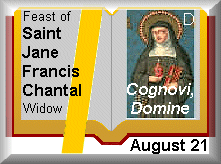 Because of the Sunday liturgy, the feast of Saint Jane Frances de Chantal is reduced to only a commemoration this year. She was born in Dijon, France in 1572, the daughter of Benigne Fremyot, president of the parliament in Burgundy, and married at twenty to Baron Christopher de Chantal who died in 1601. Nobility and riches were there for the asking for Jane Fances, but she used them wisely for the honor and glory of God. After nine years of marriage and seven children, Jane became a widow when her husband was killed in a hunting accident. Three years later she was touched in the deepest way by a sermon of Saint Francis de Sales for it was he who she had seen in a previous vision and because of this spiritual experience, persuaded him to be her spiritual director. After securing stability for her children, she turned to...More on St. Jane Frances de Chantal

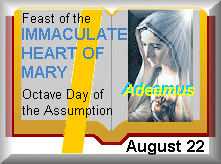

Devotion to the Immaculate Heart of the Blessed Virgin Mary always flourished in the Church, but its first
official approval did not come till the beginning of the 19th century when Pope Pius VI approved, for certain religious organizations, a Feast for the Most Pure Heart of Mary. The devotion was approved for the universal Church when
Pope Pius XII dedicated all mankind to the Heart of Mary in December, 1942, following this by the institution of the new Feast of the Immaculate Heart of the Blessed Virgin Mary on the Octave Day of the Solemnity of the Assumption...
Feast of the Immaculate Heart of Mary
Ninth and Final Day of the Novena to the Immaculate Heart of Mary
Click below for the Consecration and Reparation Prayers


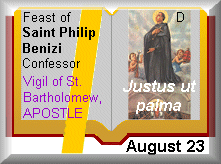

St. Philip Benizi was born in Florence on the feast of the Assumption in 1233. He was one of the first to profess the religious life as a Servite, and in time became general of the Order. With his brethren he preached in many countries of Europe, and journeyed even into western Asia to spread the
Christian faith. In his humility he refused honors and even the Papacy, which was offered him by the cardinals assembled in conclave. He entered into the glory of Heaven in the year 1285. It is said that when he was dying he repeatedly asked for his book, and when the infirmarian did not understand his meaning the saint made signs that he wanted his crucifix, which was the book in which he was accustomed to meditate. August 23rd is also the Vigil of
St. Bartholomew, Apostle. Like the other...
More on Saint Philip Benizi


In the Gospel of St. John, the Apostle Bartholomew is not mentioned among the Apostles, but it is stated that Philip and Nathaniel came to Jesus, and that Our Lord said of Nathaniel, "the Israelite in whom was no guile." In the list of the apostles in the other Gospels, Nathaniel is not mentioned, but after Philip is placed Bartholomew. The Redeemer chose all the apostles at once, and formed them from the beginning into a hierarchial group with St. Peter at their head, in order to show us that the rightful priesthood instituted by Christ is that which is derived in unbroken succession from the twelve apostles chosen by Our Savior, and being in communion with the See of Peter, is also in communion with...
More on Saint Bartholomew


Born into royalty on April 25, 1214 in Poissy, France, Saint Louis was crowned King of France in 1226 on the death of his father King Louis VIII. He had been raised in a staunch Catholic atmosphere by his mother Blanche of Castile, who became regent upon her husband's death until her son reached adulthood. The youthful Louis, one of the youngest rulers in French history, weaned on his faith by his mother exemplified his Catholicity throughout his life. It served him well in his long reign which was frought with great crisis including fending off those who would usurp his throne such as Thibault of Champagne. At the age of 20, Louis married the daughter of the Count of Provence, Margaret Berenger and they populated the royal court with eleven children. At the age of 28 Louis quelled rebellion in the south of France and followed that up by soundly defeating the English and King Henry III at the Battle of Taillebourg. With that accomplished, he turned his attention to ...
More on King St. Louis IX


While today is a Feria day for the 10th Sunday after Pentecost, there is a commemoration of the holy martyred Pontiff Pope Saint Zephyrinus, a native of Rome, who succeeded Pope St. Victor I in 198. In 202 Septimus Severus, a military despot, raised the fifth and most bloody persecution against the Church, which continued for nine years until the death of the emperor in 211. Until this furious storm ended, the holy pastor remained concealed for the sake of his flock, supporting and comforting the distressed disciples of Christ. He suffered by charity and compassion what every confessor underwent. The triumphs of the martyrs were indeed his joy, but his heart received many deep wounds from the fall of apostates and heretics. Nor did this latter affliction cease when peace was restored to the Church. The holy Pope had the affliction of witnessing the fall of Tertullian. He saw to his joy, however, the conversion of...
More on Pope St. Zephyrinus

On the feast of a martyred pope we bring you the final installment of Griff Ruby's sixteen installment on his excellent YouTube Series "Sedevacantism - A Catholic Perspective". The Traditional Bishops are the dry martyrs on the front line who have the power and authority to elect a valid Pope. Griff illustrates this in completing his dissection of the damage Lumen Gentium did in abdicating jurisdiction of every ecclesiastical authority who followed the new establishment formed at Vatican II and this included every priest, bishop and, yes, pope. He points out that the true Traditional Bishops of the Church have all the necessary authority to perform all that is needed to restore the papacy, and can and should do so, and, if they do, be confident that God shall shower the Church with miracles once that happens. Yes, that means holding a Conclave and electing a valid successor to the last true Pope - Pius XII of happy memory. Yes, it has been 53 years of an interminable interregnum, but as he reminds us from his example in part one, all the excess boosters and now non-effective pieces have fallen away and only the payload, the shuttle remains on the true course. That is the tracking line the true Bishops should follow for they have all the authority of Peter and have the full blessing of the Holy Ghost, Who withdrew His protection when the conciliar church broke away at Vatican Two. The exact point: Lumen Gentium. Once restored, do you think God wouldn't bestow wondrous miracles as a sign that it is the True Church? Oh, ye of little faith. Of course, He would and the conversions are unimaginable if one tries to understand the mind of God. He explains in installment sixteen:
God will do the rest! .


 St. Joseph Calasanctius
 was born in Aragon in 1556. Having become a priest it was revealed to him that he should teach the children of the poor. He founded the Order of the Poor Clerks Regular of the Pious Schools of the Mother of God. He was ever a devout pilgrim at the shrines of the martyrs, and daily visited the seven Churches of Rome, where he lived for fifty years. He died August 25, 1648. This is also the historical feast of the Seven Joys of the Blessed Virgin Mary.
Feast of St. Joseph Calasanctius


John Gregory provides a comprehensive reflection/meditation and study on the Fifth Sorrowful Mystery in conjunction with the tenth Saturday of the fifteen week Rosary Crusade first introduced by His Excellency Bishop Robert McKenna a few years ago. From the sixth hour to the ninth hour Jesus Christ, the King of kings, the Lord and Savior, Redeemer and Messias, hung in abject humility upon a tree, mocked and derided as the few faithful stood near. After three hours they would all know that this man was the Son of God. Many would not admit it. Pride would not let them. But for those who were sincere, such as the good thief and the centurion; they had to be honest with themselves. So also we must be honest with ourselves as we stand with His Blessed Mother, the beloved disciple, and Mary Magdalene. For this is the moment of truth. See John's meditation on this in
The Fifth Sorrowful Mystery
For the Rosary Crusade, click the banner below



To enhance each Sunday's Epistle and Gospel we present this special feature provided by John Gregory with the Haydock Commentary found at the bottom of each page of the Douay-Rheims Bible. We publish it here in conjunction with the Epistle and Gospel for the Sunday Mass, with the cogent comprehensive Catholic Commentary penned by Father George Leo Haydock. For the Eleventh Sunday after Pentecost we see how St. Paul gives witness that only through the grace of God has he been able to accomplish what God has aided, elevated and cured of sin. That is the message of the Gospel indicating that the deaf and blind man represents the spiritual blindness and deafness mankind has contracted by turning from God and embracing the chaotic din of the world, the flesh and the devil which, ironically, causes spiriritual deafness and dumbness. Really dumb! Yet, with just one word from our Lord "Ephpheta" the man in the gospel is healed. So also by absolution in the Sacrament of Penance by a valid, truly ordained priest, can one's soul be similarly healed.
Just a simple Ephpheta proves Christ's point. for the
Eleventh Sunday after Pentecost
 This year the feast of the holy Doctor of the Church Saint Augustine is superseded by the Sunday liturgy and there is only a commemoration of this great saint. It was the combined efforts of two saints who had the greatest effects on the life of one of the great Doctors of the Church Saint Augustine of Hippo. Augustine's mother Saint Monica played a major behind the scenes role in his conversion, while Saint Ambrose was on the front line with Augustine, who had become a great skeptic, teaching, influencing and converting him. Augustine was born in Tagaste in what is today Algeria on November 13, 354. By the time he was 30 he was preaching rhetoric, interspersed with Manichean heresy, at the university of Milan. It was there he met St. Ambrose and sat in on his lectures where he was enthralled with Ambrose's explanation of Sacred Scripture. In 356 Augustine heard a voice while he was embroiled in abandoned tears of helplessness searching for answers. The child-like voice chanted...More on Saint Augustine


Besides the chief feast of St. John the Baptist, that of his nativity, the Church commemorates on the twenty-ninth of August, his glorious death and birth into Heaven. Ever since the Fourth Century in Africa, in the East, in Syria, and in many places all over the world, the beheading of St. John the Baptist has been commemorated on August 29th. When in 362, pagans violated the tomb and burned his remains, some parts were saved by monks, and taken to St. Athanasius at Alexandria. The head is said to have been preserved at Jerusalem, and may later have been brought to Rome. The Gospel of the Mass recounts his martyrdom. He died because his sanctity as precursor of Christ was intolerable to the immoral Herodias. He anticipated in his death the humiliations of Calvary, but he was rewarded by having his praises spoken by the Savior Himself, even if Jesus and His disciples did not actually assist at...
More on the Beheading of St. John the Baptist

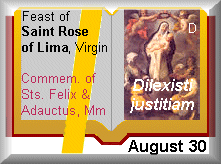

Saint Rose, the first canonized saint of the New World, was born at Lima in 1586. She received the name of Isabella in Baptism, but one day her mother saw a beautiful rose drooping over the baby's cradle and ever afterwards called her Rose. She was an obedient child; her mortifications were most severe. She prayed worked, and wept for the conversion of sinners; she excelled in her love for holy purity. She lived a life of simplicity and prayer in a small hut in a corner of her father's garden; the birds would
visit her and sing with her the praises of God. The Savior frequently appeared to her. Her devotion to the Passion of Our Lord was remarkable as were her own sufferings. Her bed was strewn with glass shards, with nails and thorns; she wore...
More on Saint Rose of Lima



The holy confessor Saint Raymund Nonnatus never knew his mother for he was born prematurely and she died at childbirth. Thus the mother of this heroic Spanish saint, did not live for him to know and love. Longing for a mother, Raymund asked the Blessed Virgin to take him as her special son. She revealed to him that he should devote himself to the ransoming of captives. He then founded the Order of Our Lady of Mercy for this purpose. He even gave himself up as a hostage to the Mohammedans for their...
More on Saint Raymond Nonnatus


The first day of the month of September, the month dedicated to Our Sorrowful Mother, is a Feria day for the Eleventh Sunday after Pentecost. There is also a commemoration of the holy abbot St. Giles. who was an Athenian and lived in the Sixth Century. He fled to the south of France where he lived as a hermit in a vast forest. Discovered by King Theodoric he founded a celebrated monastery in the diocese of Nimes and was so famous on account of his miracles that a number of churches were dedicated to him. His feast was kept at Rome with great solemnity with fireworks, music, races through the streets, etc. He is invoked for the cure of epilepsy and other diseases. The abbey erected in his honor was a magnificent structure and...
More on Saint Giles


Saint Stephen, not to be confused with the protomartyr St. Stephen, was a king and confessor and not a martyr. He introduced Christianity into his native land as the royal monarch of Hungary. Pope Sylvester II gave him the privilege of having a cross carried before him like an archbishop. He did all that an apostle could do for his country. By his example and his influence he induced the nobles and the people to embrace the Catholic Faith; he gave Christian legislation to the kingdom; he founded and endowed episcopal sees, built monasteries and established charitable institutions, not only In Hungary but even in Constantinople, Jerusalem, Ravenna and Rome. St. Stephen, seven years before his death, saw his young and most innocent son
Emerich, an angel of purity and holiness, whom God glorified by many...
More on Saint Stephen


Regarded as the Pope of the Blessed Sacrament, Giuseppe Sarto was born in 1835 at Riese, Treviso, Venice, Austria (now Italy). The glorious Saint Pius X died in 1914, at the beginning of the First World War after having been Pope for eleven years. He was truly a chosen soul. There has been no more saintly, courageous or beloved saint of modern times than Pope Saint Pius X. He was the vigorous opponent of all the Liberalism that has been trying in modern times to make its way into the Catholic Church, to water down its dogmas and to tie up Catholics with false brotherhoods that have no relationship to Jesus or to the Divine Maternity of Mary. Saínt Pius X was the great Pope of daily Communion for all, and of early Communion for children. No political influences could make him alter his assignment as Vicar of Chríst on earth and the sole ruler of the world
in all things that directly pertain to God. He approached the papacy by every simple step a priest could take. He was the first pope ever ...
More on Pope St. Pius X

John Gregory provides a comprehensive reflection/meditation and study on the First Glorious Mystery in conjunction with the eleventh Saturday of the fifteen week Rosary Crusade first introduced by His Excellency Bishop Robert McKenna a few years ago. We begin the last set of mysteries today with the Resurrection. The best meditation to inspire on the Resurrection of Our Lord and what followed up to His Ascension can be gleaned from Sacred Scripture and the holy Gospels of the Four Evangelists. What is remarkable is how the four accounts so readily strengthen each other. See John's meditation on this in
The First Glorious Mystery
For the Rosary Crusade, click the banner below


|

 or you can send your tax-deductible contribution (check, cash or M.0.) by mail to:
SANCTUS/The DailyCatholic
4815 Calle Neil
San Diego, CA 92117
|