|
|
| ||||

- (a) Christmas, which commemorates the birth of Our Lord;
- (b) Easter, which celebrates His resurrection; and
- (c) Pentecost, which celebrates the descent of the Holy Ghost.
   The Season of the Nativity The Season of the Nativity
|
With the end of this week we complete the full cycle of the 2010 Liturgical Year. Sunday, the First Sunday of Advent begins the 201l cycle in which the Church repeats the same Propers through 365 days of the year including the First Class Feasts of Our Lord and Our Lady, Holy Days of Obligation, Double Major feasts, Doubles of the Second Class of the Apostles, and Doubles of the Doctors and Saints of the Church in addition to the Sunday liturgies for the Three main seasons of the ecclesiastical year - Nativity from Advent through Epiphany, Easter from Septuagesima through the Ascension and Pentecost from Whitsunday to the Last Sunday after Pentecost. There is great wisdom in holy Mother Church's choice of liturgival propers throughout the year in documenting and emphasizing salvific history for the purpose of reminding the faithful the importance of remembering their mission as the Church Militant and our role in assisting the Church Suffering in order that we may all reach our final goal of joining the Church Triumphant. The Church paves the way through the Traditional Liturgical cycle as we focus on the first of the three seasons.
Editor's Note: This series is an effort to return to basics since too often we all make the holy Faith complicated, whereas in reality the truths and traditions of the Catholic Faith are quite simple. God doesn't complicate things, man does. Realizing the fact that, for many generations indoctrinated by conciliar ambiguities, it all seems so confusing, we are introducing this series which is an adaptation of an earlier series titled "Appreciating the Precious Gift of the Faith" in utilizing a combination of the excellent compendium of the late Bishop Morrow's pre-Vatican II Manual of Religion My Catholic Faith and Dom Prosper Gueranger's incomparable The Liturgical Year as well as the out-of-print masterpieces The Catholic Church Alone The One True Church(1902) and the Cabinet of Catholic Information (1903). This Step Twenty is taken from My Catholic Faith, including the graphic below, and "The Glories and Triumphs of the Catholic Church", published by Benziger Brothers in 1907. Through prayer and discussions, we've decided to employ this revised series to simplify the tenets of the Faith for those who continue to wallow in what they think is the 'Catholic Church' out of obedience to a man and his hierarchy who long ago betrayed Christ and His flocks. This then, is an affirmation of the basic truths the Spotless Bride of Christ has always taught and cannot change or evolve as "living documents" for truth is truth. As we say every day in the Act of Faith, "We believe these and all the truths which the holy Catholic Church teaches, because Thou hast revealed them, Who canst neither deceive nor be deceived." If you have been deceived, and the vast majority have been, then realize what you've been indoctrinated with over the past 50 years cannot be from God but from His adversary. Our advice: flee the conciliar confines as well as other man-made religions which do not teach these truths without compromise. Seek out a traditional chapel nearest to you. There is a list of churches you can absolutely trust at Traditional Latin Masses

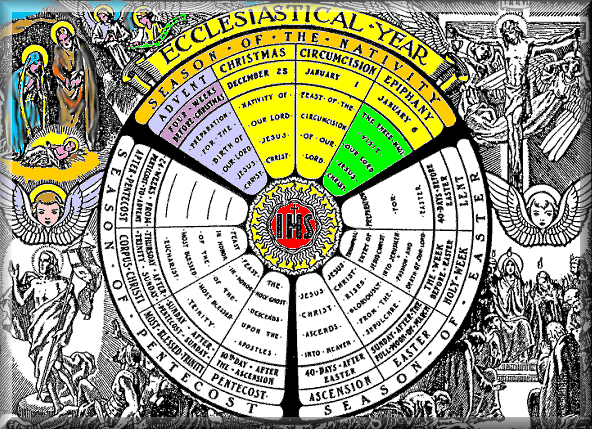
The entire year is divided by the Church into periods and seasons, some in rejoicing, some of penance, and others of ordinary prayer and work. By following the cycle of feasts and fasts, and living in the spirit of each time, we shall sanctify the whole year and make it bear fruit pleasing to God. In observing the seasons we should look upon the events as actually occurring. The Church is the Mystical Body of Christ; she lives over every year the mysteries of His life. Thus we unit ourselves with Christ. The ecclesiastical year is the succession or cycle of seasons, including all the feasts, celebrated by the Church during the year. The Church commemorates the different feasts and seasons, placing the various events of the life of Our Lord before us, in order that we may ponder over them and imitate the virtues presented. This cycle is made up of six seasons or periods of unequal length: Advent, Christmastide, Septuagesima, Lent, Paschal time, and the period from Pentecost to Advent. These periods are regulated in their occurrence by the three principal feasts of the year: Christmas, Easter, and Pentecost. The Epistles and the Gospels, as well as the Hymns and Sequences of the Mass, are in consonance with the seasons and periods of the ecclesiastical year. The ecclesiastical year differs somewhat from the civil year. Instead of beginning on a fixed date, January 1, as the civil year does, the ecclesiastical year begins with the first Sunday of Advent, four Sundays before Christmas. The three principal feasts of the year are: Each of these feasts has a season of preparation preceding, and a season of commemoration following. Easter is always the Sunday after the first full moon following March 21. Its position determines the position of the different seasons and moveable festivals of the entire year. In 2011 the Solemnity of the Resurrection will occur in late April, as late as it has been in some time. Every day of the year the Church commemorates one or more of her Saints, encouraging us to imitate them who imitated Christ, and to implore their intercession. By such commemorations, our thoughts are fixed on God, even amidst life's distractions. For Step Twenty we will focus on the first of the three, the Season of the Nativity which encompasses Advent, Christmas, the Circumcision and the Time of and after Epiphany. We will insert the other seasons as we approach them in future steps. Advent Advent is the period of preparation for Christmas. "Advent" comes from the Latin verb "venire" "come" and "ad" preposition "to", thus "to come". It begins with the first Sunday of Advent, and embraces the four Sundays before Christmas. It is a season of penance in preparation for the birth of the Redeemer. The four weeks of Advent represent the four thousand years during which the coming of the Messias was expected and prepared for. As a sign of penance, the Church uses purple or violet vestments for the Mass of the season, suppresses the joyous Gloria, omits flowers on the altar, and forbids the saying of the Nuptial Mass, etc. Flowers are permitted on Laudare Sunday, named for the Introit of the Mass, which falls on the Third Sunday of Advent. Advent ends on Christmas Eve at midnight. The day before Christmas is the vigil of Christmas and a day of fast and abstinence. Speaking of such, Ember Days are days of fast and abstinence on Wednesday (partial abstinence), Friday (full abstinence) and Saturday (partial abstinence) four times a year. The Church has always had this mirroring of the liturgical calendar with the four seasons: the Third Week of Advent - Winter after December 13, the First Week of Lent - Spring, Pentecost Week - Summer, and the Seventeenth Week after Pentecost - Autumn between September 14 and September 22. These occur at the beginning of the four seasons, which begin with the liturgical periods known as Ember weeks. This has been the practice of the Church since the fifth century. They are celebrated to implore God's blessings on the fruit of the earth, those days are likewise intended as special occasions for praying for the clergy. Never has the clergy - the hierarchy of the Church - needed more prayer than this present time of grave crisis. Ember weeks prepare those who are to be ordained to major orders or elevated in minor orders. The minor orders of Tonsure, Porter, Lector, Exorcist and Acolyte have been all but lost on the culture of the modern Church, but it was the practice for nearly 2000 years so why should it be shelved in favor of the heretical notion of lay sacerdotal commissions? It should not. The practice of Ember Days was set for the universal Church by the holy Pope Saint Gregory VII in the twlfth century with the specific purpose, as mentioned above, of consecrating the various seasons of nature to God. During Advent, the Wednesday of Ember Week the Mystery of the Annunciation is commemorated. It is called the Rorate Mass, taken from the first word of the Introit, Isais 45: 8. Many churches observed this date on December 18 rather than March 25 because this joyful feast occurred most often in Lent. Another reason is that the first Joyful Mystery keeps with the chronological events of Christ's life and Advent is the time of the waiting after the Annunciation. The anticipation grows daily until the Nativity of Our Lord in Bethlehem. Ember Friday in Advent was traditionally the Mass at the Church of the Twelve Apostles in Rome, with the emphasis on the "Expectation of Christ" as St. Andrew's Missal points out. On Ember Saturday of Advent, Mass was traditionally held at St. Peter's Basilica by the Pope. Saturdays are the most solemn of the Ember week because traditionally on this day the Holy Father would ordain new men to the priesthood. In fact, as the St. Andrew's Missal relates, "Everything in the Mass, moreover, bears the character of a very ancient liturgy. It calls to mind, with its numerous lessons, intermingled with responses and prayers, the earliest form of the introductory part of the Mass. The soul that is penetrated with it finds itself filled with a holy impatience, and with the Church it aspires to the new birth of the only begotten Son of God, Who comes to deliver us fsromthe yoke of sin (Second Collect) 'While with confidence she awaits the Lord Jesus Who shall deliver us from our enemies, destroying Antichrist with the brightness of His Coming' (Epistle). The Gospel brings before us the image of St. John the Baptist the precursor, who prepares our souls each year for the coming of the Savior. The same Gospel is again found in the Mass of the following day - [The Fourth Sunday of Advent] - because formerly the ordination, taking place in the evening, lasted well into the night, thus encroaching on the Sunday, provided it with its liturgy." We can see how this has all been blurred by the pagan Masonic and Protestant New Order 'Mass' (read: Mess) of Paul VI which so abandoned these beautiful traditions and safeguards. One safeguard, discipline that has been practicaly discarded is fasting, penance, self sacrifice. Fasting and abstinence are not something to be shunned, diminished or be ridiculed. Our Lord Jesus Christ Himself fasted often. He fasted forty days and forty nights before He began His public life. By Church law, all baptized persons between that ages of 21 and 59 years are bound to observe the law of fast, and all baptized persons over 7 years of age are bound to observe the law of abstinence. A fast day is a day on which only one full meal is allowed; but in the morning and evening some food may be taken, the quantity and quality of which are determined by approved local custom. The one full meal may be taken either at noontime or in the evening. Only at this meal may meat be taken. "Meat" is the flesh of warm-blooded land animals, including birds and fowl. At the principal meal meat may be taken on a day of fast except on days of complete abstinence. For centuries up until the relaxation of the penitential spirit at Vatican II, meatless days were every Friday and the vigils of the Solemnity of the Immaculate Conception and Christmas. Today, in the counterfeit church of conciliarism only on Ash Wednesday and Fridays in Lent are Catholics required to fast. Sad that 54 days of fast and abstinence, and eight days of fasting and partial abstinence have been reduced to a mere two days out of the entire year. No wonder satan has had the run of things. No wonder the modern church is in such turmoil today for by letting down its defenses, satan rushed right on in. The next step: Ember Days also have been discarded, thus weakening souls' resistance to sin by the practice of sacrifice and penance. Ergo sins reigns supreme today and Ratzinger's shocking announcement that contraceptive prophylactics, an evil in itself, are permitted if it prevents a greater evil is insanity and apostasy rolled into one. This Hegelian is trying to pull a fast one and no amount of fasting can overcome the damage this has done because the people have lost the sense of sacrifice. They have forgotten that fasting on a day of abstinence has always meant that two other meals, both meatless, may be taken according to each one's needs; but together they should not equal another full meal. Eating between meals is forbidden; but liquids, including milk and fruit juices, are allowed. Wine, coffee, tea, cocoa, lemonade, beer, sherbets, and like preparations are also permitted. All baptized persons between the ages of 21 and 59 are obliged to observe the fast days of the Church, unless they are excused or dispensed. Persons dispensed from fast must, however, observe abstinence unless they have also been dispensed from abstinence. When health or the ability to work would be seriously affected, the law does not oblige. For this reason those of weak health, the sick, the convalescent, nursing mothers, the very poor and those engaged in hard labor are excused from the fast; also nurses and teachers. One in doubt as to his or her duties in this matter should consult a parish priest or their confessor. A day of abstinence is a day on which we are not allowed the use of meat. Again, this has been greatly relaxed with only Ash Wednesday and Fridays in Lent, including Good Friday, as days of abstinence; although many Catholics, especially Traditional Catholics, still faithfully observe Fridays as meatless days out of obedience to the Truths and Traditions of Holy Mother Church. Besides being a deterrent from gluttony and serving self first, it is also a great reminder of our Catholic roots and purpose, a reminder of Christ's Own preparation for Calvary. Food-wise, fish, snails, frogs, oysters, shrimps, and crabs may be taken on abstinence days, as well as milk, butter, cheese, eggs, and similar foods. Lard and the fat of any animals may be used in cooking and seasoning. On an abstinence day which is not also a fast day, only the quality, not the quantity, of food is regulated. On days of complete abstinence meat, and soup or gravy made from meat, may not be used at all. On days of partial abstinence meat, and soup or gravy made from meat, may be taken only once a day at the principal meal. However, since we no longer have partial abstinence days, this is seldom observed. All baptized persons over 7 years of age are bound to observe the abstinence days of the Church unless excused or dispensed. The sick and convalescent, those who do extremely hard work, and those too poor to obtain other foods are excused. The law of abstinence binds even those not obliged to fast. One who believes he has sufficient reason to be excused should consult a priest. When there is a great concourse of people, or if public health is concerned, the bishop can grant a dispensation for a particular locality, or even for the entire diocese, from the law of fast or of abstinence, or both. In recent years many bishops have granted dispensations very liberally to the degree that the intention of fasting has been greatly lessened. The True Church, in her Second Commandment of the Church "To fast and abstain on days appointed" has always commanded us to fast and to abstain in order that we may control the desires of the flesh, raise our minds more freely to God, and make satisfaction for sin. "I chastise my body and bring it into subjection, lest perhaps after preaching to others I myself should be rejected" (1 Corinthians 9:27). It is not because meat and other foods are in themselves evil that the Church prescribes fast and abstinence. She merely commands us to deny ourselves for the glory of God and the good of our souls. A good Christian will be careful to observe the laws of fast and abstinence. One who cannot fast should do some other penance. The forty days' fast observed in Lent is in imitation of Our Lord, Who fasted forty days in the desert. It is a preparation for Easter. Friday as a day of abstinence commemorates Our Lord's Good Friday. By fast and meditation on the sufferings of Christ, we can best induce in ourselves a proper contrition for our sins. Fast and abstinence are pleasing to God only when we also refrain from sin and engage in good works. We should honor Our Lord's passion during Lent by abstaining from worldly pleasures and amusements. We should accept trials patiently, uniting them to Our Lord's. Even from merely natural motives, fast and abstinence, far from ruining the health as some people claim, on the contrary are a preservation of health. Reputable physicians will bear out this fact. To stay a step ahead of the devil we must condition ourselves spiritually. Today spiritual exercise is more needed than ever. Christmastide Christmastide is the season of celebration after Christmas, a season of joy. During this period we celebrate events in the child life of Our Lord: the Circumcision, the Epiphany, the Feast of the Holy Family, the Purification, etc. The length of this period is regulated by the position of Septuagesima Sunday, which may occur any time between January 16 and February 22. The time of Christmastide, 40 days, ends with the Time after Epiphany and if there are fewer Sundays, those are added at the end of the Time after Pentecost. The period after Christmas symbolizes the youth of Jesus, the years that intervened between His birth and the beginning of His public life. We call this His hidden life in Nazareth and this first third of the cycle is represented by the Joyful Mysteries of the Holy Rosary. The French name for Christmas, Noel, often used also in English, especially in Old English hymns and carols, is the abridgment of the word Emmanuel, God with us. The prophet had given this name to the Messias, and this great solemnity of the Church saw its accomplishment. In the popular language, the word Emmanuel did not remain unaltered. The feast of Emmanuel soon became the feast of Nouel, then Noel. It was first celebrated with the feast of the Epiphany, January 6, for it was believed that Jesus Christ was born then. Pope Julius I, having instituted the most exact researches about 340, ordered that the feast be transferred to December 25th; the Epiphany continued to be solemnized on January 6th. This, Dom Gueranger in The Liturgical Year on 'Christmas,' explains a peculiarity of the octave of Christmas, as old as the feast itself; although it is an octave of the firts order, it admits solemnities which are excluded from the octaves of Easter and Pentecost. The reason for this goes back to what was just been said. When the birth of the Savior was celebrated on January 6th, December 26th honored - and still does - the feast of Saint Stephen, December 27th Saint John the Evangelist, and December 28th the Holy Innocents. When the Nativity was finally fixed as December 25th, it was thought best not to remove these feasts. It is then in the octave of the Epiphany that the original octave of the Nativity of Our Lord is to be seen; hence it enjoys the same privileges as the other two great feasts of the year, because we count the Sundays after Epiphany, instead of those following Christmas, as those after Easter and Pentecost are counted. Communion was, for a long time, obligatory at Christmas and Pentecost, as at Easter. As a sign of the great joy brought to earth by the birth of Emmanuel, abstinence is done away with on Friday when the feast falls upon that day. In Rome on this day at Santa Maria Maggiore, which has the honor of possessing the holy manger, this relic is exposed all day. At St. Anastasia is offered to the veneration of the faithful the veil of the Blessed Virgin and St. Joseph's chlamys, or cloak, in which the infant Jesus was wrapped at the moment of His birth. In the Church of the Agonizing is exposed a piece of the swaddling-bands of Our Lord; at Santa Maria in Trastevere is shown, near the high altar, the place from which a fountain of oil miraculously burst forth at the birth of the Savior. Let us add that at St. Lorenzo, beyond the walls, on the feast of St. Stephen, two rocks of his stoning are exposed. On the feast of St. John, at St. John Lateran, is shown the cup from which, at the order of Domitian, the apostle drank poison which did him no harm; the tunic with which he raised from the dead the emperor's ministers who had tasted the same poison; and the chains with which he was bound when he was brought from Ephesus to Rome. Every priest has the right to say three Masses on Christmas - to give thanks to the ever-blessed Trinity, who cooperated in the Incarnation of Jesus Christ, to honor the threefold birth of Jesus Christ: His eternal birth in the boosom of His Heavenly Father; His temporal birth of His virgin Mother; and His spiritual birth in our hearts, which He occupies by His grace. The first Mass is said at midnight wherever practicable, to remind us that before Jesus Christ was born the world was without the true light, and lay in darkness and the shadow of death. Again, it was in the night that He was born; and both His temporal and eternal births are mysterious truths, incomprehensible to our understanding. The second Mass is celebrated at daybreak, because the birth of Christ brought light to the Gentiles, whose salvation was then night, and because, according to tradition, it was about that hour that the shepherds came to see and adore the new-born Savior. The third Mass is said at daylight, because Christ dispersed the darkness of ignorance, and appeared as the Light of the world (John 1: 9; Isaias 60: 8). How Our Lord Jesus Christ came to be born in a stable at Bethlehem is told in the gospel of the day (Luke 2: 1-14). The birth in the stable was meant to show us, from the very beginning that the Savior had not come to establish a worldly kingdom, but a kingdom of grace, justice, and peace, and to lead us to imitate His example of poverty, humility, and contempt of the world. For this reason, too, the birth of Christ was first announced to the poor shepherds, and not to the high priests. God does not distribute His graces through respect for persons: He exalts the humble, and humbles those who exalt themselves. The Magi humbled themselves by traveling from the east to adore Our Lord. This is the feast of the Epiphany. It was fo ra long time blended with that of Christmas, under the name of Theophany, manifestation of God. It took that of Epiphany, or manifestation on manifestation, when the two solemnities were separated. The first manifestation of Our Savior had been to the Jewish people, represented by the shepherds. The second was for the Gentiles, the first-fruits of whom were brought to Jesus in the persons of the Magi. "These," says Dom Gueranger, "are the veritable ancestors of the Gentile Church. One was from Chaldea, the second from Arabia, the third from Ethiopia. They represented, at the crib, the three races of humanity offering their homage to the new-born King." The Gospel speaks of their presents: gold, frankincense, and myrrh. This mysterious number honored in the first place the Blessed Trinity in the person of the Word Incarnate, but it also prophesied the triple character of the Divine Infant. He had come into the world to reign, and gold witnessed to His supreme power; He was to exercise a sovereign priesthood - frankincense, which should smoke in the priest's hand, was a present worthy of Him; His death would open Heaven - myrhh, a perfume reserved in ancient times to embalming, was there for the burial of the Divine Victim. As to their names of Melchior, Caspar, and Balthazar, their use is too recent for us to adopt them. It would be as difficult to sustain the responsibility of doing so as it would seem to us bod to attack them directly. Their bodies, transported from Persia to Constantinople, and later from Milan to Cologne, rest today in the cathedral of that great metropolis, in a magnificent hsrine, the most beautiful monument of the goldsmith's skill o fthe Middle Ages (Gueranger). The date, January 6th, recalls to the love of the Church still other memories. On this day Our Lord, baptized by John the Baptist, heard the voice of the Father proclaiming His divinity; on this same day He worked His first miracle at the Wedding Feast of Cana, and St. Augustine tells us that January 6th was also the day of the miraculous multiplication of the five loaves in the desert (Sermon, i, de Epiphanus). All these events make this feast the great manifestation of the Divinity of Jesus Christ, and full justify its name of Epiphany. However, the preference of the Church is the for the mystery of the calling of the Gentiles. Nothing is more natural, since that mystery is supremely glorious for her. For has not Rome, the capital of paganism, become the head of Christianity by the vocation which, on that day, called all the nations to the light of the true faith? In Rome itself, and Italy generally, Epiphany is called "Little Christmas," and is made the time of gifts and special rejoicings, the real Christmas of the Gentiles. In England it was a popular festival, under the name of "Twelfth Night." The kings of France, up to the fourteenth century, presented, as the offering of this day, gold, incense, and myrrh. In the Middle Ages the faithful offered them also, to have them blessed, and they then preserved them as a pledge of Heavenly favors. This pious custom still exists in Germany. Instead of the bean in the Twelfth-Night cake, the people use a bit of myrhh, a grain of incense, and a piece of gold in the mountains of Scotland. Epiphany has never been a feast of obligation in the United States and, sadly, very little importance is placed on this feast, despite its significance. In fact, many feasts in the universal Church have been condensed and streamlined, even omitted, for the sake of modernizing the liturgy. When we realize the meaning of these beautiful feasts one has to ask why would they have diminished the significance of such magnificent feasts as the Epiphany. Christmastide concludes on the Feast of the Presentation of the Child Jesus in the Temple and Purification of Mary which is also the feast of Our Lady of Good Success.
Previously: Step Nineteen: The Church Triumphant Catholicism Made Simple |





