|
|
|
Diadems of the Decade from Wednesday, May 2, 2007, vol 18, no. 122


|

 
God intends us to have Meaning and Purpose to our life
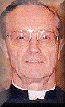
By Father James F. Wathen
 Without our Creator we can do nothing and are nothing. He made us to exist but a fleeting second in this world so that we might love the One Who created us and serve Him for this short time on earth so that we can be happy with Him forever in eternity. Yet man forgets that he is totally dependent upon his Creator and assumes he has the right to do whatever he wants, even to deny the One Who created him. Despite all the wonderful helps God gives through His Church and His simple teachings, there are still some who choose to think they can go it alone. They forget the meaning and purpose in life, and in the process give error free reign to carry the day and carry them away into everlasting nothingness: the pit of eternal fire. We can see so many spiraling toward that end in every daily headline, in the conciliar church, and in governments who have forgotten the meaning and purpose of life. Without our Creator we can do nothing and are nothing. He made us to exist but a fleeting second in this world so that we might love the One Who created us and serve Him for this short time on earth so that we can be happy with Him forever in eternity. Yet man forgets that he is totally dependent upon his Creator and assumes he has the right to do whatever he wants, even to deny the One Who created him. Despite all the wonderful helps God gives through His Church and His simple teachings, there are still some who choose to think they can go it alone. They forget the meaning and purpose in life, and in the process give error free reign to carry the day and carry them away into everlasting nothingness: the pit of eternal fire. We can see so many spiraling toward that end in every daily headline, in the conciliar church, and in governments who have forgotten the meaning and purpose of life.
 "The next principle I wish to consider, the seventh, is accept your
creaturehood. In the Baltimore Catechism, which we used to use in all Catholic grade schools, in the United States, first grade students
learned the answers to these questions. Who made you? The answer, God
made me. Why did God make you? The answer: God made me to know Him,
love Him, and to serve Him in this world, and to be happy with Him
forever in the next. Little boys and girls of five, six, and seven,
learned these answers without doubt or difficulty, and retained them
throughout their lives. Compare this with the fact that it is not
unknown that people have committed suicide, because they wrote in their
obligatory note, that they had no reason to go on living. The catechism
informed the students, that they were God's creatures. He made them
because He chose to. He made them by a special and deliberate act, at
the time of their conception in their mother's womb. And they owed Him
a life of humble and obedient service. And for making them, they owed
Him the love of their hearts." "The next principle I wish to consider, the seventh, is accept your
creaturehood. In the Baltimore Catechism, which we used to use in all Catholic grade schools, in the United States, first grade students
learned the answers to these questions. Who made you? The answer, God
made me. Why did God make you? The answer: God made me to know Him,
love Him, and to serve Him in this world, and to be happy with Him
forever in the next. Little boys and girls of five, six, and seven,
learned these answers without doubt or difficulty, and retained them
throughout their lives. Compare this with the fact that it is not
unknown that people have committed suicide, because they wrote in their
obligatory note, that they had no reason to go on living. The catechism
informed the students, that they were God's creatures. He made them
because He chose to. He made them by a special and deliberate act, at
the time of their conception in their mother's womb. And they owed Him
a life of humble and obedient service. And for making them, they owed
Him the love of their hearts."
|
Let us begin with a prayer. This is the famous prayer called: Suscipe
of St. Ignatius of Loyola. His dates are 1491 to 1556.
Take O Lord and receive all my liberty, my memory, my understanding and
whole will. Thou hast given me all that I have, and all that I possess.
I surrender it all to thee, that thou mayest dispose of it according to
thy will. Give me only Thy Love and Thy Grace. With these I will be
rich enough, and will have no more to desire.
If you have listened to any of these programs before, you know that I am
in the midst of stating what I call First Principles. I am presenting
these as fundamental ideas which have the purpose of establishing an
understanding between you and myself. I resume the effort today, first
by recalling the fifth principal, which is do not pay attention to who
says a thing, but WHAT IT IS THE MAN SAYS. This is a very difficult
thing. We are likely to be impressed or intimidated by those who are in
positions of power, or who have formidable reputations, or who have won
prizes, or who are often quoted, or who have gained many academic
degrees, or who have very much money, or who have many people who agree
with them and praise them, or who have written several books, or those
who have many microphones in front of them. And none of these
considerations, or a thousand like them, gives any value to what they
say. Robert Welch was wont to say, "There was never a time in history,when so much of what people know is wrong."
I devoted the last program to the sixth principle, which is, ALL THINGS
ARE NOT SUBJECT TO CHANGE. We may grant that men are constantly engaged
in altering the physical face of the world, whether by clearing away or
by building, men continue to upgrade the facade of human life. It must
be acknowledged, however, that all this activity does not necessarily
benefit the spirit, nor does it teach men of the unseen world or the
supernatural order. In the arena of the mind, and in that of Jesus
Christ's foundation, truth holds sway. But AT TIMES, ERROR MAY HAVE ITS
DAY, AND CARRY MANY AWAY. My efforts in these little talks, will be to
discuss the things which are permanent and indestructible. The things
which give meaning to the worthy life.
The next principle I wish to consider, the seventh, is accept your
creaturehood. In the Baltimore Catechism, which we used to use in all Catholic grade schools, in the United States, first grade students
learned the answers to these questions. Who made you? The answer, God
made me. Why did God make you? The answer: God made me to know Him,
love Him, and to serve Him in this world, and to be happy with Him
forever in the next. Little boys and girls of five, six, and seven,
learned these answers without doubt or difficulty, and retained them
throughout their lives. Compare this with the fact that it is not
unknown that people have committed suicide, because they wrote in their
obligatory note, that they had no reason to go on living. The catechism
informed the students, that they were God's creatures. He made them
because He chose to. He made them by a special and deliberate act, at
the time of their conception in their mother's womb. And they owed Him
a life of humble and obedient service. And for making them, they owed
Him the love of their hearts.
In simple language, they were told that
on the one hand, they were each of them, absolutely and perfectly
unique, with an individuality and a destiny and a responsibility, that
was all their own. On the other, that they were completely replaceable
by, dispensable to, and dependent upon the Good God their Maker. The
greatest wisdom, for each of them, they were told, would be to recognize
their creaturehood and accept it. And pray to accept their places in
the all encompassing plan of God. I am repeating this lesson here.
Every man must accept the truth of his creaturehood, if he is to know
why he is alive, and if his life is to have any substantial meaning and
purpose. This is a truth which no man may deny with any honesty.
To
substantiate the point, I can do nothing better than to quote the
eloquent, Father Frederick Faber, whose dates were 1814 to 1863. The following paragraphs were taken from the book, "The Creator and the
Creature", which I highly recommend. It can be obtained from Tan Books
and Publishers in Rockford, Illinois, 61105. Father Faber writes: 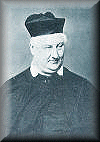 We
are creatures. What is it to be a creature? Before the sun sets in the
red west, let us try to have an answer to our question. We find
ourselves in existence today, with multitudes of our fellow creatures
round about us. We have been alive and on earth so many years, so many
months, so many weeks, so many days, so many hours. At such and such a
time, we came to the use of reason, and at such an age and in such a
way, that we clearly did not confer our reason upon ourselves. We
awaken to find ourselves with a character of our own and fulfilling a
destiny in some appointed station in life. We know nothing of what has
gone before us, except some little of the exterior of the past, which
history or tradition or family records have told us of. We do not doubt
that the sun and the moon and the planets and the stars, the blue skies
and the four winds, the wide green seas, and the fruitful earth, were
before our time. Science unriddles mysterious things about them, but
all additional lights seems only to darken and to deepen our real
ignorance. So it is with the creature, man. He finds himself in
existence. An existence which he did not give to himself. He knows
next to nothing of what has gone before and absolutely nothing of what
is to come, except so far as his Creator is pleased to reveal it to him
supernaturally. Thus it comes to pass that, he knows better, what will
happen to him in the world to come, than what will be his fortune here.
He knows nothing of what is to happen to himself on earth. Whether his
future years will be happy or sorrowful. Whether he will rise or fall.
Whether he will be well or ailing, he knows not. It is not in his
hands. Neither is it before his eyes. We
are creatures. What is it to be a creature? Before the sun sets in the
red west, let us try to have an answer to our question. We find
ourselves in existence today, with multitudes of our fellow creatures
round about us. We have been alive and on earth so many years, so many
months, so many weeks, so many days, so many hours. At such and such a
time, we came to the use of reason, and at such an age and in such a
way, that we clearly did not confer our reason upon ourselves. We
awaken to find ourselves with a character of our own and fulfilling a
destiny in some appointed station in life. We know nothing of what has
gone before us, except some little of the exterior of the past, which
history or tradition or family records have told us of. We do not doubt
that the sun and the moon and the planets and the stars, the blue skies
and the four winds, the wide green seas, and the fruitful earth, were
before our time. Science unriddles mysterious things about them, but
all additional lights seems only to darken and to deepen our real
ignorance. So it is with the creature, man. He finds himself in
existence. An existence which he did not give to himself. He knows
next to nothing of what has gone before and absolutely nothing of what
is to come, except so far as his Creator is pleased to reveal it to him
supernaturally. Thus it comes to pass that, he knows better, what will
happen to him in the world to come, than what will be his fortune here.
He knows nothing of what is to happen to himself on earth. Whether his
future years will be happy or sorrowful. Whether he will rise or fall.
Whether he will be well or ailing, he knows not. It is not in his
hands. Neither is it before his eyes.
If you ask him the particular and special end which he is to fulfill in
this life, what peculiar gift or good which he was called into being to
confer upon his fellow men, what the exact place and position he was to
fill in the great social whole, he cannot tell you. It has not been
told to him. The chances are with him as with most men, that he will
die and yet not know it. And why? Because he is a creature. His being
born was a tremendous act. Yet it was not his own. It has entangled
him in quantities of difficult problems. And implicated him in
numberless, important responsibilites. In fact, he has in him, an
absolute inevitable necessity, either of endless joy or of endless
misery. Though he is free to choose between the two. Annihilation he
is not free to choose. Reach out into the oncoming eternity as far as
the fancy can, there still will be this man, simply because he has been
already born. The consequences of his birth are not only unspeakable in
their magnitude, they are simply eternal. Yet he was not consulted
about his own birth. He was not offered the choice of being or not
being. Mercy required that he should not be offered it. Justice did
not require that he should. We are not concerned now, to defend God, we
are only stating facts, and taking the facts as we find them. It is a
fact that he was not consulted about his own birth, and it is a truer
and higher than all facts, that God can do nothing but what is
blessedly, beautifully right. A creature has no right to be consulted
about his own creation. And for this reason simply, that he is a
creature. He has no notion why it was that his particular soul, rather
than any other soul, was called into being, and put into his place. Not
only can he conceive a soul far more noble and devout than his, but he
sees as he thinks, peculiar deficiencies in himself, in some measure
disqualifying him for the actual position in which God has placed him.
And how can he account for this? Yet, God must be right, and his own
liberty too, must be very broad and strong and responsible. He clearly
has a work to do, and came here simply to do it. It is equally clear,
that if God will not work with him against his own will, he also cannot
work without God.
Every step which a creature takes, when he once has been created,
increases his dependence upon his creator. He belonged utterly to God
by creation, if words would enable us to say it, he belongs still more
utterly to God by preservation. In a word, the creature becomes more
completely, more thoroughly, more significantly a creature, every moment
that his created life is continued to him. This is in fact his true
blessedness. To be ever more and more enclosed, in the hand of God who
made him. The creator's hand is the creatures' home. As he was not
consulted about his coming into the world, so neither is he consulted
about his going out of it. He does not believe that he is always going
to remain on earth. He is satisfied that the contrary will be the case.
He knows that he will come to an end of this life, without ceasing to
live. He is aware that he will end this life, with more or less of
pain, pain without a parallel. Pain like no other pain, and most
likely, very terrible pain. Although the act of dying in itself is
probably painless, yet it has for the most part to be reached through
pain.
Death will throw open to him, the gates of another world. And will be
the beginning to him of far more solemn and more wonderful actions, than
it has been his lot to perform on earth. Everything to him depends on
his dying at the right time and in the right way. Yet he is not
consulted about it. He is entitled to no kind of warning. No sort of
choice is left him, either of time or place or manner. It is true he
may take his own life, but he had better not. His liberty is indeed
very great, since this is left free to him. Yet, suicide would not help
him out of his difficulties. It only makes certain to him the worst
that could be. He is only cutting off his own chances. And by taking
his life into his own hands, he is rashly throwing himself out of his
own hands, in the most fatal way conceivable. One whose business it is
to come when he is called, and to depart when he is bidden, and to have
no reason given him either for his call or for his dismissal, except
such can gather from the character of his Master. Such is man upon
earth. And this is so, because he is a creature.
Is it childish to say all this? We fear we must say something more
childish still. We must not omit to notice of this creature, this man,
that he did not make the world he finds around him. He could not have
done so, for lack of wisdom and of power. But it is not this we would
dwell on. As a matter of fact, he did not do so, and therefore, it is
not his world, but somebody else's. He can have no rights in it, but
such as the proprietor may voluntarily make over to him, in the way of a
gift. He can have no sovereignty over it, or any part of it. Only,
unless by a royal grace, the True Sovereign, has invested him with
delegated powers. In himself, therefore, he is without dominion.
Dominion does not belong to him as a creature. Dominion is a different
idea and comes from another quarter. Furthermore, we do not care
whether it be from faith or reason or from what proportion of both.
This creature cannot resist the certainties that there is an unseen
world, in which he is very much concerned. He is quite sure, nervously
sure, that there are persons and things close to him, though unseen,
which are of far greater import than what he sees. He believes in
presences, which are more intimate to him than any presence of external
things. Nay, in one presence, which is more intimate to him, than he is
to his own self.
Death is a flight away from earth. Not a lying down, a few feet beneath
its sod. It is a vigorous outburst of a new life. Not a resting on a
clay pillow, from the weariful toil of this. All things in him and
around him are felt to be beginnings. And the curtains of the unseen
world, as if lifted by the wind, wave ever and anon into his face, and
cling to it like a mask. And he sees through them or thinks he sees.
This is the last thing we have to note of this man, as he sits upon the
hilltop, in the sunshine, part and parcel of the creatures round about
him. He finds himself in existence, by the act of another, and he knows
nothing of what has gone before him, nothing of what is to happen to
himself, and next to nothing of what is to come. And that little only
by revelation. He was not consulted about his own birth, nor will he be
about his death. He has to die out, and has nothing to do with the when
or the how. He did not make the world he finds round him, and therefore
it is not his. Neither can he resist the conviction, that this world is
for him, only the porch of another more magnificent temple of the
Creator's majesty. Wherein he will enter still further into the
Creator's power, and learn that to be in the Creator's power is this
creature's happiness.
To these thoughts, I wish to add another. Because you are only a
creature, you must accept all your creaturely limitations and
conditions. And the sooner the better. As your discontent will not
change anything. I shall not attempt to itemize these limitations. I
call attention to one only, and that is the limitation of knowledge and
understanding. For His own purposes, your Divine Master chooses not to
explain much that he does. He has chosen to reveal in a skeletal or
better, a schematic fashion, how He runs the world, and what His mind
and purpose in the whole tremendous affair are. He has revealed to His
children, the essentials of His plan, and His ultimate objectives, which
will infallibly be accomplished. As I have said, these programs will be
devoted to speaking about what God has told us. But there is a great
deal which he has not explained, except in the vaguest generalities.
But the consequence, that it is easy to misunderstand and to
misinterpret Him. And you, His creature, will have to be satisfied with
that. We know why He has chosen to be so taciturn about so many things,
because he requires our obedience in faith and in trust. To repeat, it
is a part of our creaturehood, TO BE WITHOUT ADEQUATE ANSWERS TO
QUESTIONS WHICH TRY SOULS AND TEST OUR FAITH. Most notably, the mystery
of evil and suffering, which I shall have occasion to speak of in a
program soon to come.
In the book of psalms, Our Holy God has provided us with a prayer, which
well expresses the proper disposition of such a creature and servant as
you are, and as the psalmist himself, gladly acknowledges himself to be.
O Lord our Lord, how admirable is thy Name in the whole earth. For thy
magnificence is elevated above the heavens. Out of the mouth of
infants, and of sucklings, thou hast perfected praise. Because of Thy
enemies, that thou mayest destroy the enemy and the avenger. For I will
behold thy heavens, the work of thy fingers, the moon and stars which
thou hast founded. What is man that thou art mindful of him? Or the
son of man that thou visitest him? Thou hast made him a little less
than the angels. Thou has crowned him with glory and honor. And hast
set him over the work of thy hands. Thou hast subjected all things
under his feet. All sheep and oxen, moreover the beasts also of the
fields. The birds of the air and the fishes of the sea, that pass
through the paths of the sea. Oh Lord our Lord, how admirable is thy
name in all the earth. (Psalm 8, 1 to 10)
Yours in Christ,
Father James Wathen
|

DIADEMS OF THE DECADE
Fr. James Wathen in Making Sense of Sensus Catholicus
from Wednesday, May 2, 2007,
Volume 18, no. 112
|
|