|
|
Editor's Note: We provide Father Cekada's refutation as it appeared on TraditionalMass.org below and we do not include any emphasis or embellishments in order to be totally fair in the presentation per se.
A New Jersey
lawyer and traditionalist,
Christopher A. Ferrara, Esq., has recently produced an anti-sedevacantist tract
entitled “Defending the Papacy: Opposing the Sedevacantist Enterprise.” It has
been widely circulated by Catholic Family News and the Fatima Industry flagship publication, The
Fatima Crusader. Halfway
through his article — the first of a promised series on sedevacantism
— Mr. Ferrara remarks: “In
this time of ecclesial confusion, many Catholics do not recognize a theological
absurdity when they see one.” Well,
I for one certainly do — and Mr. Ferrara’s article is loaded with them. It’s
a rich and heady stew of errors, half-truths and misrepresentations about
theological terms (visibility), Vatican I’s teaching on the pope (perpetuity),
canonical maxims (“The First See is judged by no one”), specialized canon law
terms (manifest), church history (the cases of Popes Honorius and John XXII),
papal bulls (Paul IV’s Cum ex Apostolatus), and much, much more. Mr.
Ferrara’s polemical method is thoroughly dishonest: He says that identifying
sedevacantist “spokesmen” is “not relevant to the aim of this essay,” so he
identifies neither the authors nor the articles he is attacking. (He quotes or
paraphrases me a number of times.) His real aim, of course, is to prevent
readers from looking up articles that he fears are too convincing. His
opening argument is a lengthy attack on his targets’ sanity. Sedevacantists
adhere to a “patent absurdity.”
They are sometimes “highly intelligent” but nevertheless exhibiting the
“impenetrable self-enclosed reasoning of a madman.” Translation: Ignore all
evidence, folks. In
all this, Mr. Ferrara is very much like a truculent non-lawyer trying to argue
a case in civil court. He slings around lingo he doesn’t understand, repeatedly
ignores the rules of evidence, and pulls as many dirty tricks as he can. I
can’t fine Mr. Ferrara for contempt and clogging the system. But I can at least
blow the whistle on a few of his major howlers. But
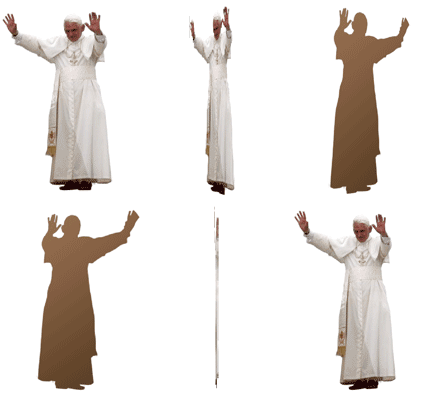
first, some prefatory remarks are in order. THE CARDBOARD POPE…
Mr. Ferrara advocates essentially the same
position as the Society of St. Pius X, Fr. Nicholas Gruner, and countless
others: You claim to “recognize” Paul VI, John Paul I, John Paul II and
Benedict XVI as true popes. At the same time YOU decide which papal
teachings, laws, sacramental rites, or commands are good, and which you’ll
reject, resist or publicly denounce. Under
this system, a pope no longer possesses the supreme authority to “bind and
loose” on earth. A New Jersey lawyer,
the Superior General of SSPX, the CEO of the Fatima Industry, the editor
of Catholic Family News, or,
generally, any traditional Catholic whatsoever, does the final review for him. The
New Mass? A sacrilege, intrinsically evil, or the pope didn’t promulgate it
correctly anyway. Ecumenism? No thanks, the pope’s wrong. Consecration of
Russia to Immaculate Heart? The pope didn’t do it right. Excommunicated or
suspended? Invalid, no matter what the pope and his curia say. Consecrate
bishops against the pope’s explicit will? Necessity lets me do it. And so on. Who
needs to visit the Throne of Peter? You give the final thumbs-up or -down from
your easy chair. The
pope speaks. You decide… This
system makes a mockery of the Catholic teaching that the pope possesses not
only a “Primacy of honor” (framed photos in the vestibules of wildcat
traditionalist chapels, say) but also “supreme and full power of jurisdiction
over the universal Church, both in matters of faith and morals, as well as in
those things that pertain to the discipline and rule of the Church spread
throughout the world,” a power that is “ordinary and immediate over each and
every church, as well as over each and every pastor and member of the faithful,
independent of any human authority.” (Vatican I, Dogmatic Constitution De
Ecclesia Christi, DZ 1827; Canon
218.) Mr.
Ferrara wrote a book on the post-Vatican II mess entitled The Great Façade. No wonder. Mr. Ferrara’s system gives you a
cardboard pope — “for display purposes only.” … VS. SEDEVACANTISM
Sedevacantism
(from the Latin phrase sede vacante, denoting the interregnum between the
death of one pope and the election of another) refers to the belief among some
traditionalists that post-Vatican II popes are not true popes. It
begins with two points all traditionalists agree on: (1) The New Mass was evil
and harmful to the Church, as was a great deal of the post-Vatican II
legislation. (2) Many teachings of Vatican II and the post-Vatican hierarchy
contradict previous Catholic teaching and are at least errors. From
here sedevacantism generally argues as follows: 1.
The authority of the Church, because of Christ’s promise, cannot give evil laws
or teach error. 2.
It is therefore impossible that the evils and errors officially sanctioned by
the post-Vatican II hierarchy could have proceeded from the authority of the
Church. 3.
Those who promulgated these evils and errors must somehow lack (have lacked)
real authority in the Church. 4.
Canonists and theologians teach that public or manifest defection from the
faith, automatically brings with it loss of ecclesiastical office (authority).
They apply this principle even to a pope, who in his personal capacity, becomes
a heretic. 5.
Two popes, Innocent III and Paul IV, explicitly mentioned the possibility that
a heretic could end up on the throne of Peter. Paul IV even declared that such
a pope’s election would be invalid and that he would lack all authority. 6.
Since the authority of the Church cannot defect (give evil or error), but a
pope (or a bishop) as an individual can, the best explanation for the
post-Vatican II evils (the new Mass) and errors (religious liberty, ecumenism,
etc.) is that they proceeded (proceed) from individuals who, despite their
occupation of the Vatican and various diocesan cathedrals did (do) not
objectively possses canonical authority, having lost it through public
defection from the faith. I
and others have repeatedly published pronouncements from pre-Vatican II
theologians, canonists and popes — Badii, Bellarmine, Beste, Coronata,
Dorsch Herrmann, Iragui, Prümmer, Regatillo, Salaverri, Schultes, Van Noort,
Vermeersch, Wernz-Vidal, Wilhelm, Zubizarreta, Pope Innocent III, Pope Paul IV,
etc. —to support the principles enunciated above. For
this I refer readers to my short study Traditionalists, Infallibility and the
Pope and to numerous articles
posted on www.traditionalmass.org
That
said, we turn to Mr. Ferrara’s more glaring errors. In each case, I will
try to sum up fairly his various objections to sedevacantism. I will then
systematically refute these objections by quoting theologians, canonists, popes
and canon law. I will also refute in passing some proofs he offers for the
cardboard pope (“recognize-but-resist”) position. 1. PATENT ABSURDITY: Sedevacantism
“can only be dismissed as patently absurd,” because it assumes that most
Catholics adhered for five decades to an imposter pope and episcopacy. This
would “make a mockery” of the promise of Christ to his Church. (pp. 10-11, 9) Mr.
Ferrara’s opening argument is circular: Sedevacantism is absurd because it is
absurd. Maybe
this works in a Jersey courtroom, but in the science of Catholic theology, you
cite teachings of recognized authorities if you want to be taken seriously. So, to Mr. Ferrara’s unproven assertion that it is “absurd” to believe that the overwhelming majority of Catholics might one day end up adhering to a false pope, we respond with the teaching of the theologian Father Sylvester Berry: “The prophecies of the Apocalypse show
that Satan will imitate the Church of Christ to deceive mankind; he will set up
a church of Satan in opposition to the Church of Christ. Antichrist will assume
the role of Messias; his prophet will act the part of Pope, and there will be
imitations of the Sacraments of the Church. There will also be lying wonders in
imitation of the miracles wrought in the Church.” (The Church of Christ, 119) “There seems to be no reason why a
false Church might not become universal, even more universal than the true one,
at least for a time.” (ibid. 155) An ecumenical Super-Church with a
false pope? Imitation sacraments? Lying wonders? The faithful reduced to a
remnant? After four decades of the Vatican II
disaster, how absurd does this sound? 2. DEAD CHURCH: “Without
the Pope at its head and bishops in communion with him, the visible Church
would cease to exist, and Christ would have been made a liar.” (p.9) Here
Mr. Ferrara gives us nearly word-for-word the major premise of an argument made by heretics
against the Primacy of the Pope. Like Mr. Ferrara, they
contended that, if Catholic teaching on the Primacy were true, the Church would
cease to exist during the vacancy of the Holy See. The
theologian Salaverri refuted their argument (and Mr. Ferrara’s) as follows:
Instead of being a “primary foundation… without which the Church could not
exist,” the pope is a “secondary foundation,” “ministerial,” who exercises his
power as someone else’s (Christ’s) representative. (See De Ecclesia 1:448) So,
during the vacancy of the Holy See, despite what heretics and Mr. Ferrara have
argued, the visible Church does indeed continue to exist. 3. HEADLESS REMNANT: The Church may well be “ultimately reduced to a
very tiny remnant by the time that the Antichrist appears… but that remnant
will still have a Pope at its head… Otherwise that remnant would not be the
Church, but a headless and diffuse body of believers… If there is no Peter,
there is no Church.” (p.9) This
is a variant of the preceding argument. Like it, it is false — contradicted this time by the
theologian Dorsch: “The
Church therefore is a society that is essentially monarchical. But this does not prevent the Church, for a short time after the death of a pope, or even for many years, from remaining deprived of
her head.
[vel etiam per plures annos capite
suo destituta manet]. Her
monarchical form also remains intact in this state.… “Thus
the Church is then indeed a headless body.… Her monarchical form of government
remains, though then in a different way — that is, it remains incomplete
and to be completed. The ordering of the whole to submission to her Primate is
present, even though actual submission is not… “For
this reason, the See of Rome is rightly said to remain after the person sitting
in it has died — for the See of Rome consists essentially in the rights
of the Primate. “These
rights are an essential and necessary element of the Church. With them,
moreover, the Primacy then continues, at least morally. The perennial physical presence of the person of
the head, however, [perennitas
autem physica personis principis]
is not so strictly necessary.” (de Ecclesia 2:196–7) So
once again, Mr. Ferrara is dead wrong. Catholic theology teaches that the See
of Peter can indeed be vacant for
many years; all the while, the
nature of the Church still remains unchanged. 4. PERPETUAL SUCCESSORS: “Sedevacantists are flirting with the Vatican I
anathema, which condemns and excludes from the Church anyone who would call
into question the perpetual succession of the papacy as the visible foundation
of the entire Church.” (p. 10) Mr.
Ferrara, like many other anti-sedevacantist controversialists, stumbled across
Vatican I’s statement that by divine right St. Peter has “perpetual successors”
in the Primacy. (DZ 1825: “perpetuos
successores.”) This he (and
others) took to mean that, except for the brief period between the death of a
pope and the next conclave, Christ promised and the Church taught that a you’d
always (perpetually) have a real, live pope on Peter’s throne. Conclusion:
good-bye, sedevacantism! It
is hard to imagine a more concentrated dose of pure theological ignorance. Vatican
I’s definition was directed against heretics who contended that (1) the Primacy
was an extraordinary power Christ gave to St. Peter alone,
(2) Christ did not intend it to be passed along in perpetuity to his
successors, (3) this power either died with Peter, or was passed along to the
Church or episcopal college. (See Dorsch, de Ecclesia, 2:191-2) What
does the definition itself mean?
That “a primacy of true jurisdiction, together with a full scope of rights and
duties would continue in the Church, and this in virtue of the will of Christ
or by divine law.” (Dorsch 2:191) The
dogmatic theologian Salaverri devotes 23 dense pages to this passage in Vatican
I, nearly all of it directed at proving that Christ intended the office of the
Primacy to be perennis —
not limited to Peter, but rather “a power which will perpetually endure to the
end of the world.” (de Ecclesia,
1:385.) Mr.
Ferrarra, then, has confused two things: (1) the perpetuity of the papacy as a
perpetual institution whose rights and duties continue forever, and (2)
always having a live pope to fill it. 5. FIRST SEE JUDGED BY NO ONE: “Prima Sedes a nemine iudicatur — no one
may judge the First See… That no
one may judge the Pope — that is, his personal sin of heresy as opposed
to the heretical import of his words — is a fundamental truth of our
religion…” (p.13.) (A)
Context: Any first-year canon law student knows that it says
no such thing. The
maxim “the First See is judged by no one” is incorporated into the Code of
Canon Law as canon 1556. The
canon appears in Book IV (Ecclesiastical Trials), Part I (Trials), Section 1
(Trials in General), Title 1 (The Competent Forum), which prescribes which
ecclesiastical courts have jurisdiction to try which types of cases. While
it is true that the pope has the final say on doctrinal and disciplinary
matters in the Church — except in the system Mr. Ferrara and SSPX
propose, where they do —
the maxim itself merely means that there is no ecclesiastical tribunal before
which one could summon the pope or to which one could appeal the pope’s final
judicial decision. Here
is an explanation from a standard canon law manual: “Immunity
of the Roman Pontiff. ‘The First See is judged by no one.’ (Canon 1556). This
concerns the Apostolic See or the Roman Pontiff who by the divine law itself
enjoys full and absolute immunity.” (Cappello, Summa Juris Canonici 3:19.) The judicial
immunity of the pope was disputed in church history by partisans of Gallicanism
and Conciliarism, who also maintained that a pope’s decisions could be appealed
to a general council. The
maxim “the First See is judged by no one” is a procedural norm, then. (B)
Sources: One of canonical sources for the maxim, the Decree of Gratian (ca. 1150), reads as follows: “Whose
sins [the pope’s] no mortal man presumes to rebuke, for he shall judge all and is to be judged by no one,
unless he is suddenly caught deviating from the faith [nisi deprehendatur a fide devius].” (Decree, I, dist. 60, ch. 6.) If
anything, one can conclude from this the very opposite of what Mr. Ferrara maintains: defection from the
faith is the one sin of a pope we are permitted to judge. (C)
Papal Teaching: In two of his coronation sermons, Pope Innocent III
(1198-1216) — considered one of the greatest canonists of his time
— explained how a pope who falls into the sin of heresy is “judged.” “’Without
faith it is impossible to please God.’… And so the faith of the Apostolic See
never failed, even in the most trying circumstances [turbatione], but always continued intact and undiminished,
so that the privilege of Peter remained constant and unshaken. “To
this end faith is so necessary for me that, though I have for other sins God
alone as my judge, it is alone for a
sin committed against faith that I may be judged by the Church. [propter solum peccatum quod in fide
commititur possem ab Ecclesia judicari.]
For ‘he who does not believe is already judged’.”(Sermo 2: In Consecratione, PL 218:656) “You
are the salt of the earth… Still
less can the Roman Pontiff boast, for he can be judged by men — or rather
he can be shown to be judged, if he
manifestly ‘loses his savor’ in heresy. [quia potest ab hominibus judicari, vel potius judicatus ostendi,
si videlicet evanescit in haeresim.]
For he who does not believe is already judged.” (Sermo 4: In Consecratione, PL 218:670) A
pope who commits the sin of heresy, then, can indeed be “shown to be judged.” (D Finally: Mr. Ferrara, who are you trying to kid? If the publications you write for actually applied the maxim “The First See is judged by no one” to themselves, they’d be sending their entire editorial content out each month on a postcard. 6. “MANIFEST” HERESY: When
the term “manifest” is applied to heresy, this means “the denial of an article
of divine and Catholic faith, such as the Trinity, not just any error against
the teaching of the Church.” (p.13) Like
the non-lawyer arguing his own case, Mr. Ferrara has the technical lingo all
messed up. “Manifest,”
as applied to heresy in canon law, however, does not refer to what
truths a heretic denies (Trinity, transubstantiation, etc.), but rather to how openly he denies them. A
heresy becomes manifest (or notorious), when its existence is “established in a
public way” (constat modo publico). This
occurs, for instance, when the existence of the heretical statement “is
established through authentic public documents… because such documents of their
nature are open to inspection by many people, and therefore necessarily bring
with them public notice.” (Michels, De
Delictis et Poenis, 1:140) The authentic public
digest for all the documents of the Holy See is the Acta Apostolicae Sedis. (See canon 9.) Publishing heretical decrees, pronouncements and
encyclicals in the Acta
— as JP2 and company did — would therefore render heresy “manifest”
or “notorious. “Manifest,” again,
refers to the how, not the what, of heresy. 7. NO REAL HERESIES: Sedevacantists have failed to identify any
true heresies “among the many ambiguous pronouncements and disturbing (even
scandalous) actions of John Paul II or Paul VI.” (p.15) For
openers, I suggest the following: (A)
Justification: The
October 31, 1999 Joint Declaration on Justification , approved by Ratzinger and
John Paul II. This
overthrows the solemn dogmatic definitions of the Council of Trent concerning
justification. (B)
The Church: The
Declaration on Communion, the Ecumenical Directory and the Declaration Dominus
Jesus, written by Ratzinger and approved
by John Paul II. These
documents promote the “Subsistent Superchurch” heresy, which, among other
things, denies an article of the Creed (“I believe in one Church”), as well as the proposition “outside the
Church there is no salvation.” (C)
Notes: The former is “an article of the divine and
Catholic faith,” the latter a “dogma of the faith.” (Salaverri 1:1095, 1153) Bishop
Donald Sanborn has written several lengthy articles exposing these heresies.
Readers may find them posted at traditionalmass.org 8. KORAN KISSING: “The latter did not amount to formal heresy, as
the kissing of the Koran was not the pertinacious denial of an article of
divine and Catholic faith.” (p.15) Oh
really? Canonists and theologians teach that external heresy consists in dictis
vel factis — not only in
words, but also in “signs, deeds, and the omission of deeds.” (Merkelbach, Summa
Theologiae Moralis, 1:746.) 9. COUNCIL FOR A HERETIC POPE: “A general council could assemble to verify
the statement or statements allegedly uttered by the Pope,” who would “be given
the opportunity to explain his words or retract them.” The council could
declare “that the Pope, by his own act, had excluded himself from the Church,
thereby ceasing to be pope.” (p.14) Mr.
Ferrara claims this scenario of a pope summoned before a council, asked to
defend himself, and then declared fallen from office is an “accepted
theological view.” Accepted by whom? He
mentions St. Alphonsus Liguori — but he provides no citations one can use
to verify his claim. Mr.
Ferrara also says — again without citations — that this view was
“taught by St. Anthony of Florence.” I
can find no theologian by that name in the 33-volume Dictionnaire
de Théologie Catholique. (See Tables
Générales 1:184-187.) Does Mr. Ferrara mean the Dominican
theologian Anthony of Siena, which
is not far from Florence? Or did St. Anthony of Padua say something about this? Or maybe St. Antoninus, who was Archbishop of Florence? Who knows? This
is the sort of half-baked “evidence” that opposing counsel moves to strike, and
the judge instructs the jury to disregard. Wherever
he got it, the elaborate council/trial/defense /declaration rigmarole Mr.
Ferrara describes is absent from the writing of later canonists and theologians
who treated the question of a heretical pope. Nearly
all resolved it the same way: The Roman Pontiff “would, by divine law, fall
from office without any sentence, indeed, without
even a declaratory one.” (Coronata, Institutiones
Iuris Canonici, 1:316) . 10. DUE PROCESS, GUILT, PERTINACITY: “Absent a procedure to investigate the papal
statement and the surrounding circumstances, including direct questions of the
Pope himself with an opportunty to retract, it would be impossible to judge the
matter fully and fairly.… Who would afford the pope this due process?” (p.14) But
assume for the sake of argument that a papal trial were permissible. Assume further that Christopher A.
Ferrara Esq. were the heretical pope’s chief defense counsel, the head of his
legal “dream team.” Before
he got to his stirring final summation to the cardinalatial jury (“If anathema don’t sit, you must acquit”?), what ground rules would Mr. Ferrara have to
follow? (A)
General Presumption: Would canon law in general consider Mr. Ferrara’s
client innocent until proven guilty? No.
Canon 2200.1 lays down the general principle: “When an external violation of
the law occurs, in the external forum the existence of malice (dolus) is presumed until the contrary is proved.” The
reason such presumptions exist in the law, says the canonist Michels, is that
“in the external forum one acts based on the way things ordinarily happen and
externally appear. And indeed ordinarily, each person of sound mind customarily
acts reasonably and freely, fully knowing and deliberately willing whatever he
really does.” (De Delictis,
1:134) (B)
Heresy and Burden of Proof: In
the case of heresy, though, wouldn’t canon law at least require the prosecutor to
prove that Mr. Ferrara’s client
was “pertinacious” or “obstinate” in the alleged heresy? No
again. “The very commission of any act which signifies heresy, e.g., the
statement of some doctrine contrary or contradictory to a revealed and defined
dogma, gives sufficient ground for juridical presumption of heretical
depravity… [E]xcusing circumstances have to be proved in the external forum,
and the burden of proof is on the
person whose action has given rise to the imputation of heresy. In the absence
of such proof, all such excuses are presumed not to exist.” (McKenzie, The Delict of Heresy, 35.) Mr.
Ferrara, then, would have to rebut the presumption that his client is a
heretic. (C)
Excusing Causes: Mr.
Ferrara is arguing that his client’s heresy, if any, would not be “manifest.”
How could he prove that? Mr.
Ferrara could argue one of seven causes that would excuse his client from moral
culpability for the alleged offense, and hence from “manifest” or “notorious”
heresy. (See canon 2199ff.) They are: (1)
lack of reason (I was crazy). (2)
habitual inculpable ignorance (I was stupid). (2)
actual inculpable inadvertence or error (I was daydreaming). (4)
involuntary intoxication (Those German Lutherans forced the beer down my
throat). (5)
physical force (I was strong-armed). (6)
uncontrollable passion preceding an act of the will (I got really mad). (7)
legitimate self defense (I ducked down over that Koran because the imam took a
swing at me ). Of
the seven, I would advise Mr. Ferrara against choosing ignorance as an excuse.
His client is cleric who holds several doctorates in theology: “If
the delinquent making this claim be a cleric, his plea for mitigation must be
dismissed, either as untrue, or else as
indicating ignorance which is affected, or at least crass and supine… His
ecclesiastical training in the seminary, with its moral and dogmatic theology,
its ecclesiastical history, not to mention its canon law, all insure that the
Church’s attitude towards heresy was imparted to him.” (McDevitt, 48. My
emphasis) You have six
excusing causes left, Mr. Ferrara. Which do you plead, counselor? 11. JOHN XXII, HONORIUS I: Both these popes “were accused of heresy.”
Despite this, they never ceased to be regarded by the Church as popes. These
examples “show us the Catholic way to address a pope who is in error or takes
some action that threatens the common good of the Church.” One may “resist
him.”(p.15, 49-50) At
this point in his article, Mr. Ferrara begins to introduce arguments supporting
the cardboard pope theory as the “Catholic” alternative to sedevacantism. He
begins with Popes John XXII and Honorius I. (A)
Unsavory Company: Citing these cases to justify “resistance” to the
Roman Pontiff puts Mr. Ferrara in some very unsavory company. Opponents
of papal authority — protestants, eastern schismatics, Conciliarists,
Gallicans, the anti-infallibilists at Vatican I, etc. — routinely pointed to John XXII and Honorius to shore
up attacks against Catholic teaching. (B)
Inadequate Sources: As the sources for his account and explanation of
both cases, Mr. Ferrara cites only popular vernacular histories (John, Jedin,
Carroll) and an article on Honorius in the Catholic Encyclopedia. Such
sources have their place. But you can’t put much stock in them if you’re trying
to make a serious argument about what ultimately boils down to a question of
dogmatic theology. You have to
consult and cite the lengthy dogmatic treatises on the papacy written by major
academic theologians. So
on the grounds of his sources alone, we can dismiss Mr. Ferrara’s comments on
John XXII and Honorius as lightweight pop polemics. (C)
Missing Elements: Mr. Ferrara’s analogy between these cases and
that of the post-Conciliar popes fails on several points anyway, because in
both, one or several of the elements required for a heretical pope to lose
office were missing. (1)
John XXII (1316-1334) preached
a series of sermons in Avignon, France in which he taught that the souls of the
blessed departed do not see God until after the Last Judgement. Mr.
Ferrara’s analogy to the situation of the post-Conciliar popes does not hold
here because: (a)
The doctrine on the Beatific Vision had not yet been defined, so a denial of it
would not constitute heresy. (b)
The pope, who had been a theologian before his election, proposed his teaching
only as a “private doctor who expressed an opinion, hanc opinionem, and who, while seeking to prove it, recognized
that it was open to debate.“ (Le Bachlet, “Benoit XII,” in Dictionnaire de
Théologie Catholique, 2:662.) In
the pope’s second sermon, moreover, he said the following: “I
say with Augustine that, if I am deceived on this point, let someone who knows
better correct me. For me it does not seem otherwise, unless the Church would
so declare with a contrary statement [nisi ostenderetur determinatio
ecclesie contraria] or unless authorities
on sacred scripture would express it more clearly than what I have said above.”
(Le Bachelet, DTC 2:262.) Such
statements excluded the element of “pertinacity” proper to heresy. (2) Honorius I (625-638)wrote several letters relating to the Monothelite
heresy (=Christ had only one will, the divine), for which he was later accused,
variously, of being a heretic himself or being soft on heresy. The
ins and outs of this complex case need not detain us, except to mention the
following fact: The disputed
formulas came to light only after
Honorius died. According
to the theologian Hurter, it is certain that “the letters of Honorius were
unknown [ignotae] until the
death of the Pontiff and [the Patriarch] Sergius.” (Medulla Theologiae
Dogmaticae, 360.) Hence,
even if heretical, Honorius’ statements could not have constituted the “public”
heresy required for a pope to lose office. (D)
Failed Analogies: To
sum up, Mr. Ferrara’s attempt to refute sedevacantism with an analogy to the
cases of John XXII and Honorius fails because: (1)
The doctrines denied by the post-Conciliar popes have been defined. (2)
The post-Concilar popes were not proposing their teachings as mere opinion for
theological debate. (3)
The teachings of the post-Conciliar popes were not “unknown” until after their
deaths, but were published in encyclicals, decrees, instructions, speeches and
discourses transmitted throughout the entire world during their lifetimes. 12. RESIST A WAYWARD POPE: St. Thomas, St. Robert Bellarmine and the
“pious and eminent” Francisco Suarez teach that one may “resist” a “wayward
pope.” (p.50-1) Here
Mr. Ferrara reprints and interprets for us three quotes from a larger group
first published in 1970 in Portugese by the Brazilian traditionalist Arnaldo
Xavier da Silveira. They
are part of Mr. Ferrara’s “direct case” — that is, the system he proposes
instead of sedevacantism. These
endlessly recycled quotes are favorites in SSPX/ CFN “recognize-but-resist”
circles, and they pop up all over the place. This allows all sorts of unlikely
types to offer assurances about, say, Suarez’ teachings, eminence and piety
— all without the inconvenience of slogging through about 21,000 pages of
his Latin in really small
type. I
will devote more time to this material at a later date. In the meantime, here
are a few brief comments: (A)
St. Thomas Aquinas: Mr. Ferrara quotes St. Thomas’ justification for
fraternal correction of superiors in general, especially when they say
something that endangers the faith.
(Summa, II-II.33.4) From
this standard nugget of spiritual wisdom, Mr. Ferrara, SSPX and countless
others have drawn several rather generous practical conclusions about what the
Angelic Doctor is supposedly endorsing: (1)
Catholics are free to decide for themselves on a case-by-case which teachings,
laws, sacramental rites and commands emanating from the Roman Pontiff they will
accept (very few, thank you) and which they will “resist” and publicly denounce
(just about everything). (2)
Catholics are free to pursue this “resistance” to the Successor of Peter on a
continuous basis — so far, forty years and counting, with no end in
sight. (3)
Moreover, “implicit in St. Thomas’ teaching,” says Mr. Ferrara, “is that the
pope who commits ‘scandal concerning the faith’ remains the pope, though he may
be rebuked and corrected.” “Implicit”
indeed! So implicit that one cannot find it at all… (B)
St. Robert Bellarmine: Not long ago, I published an analysis of the
Bellarmine “resistance” quote, and based my conclusions upon its context in De
Romano Pontifice and upon
Cardinal Cajetan’s De Comparatione Auctoritatis Papae et Concilii, which Bellarmine cited to support his position. Among other
things, I demonstrated that Bellarmine was talking about resisting a pope who
gives morally evil commands — not one who, like the
post-Vatican II popes, teaches doctrinal error
or imposes evil laws. In his next chapter, the Saint
taught that a heretical pope automatically loses his authority. Mr. Ferrara’s
“answer” to this is that “nowhere does Bellarmine teach that ‘kings or
councils,’ much less isolated members of the Church, can judge a pope guilty of
heresy.” (p.51) Nowhere? Has Mr. Ferrara based this
confident assertion on a careful reading of Bellarmine’s entire Opera Omnia in the 8-volume 1861 Neapolitan quarto edition? Would he care to
demonstrate, based on that edition and a comparison with Cajetan’s de
Comparatione,
where my analysis of the quote in question was in error? Mr. Ferrara? In the meantime,
I will deem that he has conceded my conclusion about the quote. (C) Francisco Suarez. Mr. Ferrara quotes a passage from
Suarez stating that a pope who would “overturn all the rites of the Church
founded on apostolic tradition” — think Paul VI, of course — would
become a “schismatic.” (p.51-2) Mr. Ferrara takes
consolation in Suarez’ opinion that a schismatic pope would retain his office,
and uses this to shore up the “resistance” argument. But Suarez, who
tended to lose most controversies with other Catholic theologians, was the only theologian who held that position. The rest all
taught that a schismatic pope loses the pontificate automatically because
heresy and schism both represented “defection from the faith.” Mr. Ferrara also
provides us with a “nowhere does Suarez teach…” argument. Again, nowhere, Mr. Ferrara? Will we be swearing
you in as an expert witness to testify that you have (a) read the entire
30-volume 1858 Paris edition of Suarez’ Opera Omnia, and (b) based your prior factual
claim thereupon? Finally,
Mr. Ferrara quotes Suarez as stating, “If [the Pope]… gives an order contrary
to right customs, he should not be obeyed; if he attempts to do something
manifestly opposed to justice and the common good, it will be lawful to resist
him.” In
this quote too, Mr. Ferrara, like many other traditionalist writers, sees a
grand charter for global “resistance” to the post-Conciliar popes laws,
doctrines, etc. However,
the translation into English is faulty: It mistranslates bonos mores as “right customs,” implying, perhaps, justification
for resisting changes a pope legislates in liturgical traditions, etc. In
fact the phrase really means “good morals.” (See Suarez, Opera Omnia, 12:321: “Si enim aliquid statuat contra bonos
mores, non erit illi parendum.”) So
once again, Suarez, like Bellarmine, is saying nothing more than this: if a
pope gives you a command to do something contrary to the moral law, you don’t
have to obey — something like, “I’m ordering you this time, Monsignor: Bring me a blonde
chorus girl, and if the piano player complains, shoot him between the eyes…” 13. PAUL IV & “RESISTANCE”: The 1559 Bull Cum ex Apostolatus Officio
supports the “resistance” theory, because Paul IV said that “[The Pope] who may
judge all and be judged by none in this world, may nonetheless be contradicted
if he be found to have deviated from the Faith.” A pope remains pope even if he
deviates from the faith. In this case, one may contradict him. (p.52) This
assertion is ridiculous. In
para. 1 of the Bull, the verb in the Latin phrase si deprehendatur a fide
devius connotes not just a
pope who is “found” to have
deviated from the faith, but one who is “caught” — as in “caught red-handed” in a crime. Then
there is the verb redargui —rebuke.
What “rebuke” did Paul IV envision for a pope caught this way? Not, as Mr.
Ferrara might have us think, forty years of open
letters/we-contradict-you-to-your-face articles written by laymen for some
Counter-Reformation equivalent of The Angelus, Fatima Crusader or Catholic
Family News. Rather,
Paul IV promulgated the Bull to automatically deprive or bar from office those
who had defected from the faith, whether secretly or openly. In
particular, he wished to bar from the papacy in the next conclave Giovanni
Cardinal Morone (1509-1580), whom he suspected of being a secret Protestant
heretic, and whom he even imprisoned in the Castel’ Sant’ Angelo. So,
the Bull fills nearly 10 double-columns in one edition of the Bullarium
Romanum with line after line of blood-curdling language automatically
depriving of ecclesiastical office not just those actually convicted of heresy,
but even those simply caught (deprehensi) deviating from the faith (a fide deviasse). Then
in para. 6, we get to the punch line of Paul IV’s rebuke for the secret heretic
who has been caught red-handed: Paul IV explicitly decrees invalid and null the
election of a Roman Pontiff “who has beforehand deviated from the Catholic
faith [a fide Catholica deviasse]
or fallen into any heresy,” and this “without the need to make any further declaration”
[absque aliqua desuper facienda declaratione]. Note
again: without the need to make any
further declaration. No trial, no
dream team, no Court Channel interviews. Invalidity
of election and automatic loss of office
— not “contradiction” in the popular press from the likes of Mr.
Ferrara — was the rebuke Paul IV prescribed for the a pope who had
“deviated from the faith.” Should
Mr. Ferrara, by the way, continue to advocate Suarez’ superseded opinion that a schismatic pope does not lose office, I call his attention
to the following: A footnote in the Bullarium quotes another edition of the Bull that, after
deviation from the faith and heresy, also specifically applies all its
provisions to those “who have incurred, stirred up, or committed schism” [seu
schisma incurrisse vel excitasse aut commisisse]. And
finally, it was for planning to sell out to the Lutherans on the doctrine of
justification that Paul IV barred Morone from papal office as a heretic and
threw him in jail. (See Francesco Ricossa, “L’heresie aux Sommets de l’Eglise,”
50-1.) This,
of course, is exactly what the heretics Ratzinger and John Paul II did
in 1999: sold out the Catholic teaching on justification to the Lutherans. * *
* At this
point we have gotten though
two-thirds of the first installment of Mr. Ferrara’s article and disposed of
any substantive issues he tried to raise. The
rest of his article is nothing more than the type of argumentation that my
lawyer-friends call “pounding the table”: guilt by association (Palmar de
Troya), creating the specter of a conspiracy (the sedevacantist “Enterprise”
— though Mr. Ferrara has been the one “exploring strange new worlds”),
special pleading (SSPX’s “state of necessity”), inadmissible evidence (secret
Vatican assurances), circular arguments from authority (the opinion of
Ratzinger — who declared that a Mass without the words of consecration was valid — taken seriously regarding Holy
Orders conferred by Abp. Thuc), pompous generalizations (conclaves are “logical
outgrowths”), etc. etc. — and the whole production backed up by
non-existent to dodgy sourcing at about the level of a high school religion
paper. Mr.
Ferrara, accustomed to flattering his juries during summations, closes with a
final appeal to the crowd: For those, he says, who “are reasonably
well-informed about the Faith, however, refutation is a simple matter.” That’s
for sure: Mr. Ferrara’s circular argument on sedevacantism as an “absurdity” is
refuted by the theologian Berry. His pronouncement on visibility shot down by
Salaverri. His “headless/diffuse body” statement on the length of the vacancy
buried by Dorsch. The “perpetual successors” argument rendered unsuccessful by
Dorsch and Salaverri. His misrepresentation of canon 1556 corrected by the
Code, Cappello, Gratian and Pope Innocent III. His misuse of “manifest” exposed
by Michels. JP2’s Koran-kissing re-criminalized for him by Merkekbach. “Due
process” fallacies refuted by Michels, McKenzie, the Code, and McDevitt. Faulty
analogies about John XXII and Honorius I demolished by Le Bachlet and Hurter.
Myths about “resistance” texts duly toppled by the Latin originals. Refutation
by the “reasonably well-informed” has been very simple indeed… So
when Mr. Ferrara publishes the next installment of his attack on sedevacantism,
filled with more confidently stated assertions and aggressively formulated
arguments about theology, church history and canon law, just remember the one
great truth we have demonstrated here: Christopher
Ferrara is a windbag. He has no idea what he’s talking about. (August 2005) Bibliography Berry, Sylvester. The Church of Christ: An Apologetic and Dogmatic
Treatise. St. Louis: Herder 1941. Cappello, F. Summa Juris Canonici. 4th ed. Rome: Gregorian 1945. Cekada, Anthony. “The Bellarmine Resistance
Quote: Another Traditionalist Myth.” 2005. traditionalmass.org ---- Traditionalists,
Infallibility and the Pope. Cincinnati & West
Chester OH: St. Gertrude the Great Church 1995. Code of Canon Law. 1917. Dorsch, A. Institutiones Theologiae
Fundamentalis: de Ecclesia Christi. Innsbruck: Rauch 1928. Ferrara, Christopher. “Defending the
Papacy: Opposing the Sedevacantist Enterprise.” Part 1. Fatima Crusader. Summer 2005. 8-15, 49-60. See also Catholic
Family News.
August 2005. 1ff. GRATIAN. Decretum Magistri
Gratiani HURTER, H. Medulla Theologiae
Dogmaticae.
Innsbruck: Wagner 1902. INNOCENT III. Sermo 2: In
Consecratione Pontifici Maximis, “De Primatu Apostolicae Sedis.” Migne, Patrologia
Latina. 218:654-60. ---- Sermo 4: In Consecratione
Pontificis Maximi, “Quod
Doctori Necessaria Sit.” Migne, Patrologia Latina. 218:665-672. Le
Bachlet, X. “Benoit
XII.” Dictionnaire de Théologie Catholique. Paris: Letouzey 1950. 2:653-704.. Merkelbach B. Summa Theologiae Moralis. 8th ed. Montreal: Desclée 1949. McDevitt, G. The Delict of
Heresy.
CU Canon Law Studies 77. Washington: 1932. Michels, G. De Delictis et Poenis. Paris: Desclée
1961. PAUL IV.
Bull Cum ex
Apostolatus Officio.
16 February 1559. In Bullarium Romanum. RICOSSA,
Francesco.
“L’heresie aux Sommets de l’Eglise.” Sodalitium 36. June-July 1994. 44-58. Salaverri, Joachim. Sacra Theologiae
Summa: De Ecclesia.
Madrid: BAC 1958. vol 1. SANBORN, Donald J. “Communion:
Ratzinger’s Ecumenical One-World Church.” Autumn 1992. traditionalmass.org ---- “Critical Analysis of the
Joint Declaration on Justification.” January 2000. traditionalmass.org --- “Don’t Get Your Hopes Up
about Ratzinger.” May 2005. traditionalmass.org. --- “O Sacrament Unholy.”
February 2002. traditionalmass.org ---- “Ratzinger’s Dominus
Jesus: A Critical
Analysis.” October 2000. traditionalmass.org SUAREZ, Franciscus. Opera
Omnia. Paris:
Vivès 1858. Summa Theologica. Vatican
Council I. First
Dogmatic Constitution De Ecclesia Christi. 18 July 1879. DZ
 | |||||



 Sedevacantism and Mr. Ferrara's Cardboard Pope








