by
Father Kevin Vaillancourt
On the loss of ecclesiastical offices, Canon Law 188: 4 of the Pio-Benedictine Codex Iuris asserts that an ecclesiast who publicly defects from the Catholic faith automatically loses his authority and all jurisdiction. The "office becomes vacant upon the fact without any declaration by tacit resignation recognized by the law itself." This applies to any ecclesiast no matter his rank. This is reaffirmed by four noted and inspired saints.
"There are
not two sets of laws in the Church: one for the faithful, and another
for the pope. There is only one law, and that states that those who are
involved in acts such as described above are ipso facto (by the very
fact) excommunicated and placed outside the Church. Canon Law does not
distinguish between a Pope and a non-Pope in this area. Actions done in
this way are public, they are manifest, and, as a great consensus of
theologians, saints and those not yet raised to the altars, agree: a
manifestly heretical Pope ceases to be Pope. He does it to himself by
embracing and teaching error in a public manner.
"
All Catholics agree with the statement:
"A man who is a heretic, after the first and second admonition, avoid."
But, how many Catholics will agree with his statement:
"The Pope heretic ceases to be the Pope by himself, without a
deposition from the Church."
This is an important consideration if we are to judge who those referred
to as sedevacantists are. Are they heretics? Have they lost the Catholic
Faith? Or, are their considerations valid?
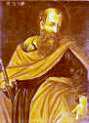 The first statement above comes from St. Paul's Epistle to Titus,
Chapter 3, verse 10. No one will doubt what St. Paul says here. After
all, they are the words of Scripture and cannot be doubted. The Apostle
to the Gentiles here writes to Titus, a man whom he made a bishop,
instructing him on the manner of dealing with heretics. "Avoid them", he
says, for they are a danger to Faith, having lost it themselves, all the
while having no desire to correct their error.
The first statement above comes from St. Paul's Epistle to Titus,
Chapter 3, verse 10. No one will doubt what St. Paul says here. After
all, they are the words of Scripture and cannot be doubted. The Apostle
to the Gentiles here writes to Titus, a man whom he made a bishop,
instructing him on the manner of dealing with heretics. "Avoid them", he
says, for they are a danger to Faith, having lost it themselves, all the
while having no desire to correct their error.
Now, let's move to the second statement. It takes the concerns of St.
Paul one step further. If the Pope should fall into heresy, is he a
heretic? Is he protected from heresy? Should we avoid him? What is more
important, is he still the Pope?
Those involved in the Traditional Movement are polarized over the word
sedevacantist. Many have been told by priests and lay theologians alike
that the "dirty ol' sedevacantists" are not even Catholic. "They don't
believe in the Pope, or, if they do, they don't pray for him. They're
heretics, or, at best, schismatics." Based on all this, most traditional
Catholics would agree that the second statement above is something that
would come from the sedevacantists, and, according to their sources and
opinions, it is heretical. But, is it?
Yes, the above statement was made by someone who professed the
sedevacantist views, but, no, it is not a heretical statement. How can I
say this? Simply because it is a statement made by St. Robert
Bellarmine, as found in his writing On The Roman Pontiff. St. Robert
Bellarmine is a canonized saint and a Doctor of the Church. His writings
are free from error, else he would not be a canonized saint, much less
an ecclesiastical Doctor. St. Robert Bellarmine did not consider himself
a sedevacantist, for this is a term invented by the lay theologians of
our time. But, perhaps, if he were alive today, our saint would agree
with the term as applying to himself, but not according to the bombastic
definition that has been given for sedevacantism by those who either
oppose it or who are afraid of it.
What does sedevacantist really mean? In short, it comes from the Latin
words which mean "the chair is vacant" (sede vacante). It is applied to
Catholics who, seeing the heresy prevalent in the modern church, are
unwilling to say that the identification of heretics doesn't stop with
just some wild lay theologians, or the priests, or the bishops and
cardinals. No, the power to permit heresy's survival in our age rests
right at the top. What is more, those men who have occupied the Chair of
Peter since the Second Vatican Council have done publicly heretical acts
-- acts which have been condemned by the Church over the centuries, and
which are blatantly performed in spite of these Church decrees. Some of
these acts include the destruction of the Roman Mass by the introduction
and continued promotion of the Novus Ordo Missae, the promotion of false
and heretical ecumenism, and the participation in false religious acts
under the spirit of being "ecumenical". All these actions are condemned
by the Church, and they bring the penalty of excommunication.
There are
not two sets of laws in the Church: one for the faithful, and another
for the pope. There is only one law, and that states that those who are
involved in acts such as described above are ipso facto (by the very
fact) excommunicated and placed outside the Church. Canon Law does not
distinguish between a Pope and a non-Pope in this area. Actions done in
this way are public, they are manifest, and, as a great consensus of
theologians, saints and those not yet raised to the altars, agree: a
manifestly heretical Pope ceases to be Pope. He does it to himself by
embracing and teaching error in a public manner.
But, wait a minute? Doesn't sedevacantism contradict the dogma of Papal
Infallibility? The catechism teaches that the Pope is incapable of
teaching error in matters of faith and morals for the universal Church.
This is true. But, does this mean that the Pope would have to die before
he would preach heresy to the Church? No. By embracing heretical notions
in a public manner (not as a private opinion), and not desiring to
correct himself, he separates himself from the Papacy of the Roman
Catholic Church, so any statements he makes, even if he still wears the
robes and is called "Holy Father" by many, are still not the statements
of the Pope. Why? Because one of the first requirements to be the Pope
of the Catholic Church is that a man be Catholic, and the public heretic
cannot be a member of the Mystical Body of Christ.
But, who says so? The Church hasn't proclaimed this a dogma, has it? No,
for who would ever think this would ever be possible. Yet, saints and
theologians have debated this over the centuries, and the majority of
them come to the same conclusion: the pope cannot be a heretic.
Let's look at a few of these statements:

"Now when he (the pope) is explicitly a heretic, he falls ipso facto
from his dignity and out of the Church, and the Church must either
deprive him, or, as some say, declare him deprived, of his Apostolic See
..." -- St. Francis de Sales
 "There are two instances in which the cardinals may call a council
without permission of the Pope. The first is when it is doubtful as to
who the rightful Pope should be; and the second, when the Pope should
notoriously lapse into heresy. In the first instance, we are guided by
the principle 'a doubtful pope is no pope'; in the second, the council
will be called to declare what is already an established fact, for the
manifestly heretical pope deprives himself of office without needing the
decision of the Church." -- St. Alphonsus Ligouri
"There are two instances in which the cardinals may call a council
without permission of the Pope. The first is when it is doubtful as to
who the rightful Pope should be; and the second, when the Pope should
notoriously lapse into heresy. In the first instance, we are guided by
the principle 'a doubtful pope is no pope'; in the second, the council
will be called to declare what is already an established fact, for the
manifestly heretical pope deprives himself of office without needing the
decision of the Church." -- St. Alphonsus Ligouri
"Therefore, the true opinion is the fifth, according to which the Pope
who is manifestly a heretic ceases by himself to be Pope and head, in
the same way as he ceases to be a Christian and a member of the body of
the Church; and for this reason he can be judged and punished by the
Church. This is the opinion of all the ancient Fathers, who teach that
manifest heretics immediately lose all jurisdiction, and outstandingly
that of St. Cyprian (lib. 4, epist. 2) who speaks as follows of
Novatian, who was Pope [i.e. antipope] in the schism which occurred
during the pontificate of St. Cornelius: 'He would not be able to retain
the episcopate [i.e. of Rome], and, if he was made bishop before, he
separated himself from the body of those who were, like him, bishops,
and from the unity of the Church.' According to what St. Cyprian
affirms in this passage, even had Novatian been the true and legitimate
Pope, he would have automatically fallen from the pontificate, if he
separated himself from the Church.
 "This is the opinion of great recent doctors, as John Driedo (lib.
4 de Script. et dogmat. Eccles., cap. 2, par. 2, sent. 2), who teaches
that only they separate themselves from the Church who are expelled,
like the excommunicated, and those who depart by themselves from her or
oppose her, as heretics and schismatics. And in his seventh
affirmation, he maintains that in those who turn away from the Church,
there remains absolutely no spiritual power over those who are in the
Church. Melchior Cano says the same (lib. 4 de loc., cap. 2), teaching
that heretics are neither parts nor members of the Church, and that it
cannot even be conceived that anyone could be head and Pope, without
being member and part (cap. ult. ad argument. 12). And he teaches in
the same place, in plain words, that occult heretics are still of the
Church, they are parts and members, and that therefore the Pope who is
an occult heretic is still Pope. This is also the opinion of the other
authors whom we cite in book I De Ecclesia."
-- St. Robert Bellarmine
"This is the opinion of great recent doctors, as John Driedo (lib.
4 de Script. et dogmat. Eccles., cap. 2, par. 2, sent. 2), who teaches
that only they separate themselves from the Church who are expelled,
like the excommunicated, and those who depart by themselves from her or
oppose her, as heretics and schismatics. And in his seventh
affirmation, he maintains that in those who turn away from the Church,
there remains absolutely no spiritual power over those who are in the
Church. Melchior Cano says the same (lib. 4 de loc., cap. 2), teaching
that heretics are neither parts nor members of the Church, and that it
cannot even be conceived that anyone could be head and Pope, without
being member and part (cap. ult. ad argument. 12). And he teaches in
the same place, in plain words, that occult heretics are still of the
Church, they are parts and members, and that therefore the Pope who is
an occult heretic is still Pope. This is also the opinion of the other
authors whom we cite in book I De Ecclesia."
-- St. Robert Bellarmine
Who, then, are the sedevacantists? You have just been reading from their
excerpted works.
Father Kevin Vaillancourt
For past articles of TRADITIONAL THOUGHTS, see 2005tra.htm Archives

|


 October 12, 2005





