|
|
| |||||
|
|
| |||||
 Editor's Note: This series on the Propers of the Mass features the apologetics of Kevin M. Tierney. Helping Kevin launch this project was Jacob Michael, but now that it is up and running Jacob, with a heavier work-load and more in demand on other necessary projects, has turned it over to Kevin full-time. We are confident Kevin will do an excellent job in this special feature simply called "Lex Orandi, Lex Credendi" which, of course, translated means roughly how one prays is how one believes. As you can see the differences between the two are as clear as black and white. One, the Latin Mass is full and reverent, the Novus Ordo sterile and bland. It needs innovation and novelty to spice things up. The Latin Mass merely depends on the Divine. This series will compare the Propers of the synthetic Novus Ordo with the absolute Propers of the Traditional Latin Mass to show all that the NOM comes up far, far inferior, if not worse. Many might place the blame on the venom of the vernacular, but we all know what vipers injected this poison. It must be sucked out and spit out forever. Hopefully this series will give readers motivation to expedite that process in the counter-revolution dedicated to taking back the Mystical Body of Christ for Christ! We continue in the Season of Paschaltide: Editor's Note: This series on the Propers of the Mass features the apologetics of Kevin M. Tierney. Helping Kevin launch this project was Jacob Michael, but now that it is up and running Jacob, with a heavier work-load and more in demand on other necessary projects, has turned it over to Kevin full-time. We are confident Kevin will do an excellent job in this special feature simply called "Lex Orandi, Lex Credendi" which, of course, translated means roughly how one prays is how one believes. As you can see the differences between the two are as clear as black and white. One, the Latin Mass is full and reverent, the Novus Ordo sterile and bland. It needs innovation and novelty to spice things up. The Latin Mass merely depends on the Divine. This series will compare the Propers of the synthetic Novus Ordo with the absolute Propers of the Traditional Latin Mass to show all that the NOM comes up far, far inferior, if not worse. Many might place the blame on the venom of the vernacular, but we all know what vipers injected this poison. It must be sucked out and spit out forever. Hopefully this series will give readers motivation to expedite that process in the counter-revolution dedicated to taking back the Mystical Body of Christ for Christ! We continue in the Season of Paschaltide: Editor's Note: For the THIRD SUNDAY AFTER EASTER Mass see "Jubilate Deo"
Editor's Note: For the full Traditional Latin Liturgy for Good Shepherd Sunday, see Misericordia
As is often the case, the Gospel theme doesn't always follow. Such is the case this week. Therefore, since last Sunday which in the Traditional Latin Rite was "Good Shepherd Sunday" but was superseded by the Feast of Saint Mark the Evangelist, I will utilize the Propers from Good Shepherd Sunday from last week for today in the Novus Ordo service it is earmarked as "Good Shepherd Sunday" or the Fourth Sunday of Easter.
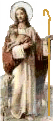
For this Mass Misericordia the Traditional Rite celebrates Christ as the Good shepherd. Jesus Christ is the One Who retrieves His flock, bringing the wayward sheep home to His Church, the Holy Catholic Church. The emphasis of the Proper for "Good Shepherd Sunday" should be of Christ caring for His flock. Therefore, let us examine which liturgy truly exemplifies this. (Note: For this column, I will be taking the Propers from the Fourth Sunday of Easter today in the Novus Ordo, as that is the day that is Good Shepherd Sunday in the Novus Ordo, while employing, as I said, last Sunday's Proper from the Second Sunday After Easter in the Traditional Latin Rite.)
As is the custom in this series, The Traditional Mass will be marked by TM and both in Latin (in blue type) and English (in black type), the Novus Ordo Missae by NOM and in maroon type, as in marooned by synthetic novelty) We shall begin, with the Introit/Opening Prayer:
One wonders if this is what the Novus Ordo means by "reforming" something. Is there absolutely any resemblance between the Traditional Prayer and the Novus Ordo? The Traditional Collect states that Christ, by His death, has saved us from certain death, and that life everlasting is what the faithful receive. The faithful are the sheep. The shepherd, Christ, saves them from death. For if the sheep wanders away, he is guaranteed to be devoured by the wolves. The only problem in today's world is that what were once wolves 40 years ago are now great spiritual instructors, to the point where Bishop Fabian Bruskewitz in his "Sermon A la Carte" program, encourages the faithful to hear sermons from Protestant ministers. That's right, the shepherd is telling the sheep to visit the wolves, and that this is a beneficial experience. Let us remember that his Excellency is lionized as the staunch conservative in America. Compared to the rest of the Bishops, he most certainly is. Yet is one really a staunch defender of tradition when he tells his faithful to go listen to those teachers who believe that very Tradition is a man-made corruption? One cannot say prayers such as that of the Traditional collect, and then think the programs being pushed such as the one described above is a good idea. One can garner these ideas out of the Novus Ordo based on solid catechesis, but who is going to look at me with a straight face and say that the Novus Ordo is a catechesis machine today? Has anyone read the New Catechism of the Catholic Church - all 800 pages? Better yet, does anyone understand it considering all the gray areas and ambiguous baffle-gab? How simple with everything in black and white was the Baltimore Catechism. Before we start fuming more over how the Modernist destructionists have so deconstructed the basic catechetical truths, let us move on to the Epistle/First Reading.
What I'd like everyone to do is read all of Acts 13, first and foremost. This selection, like the traditional epistle from Peter, stresses the necessity of conversion, and that Christ saves us, and only Christ. There are some rather interesting events the Novus Ordo leaves out when it goes from verse 14, skipping all the way to verse 43. Besides the always present aversion to miracles (and there is one very prominent one Paul performs on one who resists God's teaching), this also features Paul giving the Gospel to the Jews in the synagogue. He explicitly spells out the Gospel, and gives the identity of the Messiah as Jesus, whom they crucified. Eventually, this message entails a near riot, and Paul and Barnabas state explicitly that since they have rejected the teaching, "we now turn to the Gentiles." This specifically states a shift in emphasis, and also alludes to the fact that God no longer works through one country, but His Church comprises of people from every nation. Yet the big idea today - the heretical concept so liberally set forth by the New Order is that Jews still have a salvific relationship with God, so this would obviously have to go. The specific fact that they turned to the Gentiles, turning their backs on the Jews there is quite significant. If omitted, one could simply say the Gentiles were just grafted in, but there was a purpose, this was more of condemning the man-made religion, the corruption of God's truth that these men participated in. Yet that's a little too anti-Semitic for today's world, isn't it? There is not much to mention in the Second Epistle, so let us move onto the Gospel Accounts of the Good Shepherd.
Given what we had focused upon in the last reading, one can see why they didn't choose the Traditional Reading of the Good Shepherd. Christ has some rather nasty things to say about those in power during His day, and how they were deserting their flocks and leaving the sheep to the wolves, an obvious reference to the Pharisees and the Sanhedrin of Christ's day. He furthermore states that there are sheep not of this fold that Christ must bring into the fold, a reference to the Gentiles. Implicitly, He is stating that those of the Pharisees (on the majority, as there are exceptions such as Nicodemus who did follow Christ) are not His sheep, because they do not hear His voice. But of course, this is far too anti-Semitic, and has to go, after all, liberal historical-critical Biblical scholars tell us so, and they have PhD's, they must be right! And, because we have no St. Athanasius types in the modern church to stand up and speak out against these heretical thoughts, the lie only permeates further down to the parish level. "We don't do that any more, or we don't have to believe that anymore" is common-speak in Novus Ordo circles. Optional in the Novus Ordo is the fact that Christ gives His sheep eternal life. The Traditional Gospel stated specifically that Christ lays down His life for His sheep, and only His sheep receive eternal life. Omit this from the Novus Ordo, and well, Christ can give eternal life to just about anyone, or everyone. Is not universalism, all religions lead to salvation, a prominent thought today? While of course this omission is not mandatory, depending on who your priest is, your liturgy either instructs you in the faith, or leaves you to your own devices, limited as they could very well possibly be. As a friend told me, "The Novus Ordo is to liturgical Reform what the Enola Gay was to urban development."
Is there even any talk about an offering, much less a sacrifice here? The Traditional Secret refers absolutely to the oblation, sacrifice, salvation, and the usual things that we normally see left out of the Novus Ordo. Besides being absolutely bland, nowhere would one know that a sacrifice is about to be offered up to God. Can one say this about the Traditional Secret? Also, in the Proper Secret from the Monday after Low Sunday to the Friday after the Octave of the Ascension there are two additional Secrets, as also two additional Collects and Postcommunions offered for Our Lady and for God's Holy Church. In each there is also an alternate prayer for the Pope. If any pope ever needed prayer, Pope John Paul II surely does. Now let us conclude with the Communion and Postcommunion Prayers.
I would note the latter very well could be the prayer at any time during the Mass. The purpose of the prayer after communion is to call to mind what we just received, the Blessed Sacrament, and how to make it useful towards our salvation. Nowhere does anyone even have the idea that what we just received was Our Lord's Body and Blood, or that they just received an abundance of God's grace! The Traditional prayer lets us know that we are quickened by grace, and that this is a result of the Gifts God has given us, the gift in mind being the Holy Eucharist. If after all, you aren't praying to make the Eucharist useful in your life and salvation, why even believe that what you just received was indeed the Eucharist? To say that there is a crisis with the Real Presence today in Catholicism is a massive understatement. Prominent Neo-Catholic internet polemicist Arthur Sippo, M.D. once stated that the basis of the changes of the liturgical reform in the prayers was that the Tridentine Rite just treated us always as "unregenerate pagans." Of course this is false, but it seems as if he wants to take it to the other extreme, where based on options, one can pretty much turn into universalism. Furthermore, as we have seen, the basic facts that it is Christ Who gives us eternal life, that the Jews as a whole rejected Christ, their Messiah (while some individual Jews did indeed accept, a great number did not and we're talking about the religion as a whole), and that this was part of God's plan, these things aren't really worth mentioning in the Novus Ordo. If one believes with the recent liturgical document Redemptionis Sacramentum that all the abuses will stop, and the liturgy will be restored, I've got some swampland in Florida to sell you. The only way we will have a true liturgical restoration is a return to the Traditional Mass. It won't happen today, probably not tomorrow, but we must continue in prayer, and work for that day to happen.
 | ||||||||||||||||||||||||||||||||||||||||||||||||||||||||
 May 2, 2004
vol 15, no. 123 Lex Orandi, Lex Credendi |





|


 Increasing Our Awareness of the Differences