 |
|
Verifications |

To print this page, we recommend you CLICK HERE to go to TEXT ONLY vol, 9
no. 32
|
| |||
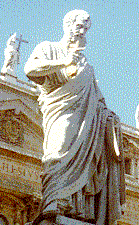 We will resume our segment on the Sacred Liturgy next week with the focus on the ministers of the Word and the Canon of the Mass. However, in relationship with the series begun yesterday on the vision of Saint John Bosco and the vital importance of loyalty to the Pope, we bring you a special segment on the Hierarchy of the Church which proves the Vatican II council fathers did not "downsize" the Pope or diminish his powers as many liberals would lead us to believe. They did not give the bishops power over the Holy Father as so many radicals insist. They did not declare Holy Mother Church a democracy where everybody's voice would have impact as so many modernists clamor for. No, the Second Vatican Council merely reinforced what has always been standard in the Church - the supremacy of the Pope as head of the Church who governs over all!
To prove this, we go to the source: the Vatican Council Postconciliar Documents, expertly compiled by the revered Dominican Austin P. Flannery in two volumes. We will resume our segment on the Sacred Liturgy next week with the focus on the ministers of the Word and the Canon of the Mass. However, in relationship with the series begun yesterday on the vision of Saint John Bosco and the vital importance of loyalty to the Pope, we bring you a special segment on the Hierarchy of the Church which proves the Vatican II council fathers did not "downsize" the Pope or diminish his powers as many liberals would lead us to believe. They did not give the bishops power over the Holy Father as so many radicals insist. They did not declare Holy Mother Church a democracy where everybody's voice would have impact as so many modernists clamor for. No, the Second Vatican Council merely reinforced what has always been standard in the Church - the supremacy of the Pope as head of the Church who governs over all!
To prove this, we go to the source: the Vatican Council Postconciliar Documents, expertly compiled by the revered Dominican Austin P. Flannery in two volumes.
The following is taken from VATICAN COUNCIL II, VOLUME II, More Postconciliar Documents; General Editor Austin Flannery, O.P. Costello Publishing Company, Chapter II, pages 375-6, 378-380 on the The Church is Hierarchical , Chapter III. THE CHURCH, Paragraphs 22, 24, and 25.
The college or body of bishops has for all that no authority unless united with the Roman Pontiff, Peter’s successor, as its head, whose primatial authority, let it be added, over all whether pastors or faithful, remains in its integrity. For the Roman Pontiff, by reason of his office as Vicar of Christ, namely, and as pastor of the entire Church, has full, supreme and universal power over the whole Church, a power which he can always exercise unhindered. The order of bishops is the successor to the college of the apostles in their role as teachers and pastors, and in it the apostolic college is perpetuated. Together with their head, the Supreme Pontiff, and never apart from him, they have supreme and full authority over the universal Church. (27);
The canonical mission of the bishops, on the other hand, can be made by legitimate customs that have not been revoked by the supreme and universal authority of the Church, or by laws made or acknowledged by the same authority, or directly by Peter’s successor himself. Should he object or refuse the apostolic communion, then bishops cannot be admitted to office.
...Bishops who teach in communion with the Roman Pontiff are to be revered by all as witnesses of divine and Catholic truth; the faithful, for their part, are obliged to submit to their bishops’ decision, made in the name of Christ, in matters of faith and morals, and to adhere to it with a ready and respectful allegiance of mind. This loyal submission of the will and intellect must be given, in a special way, to the authentic teaching authority of the Roman Pontiff, even when he does not speak ex cathedra in such wise, indeed, that his supreme teaching authority be acknowledged with respect, and that one sincerely adhere to decisions made by him, conformably with his manifest mind and intention, which is made known principally either by the character of the documents in question, or by the frequency with which a certain doctrine is proposed, or by the manner in which the doctrine is formulated.
Although the bishops, taken individually, do not enjoy the privilege of infallibility, they do, however, proclaim infallibly the doctrine of Christ on the following conditions: namely, when, even though dispersed throughout the world but preserving for all that amongst themselves and with Peter’s successor the bond of communion, in their authoritative teaching concerning matters of faith and morals, they are in agreement that a particular teaching is to be held definitively and absolutely. This is still more clearly the case when, assembled in an ecumenical council, they are, for the universal Church, teachers of and judges in matters of faith and morals, whose decisions must be adhered to with the loyal and obedient assent of faith. (41)
...The Roman Pontiff head of the college of bishops, enjoys this infallibility in virtue of his office, when, as supreme pastor and teacher of all the faithful—who confirms his brethren in the faith (cf.Lk.22:32)...he proclaims in an absolute decision a doctrine pertaining to faith or morals. (42)
Next installment: we will focus on the ministers of the Word and the Canon of the Mass as we resume the Sacred Liturgy segment.
|


 Ship Access Logs