Recently, a correspondent of mine mentioned that he had commented
to someone else that "I don't think I ever got around to clarifying the
difference between material and formal heresy. Material heresy is asserting
what is contrary to the doctrine of the church. Formal heresy is knowing
that that's what you're doing, and doing it anyway. So pointing out the
egregious heterodoxy of this or that papal pronouncement does not prove
formality of heresy." This was meant to lead up to the idea that since we cannot prove that recent and current Vatican leadership are formally heretical, only material heretics, this therefore allows that they might still be popes, at least legally and canonically.
Well, it's time to put a certain piece of nonsense to rest. Repeatedly, I
have come across this rather pathetic piece of self-subterfuge by which
persons, determined to continue pretending to have a pope in the
blatant heretics running Vatican City these past several decades. It
has absolutely no real basis in Catholic theology, and in fact is plainly
erroneous, as I shall prove here.
We educated Catholics all know that the recent and current Vatican
"leaders" have been at least materially in heresy. That fact absolutely
cannot be disputed and I know of no real Catholic who does.
"But," some say, "we don't know his interior dispositions and so cannot
judge him to be formally a heretic, for it is just possible, however unlikely,
that he might be honestly mistaken in his modernist beliefs, sincere, and
as such not at all formally a heretic. And because we cannot know that
he is formally a heretic, we cannot regard him as a heretic to be rightly
removed from the papacy." How many times have you heard that?
And it's absolute balderdash. No Catholic source, theologian, doctor,
canonist, pope, council, saint, or even mystic has ever been quoted in
support of such absurd reasoning, for indeed none have ever proved
to be so patently irrational.
Let us start with the easy part of the refutation first. "We don't know
his interior state of mind, so we can't know that his heresy is formal
or not." That is true that we do not know, nor shall we ever know,
but so what? Not even a future pope would be able to solve that
question. If we had to prove anyone at all to be a formal heretic
before we can consider him a heretic at all, or apply any canonical
penalties to him, then no one could ever be rightly found to be a
heretic. For example, prove to me that Martin Luther was a formal
heretic, and as such the rightful recipient of the excommunication he
received from Pope Leo X. Perhaps, he was only a material heretic?
Who (but himself and God) can know? No one can ascertain his
interior state, whether he himself knew himself to be a heretic or not.
Perhaps he sincerely believed in his errors. Unlikely as that sounds,
we'll never know, and if he was only materially a heretic, what right
did the Church have to apply any canonical penalties to him? None
whatsoever by the above balderdash "reasoning."
 No. True Catholic theology and canonical principle is that heresy
is discerned and judged in the external forum, that is in the realm of the
material. The Church never presumes to know the person's interior
state even as the Church never presumes to declare any particular
person to be in Hell. We don't ask if he is sincere in his wrong beliefs,
only if he is willing to back down, or at least keep them to himself.
And if he does back down, recant, or at least agree to keep silent
about it, then the cause for penalty is over. The Church does not ask if
he might still sustain the heretical beliefs in the secret places of his mind,
as that is altogether immaterial to judging a case of heresy, and we
would only have the person's own word on that, which may or may
not be honest. There is never a way to know someone's interior state
of mind.
No. True Catholic theology and canonical principle is that heresy
is discerned and judged in the external forum, that is in the realm of the
material. The Church never presumes to know the person's interior
state even as the Church never presumes to declare any particular
person to be in Hell. We don't ask if he is sincere in his wrong beliefs,
only if he is willing to back down, or at least keep them to himself.
And if he does back down, recant, or at least agree to keep silent
about it, then the cause for penalty is over. The Church does not ask if
he might still sustain the heretical beliefs in the secret places of his mind,
as that is altogether immaterial to judging a case of heresy, and we
would only have the person's own word on that, which may or may
not be honest. There is never a way to know someone's interior state
of mind.
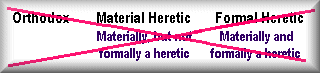
Now, let's dig into this more deeply. Some people, in only thinking
in a limited way, only see a linear sort of degrees, from orthodox
to material heresy, clear to formal (together with material) heresy at the
opposite extreme. This is a wrong picture. It overlooks the actual full
set of logical possibilities. Now let's get the right picture:

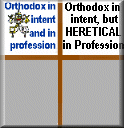 Take a blank piece of paper and draw a large cross (or + sign) dividing
it into four equal quadrants. Now label the upper left quadrant as
"Orthodox in intent and profession." This quadrant applies to a good and
knowledgeable Catholic. Label the upper right quadrant as "Orthodox in
intent but heretical in profession." This quadrant applies to a material
heretic who nevertheless is in good faith and truly unaware of the
heretical nature of his sincerely mistaken beliefs.
Take a blank piece of paper and draw a large cross (or + sign) dividing
it into four equal quadrants. Now label the upper left quadrant as
"Orthodox in intent and profession." This quadrant applies to a good and
knowledgeable Catholic. Label the upper right quadrant as "Orthodox in
intent but heretical in profession." This quadrant applies to a material
heretic who nevertheless is in good faith and truly unaware of the
heretical nature of his sincerely mistaken beliefs.

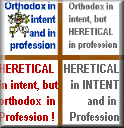 Label the lower right quadrant as "Heretical in intent and profession."
This is the classical case of what we normally call a "formal heretic."
He errs and freely chooses to err no matter what. Now comes the
kicker: Label the lower left quadrant as "Heretical in intent but orthodox
in profession." What? Someone can formally intend to be a heretic but
somehow escape the material fact of heresy? Rare as this may indeed be,
odd as it may sound, it is possible. Let me give you an example.
Label the lower right quadrant as "Heretical in intent and profession."
This is the classical case of what we normally call a "formal heretic."
He errs and freely chooses to err no matter what. Now comes the
kicker: Label the lower left quadrant as "Heretical in intent but orthodox
in profession." What? Someone can formally intend to be a heretic but
somehow escape the material fact of heresy? Rare as this may indeed be,
odd as it may sound, it is possible. Let me give you an example.
As we know, Jesus in His own time equated the "Chair of Moses" with
what the Church now calls the "Chair of Peter." Caiaphas sat in that
chair when Jesus preached and when He was crucified. The charism of
infallibility ("Do as they say, but [given their blatantly criminal behavior, as
it was in Jesus' time] do not do what they do, for they sit in the Chair of
Moses.") passed to Peter on the first Pentecost. But before Pentecost,
Caiaphas was, in effect, "pope" in a manner of speaking. Caiaphas
saying that "one man (Jesus) must die for the good of the nation," is given as an example of the unusual combination of "Heretical in intent but orthodox in profession." He could not err, though he desired to. Either of the left-hand portions (upper and lower) are possible for an infallible pope. For a pope to truly enter the right hand portion (the instances of papal heresies, e.g. John XXII and Honorius I are both right on top of that dividing line between left and right halves), that would constitute a counterexample of papal infallibility and itself a disproof of that Catholic teaching. Therefore, Caiaphas was,
from his own subjective standpoint (the Bible does not claim his
innocence), culpably lying, as it were, formally attempting to teach a heresy.
For he fully believed that killing Christ would not be "for the good of the
nation" but rather "for the enlargement of his own pocketbook." He was
worried about losing his own position, status, money, and so forth, and was
willing to gravely injure his nation (as he saw it) to hold onto those
temporal things. But God had other plans, for indeed it proved infallibly
true that indeed, one man's death (Christ's) really would prove to be for
the good of the nation (by redeeming Israel and all the world from sin)
after all, so in fact what he said in bad faith nevertheless held true.
So, as you can see, there are actually two axises on which heresy turns, one
in the realm of the material ("profession") and the other in the realm of the
formal ("intent"). When the above balderdash "reasoning" is applied to a
pope, it demonstrates a significantly false (and in fact, patently absurd)
understanding of papal infallibility. In effect it amounts to a claim that the
charism of infallibility will confine a pope to the upper portions, namely that
he will never formally intend to teach error, only that he could nevertheless
accidentally teach material error, though not meaning to err. It amounts to a
claim that infallibility confines a pope to the upper half of this page we have
just drawn. He may teach the truth (upper left), or he may make a sincere
mistake and teach a material heresy (upper right), but he could never intend
to teach error (whether he professes a heresy or not, bottom half).
The correct Catholic understanding of infallibility on the other hand confines
the pope to the left-hand portion of this page I had you make. It means that
whether he intends the truth (upper left) or even if he intended to err and
teach a heresy (lower left), he would, by whatever move of Providence it
takes, be incapable of teaching materially a heresy, even if his own soul is
formally in heresy. It means that in his official capacity (under the criteria
where infallibility applies), he cannot teach error, either accidentally and
sincerely through some mistake (upper right) nor through deliberate malice
(lower right).
How can I prove this? Suppose that infallibility only referred to his intent
rather than his actual profession, as the above balderdash argument amounts
to actually claiming. He'll never be a formal heretic, so he won't ever intend
error, but he can make honest mistakes and thereby teach material heresy,
not even knowing it of course. If even he cannot determine whether he is
teaching truth or error, then how in the world (or out of it) are we supposed
to be able to trust it? No, Infallibility is not a guarantee that the pope shall
always remain on the upper half of the page, but rather that he shall always
remain on the left-hand side of the page. That is the only arrangement that
gives infallibility any meaning whatsoever.
So now, given the obvious and evident material heresy of the recent and
current Vatican leadership, there is no room to doubt that they had
operated consistently on the right-hand side of the page. And that is where
popes, by virtue of the charism of infallibility, cannot go, so long as they are
truly popes in the first place, and so long as they remain popes.
Now, despite the obvious likelihood that they are actually in the bottom
right part of the page (materially and formally heretical), we cannot know
that, as the man's interior state is not open to us. We are therefore bound
in charity to assume that he may function in the upper right portion and is
therefore only materially a heretic. But even with that he plainly functions
outside the parameters for a pope, demonstrating by his material heresies
(the only kind open to our observation) that the charism of infallibility does
not in fact apply to him at all.
And that is where application of what I call "The Procedure" comes in. If
one sees a supposed "pope" plainly functioning on the right-hand side of the
page, teaching error (whether he means to or not - we neither know nor
care), then we are obliged to ascertain how it is he does not possess the
papacy, whether he never attained it due to some defect of election, or lost
it through some subsequent resignation from the office.
While I can't presume to speak for other sedevacantists on this, at least
for myself I can honestly claim that I have never judged a pope. And that
claim stands the test. For I have positively identified exactly where Paul VI
lawfully resigned the papacy, and what he did at that same point that
rendered all subsequent elections invalid. I can show them to not be popes
without having to accuse any of them of heresy, or indeed, without even
having to "accuse" them of anything whatsoever. I merely take them at their
own word, and their own word is "I do not claim authority or jurisdiction
over the whole Church." Ergo, on their own authority, they are not popes.
As I say in "The Procedure", there does exist one man with the authority to
rightly depose a pope, and that is ... himself. And he did. In 1964.


 Time to Put a Certain Piece of Nonsense to Rest
  The True and Only Catholic Position Possible is that the Papacy is protected by the Holy Ghost and cannot err in faith and morals. If a man sitting on the chair circulates error, then he cannot be a Pope. Period.


